
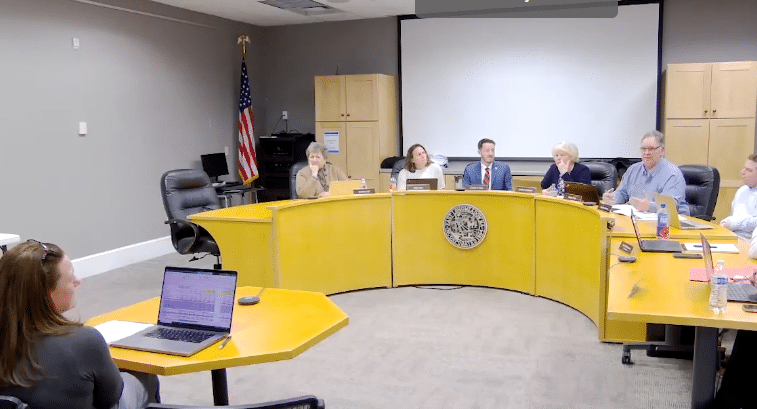
Director of Municipal Finance and Town Accountant Kimberly Collins discusses budget projections with the Town Council
Photo credit: ELCAT01028
EAST LONGMEADOW — The East Longmeadow Town Council was joined by Director of Municipal Finance and Town Accountant Kimberly Collins to discuss the town’s high level budget forecast and what spending in the town will look like through 2032 during the council’s meeting on Feb. 24.
Town Manager Tom Christensen said projecting out is to think about the strategies that can be done now so there aren’t conversations later on, such as cutting services.
He said although spending has gone way down over the last couple years, it’s hard to keep going at the same level with inflation, considering health insurance and retirement are up over 10% per year.
“These are driving our budget, they’re driving everybody’s budget,” Christensen said. “Thankfully, when, sort of, this trend started, we were in a decent position with our excess levy, $2.7 million in 2022 and 2023, which we’ve had to eat into because of this.”
He said there has been some irregular budgeting “to the tune of $2 or $3 million” in the health insurance line item, which has helped stretch dollar amounts over a few years. The town is in a similar spot as last year, which Christensen said is pretty miraculous.
“We keep getting there by taking our bare bones budgets and skinning another layer off,” Christensen said. “We’re getting to the point where we’re running out of that room too.”
Finding additional revenue was a topic of conversation last year, and the new growth is the most influential number. The problem with revenue and new fees is “it’s the same group of people, just paying for the different bill,” according to Christensen.
Collins said the thing she would focus on is the excess levy. In speaking of the other towns, she said East Longmeadow was one of the few in the area with any excess levy available. She added that there has been excess budgeting the town is slowly dipping into to avoid using a lot of that levy.
State aid went up about $2 million in 2024, which was a large impact to help the levy. $1.4 million was targeted last year in excess levy, which turned into $1.9 million from prior year growth and increased amount of new growth.
“If you look at the draft level, we aimed for [$1.4 million],” Collins said. “When we got our actual request for level one, we’re negative excess levy, and the majority of that was due to the fact that the school’s level budget is over a 6% increase. So as we’re reviewing everybody’s budgets in level two, bringing the school back down to that 3% target that we’re looking at for departments and school, that’s the only way we really get back up to [$1.4 million], and you’re still digging into excess levy, you know, half a million dollars, in order to support.”
Collins said that’s the whole point of looking at the projected budget, because if the town does the same thing every year, all the assumptions are there to show you projected growth. Based on historical spending, the town has been able to reduce budgets in various departments to avoid digging into the levy, because if they continue to do it, overrides could happen around 2030-2032.
“The number one thing you look at is growth,” Collins said. “How can we make some decisions that could help support growth for the town so that we’re continuing to grow and increase that levy.”
Council President Connor O’Shea said the projections are helpful because the next year’s budget is often so fixated on, that the next five years is lost on.
“This is helpful to see the road that we’re on and what we might be able to change now instead of running into the catastrophe the year of,” O’Shea said.
Councilor Kathy Hill said that there are things they can’t control, such as utilities or health insurance, but what can be controlled are how the council negotiates bargaining contracts with each unit, such as police, fire, the several in the schools and town employees.
“In the past, I think [Christensen’s] guideline was to stick around 2%,” Hill said. “As unfortunate as it is, I think we need to look at a leaner perimeter for negotiating. Unfortunately, we have a large bargaining unit that did not adhere to your recommendations or perimeters and that certainly cost a significant amount of additional funds.”
She went back to the point of the school level service currently being at 6%, which she said will be impossible to adjust this year. If there is an agreement that exceeds the wishes of the finance team, 6% looks like 9% or 10%, and the alternative may be to shave staff, according to Hill.
Christensen said that anybody who owns a TV or a newspaper knows that it is a difficult time everywhere, a sort of “be thankful for what we got” kind of time. He said it’s a balance of providing good benefits without taking a huge hit on the budget.