
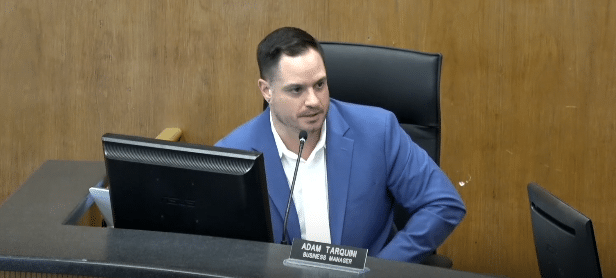
Chief of Finance and Operations Adam Tarquini details the budget at the hearing on March 24.
Photo credit: West Side Media
WEST SPRINGFIELD — The West Springfield School Department is looking at a number of reductions to positions and expenses after Mayor William Reichelt asked the School Committee to reduce the original level service recommendation by $3 million for a level funded budget.
Chief of Finance and Operations Adam Tarquini and Superintendent Stefania Raschilla detailed what goes into the budget and what needs to come out for fiscal year 2027 in a hearing spread out across the meetings on March 10 and 24.
The budget for FY27 stands at $58.45 million, a decrease from the initially requested $61.5 million. The budget also marks a $257,986 decrease from the $58.71 million approved for FY26.
Tarquini began by explaining the Chapter 70 foundation budget is the minimum amount it costs a district to provide an adequate education for all students. He said it can be confused with net school spending, the required minimum amount a district must spend on education.
The foundation budget was previously discussed at the Feb. 17 meeting and is set for FY27 at $72.85 million A major component driving that number is the district’s enrollment, which saw a decrease of 166 students. Taquini cited that as having a “huge impact” on the foundation budget, considering there is currently a $1.33 million gap from net school spending at $74.18 million.
The majority of the requested FY27 budget is personnel services at $47.26 million, or 81%. Transportation makes up 7%, or $4.21 million; out of district tuition is 7%, or $4.12 million; and operating expenses at 5%, or $2.86 million.
Tarquini said when “80% or so of our budget is made up of salaries and we’re looking to cut such a large number, unfortunately it will impact staff.” With 34 positions set to be reduced for $2.04 million, he made a note these are only positions and not “people who will be reduced from the budget.”
“Our hope is that we move over the next few months, we have some retirements, we may have some non-renewals, some other resignations,” Tarquini said. “People that are filling these positions here, may be able to slide into those positions.”
Raschilla added that there are a number of people who resign, retire or are non-renewed each year, and that “just because we see a number of 34, does not necessarily mean we are cutting 34 peoples’ jobs.” She added that some of those positions are vacant as well.
Unit A, which are teacher contracts, is seeing a reduction of 12.9 full-time equivalent positions at the highest cost of $1.16 million.
Paraprofessionals in Unit D saw the largest FTE position reduction at 15.5, equaling $394,897. Raschilla said a component of the Unit A reductions is a result of decreasing enrollment.
“We’ve had a large decline at the elementary level,” Raschilla said. “When [Tarquini] explained that we lost 166 students, when we look over time, over the past three years, we lost over 100 students in just kindergarten, first and second grade, and so it isn’t possible to keep the amount of teachers that we currently have at those grade levels if we do not have students sitting in those seats.”
She added that although there are position reductions, there will be no reduction to current student services, and that the exact number of people the district will be losing from retirement or non-renewals won’t be known for another few months.
The rest of the $3 million asked to cut comes from reduced contracted services at $140,000, reduced homeless transportation funds at $500,000 and $320,000 in offset curriculum renewals.
The committee also discussed the effect that charter schools have on the budget and community. Out of the 113 resident students enrolled in charter schools, 74 attend the Hampden Charter School of Science.
Charter schools are legally required in Massachusetts to be free to all students, which costs the town $1.9 million. The tuition assessment costs $2.39 million, but $480,291 is reimbursed by the state.
Reichelt asked Tarquini if those 113 students were really costing the town $2 million, who replied those students are the town’s financial responsibility. Tarquini explained that those students are included in the enrollment for the foundation budget formula, so funding is received for them as well.
Tarquini said what the town receives in funding for those depends on factors in the formula, such as low-income students. Reichelt said he was curious to know that number before he goes on Facebook and tells the state “you’re screwing us for $2 million a year.”
The final budget presentation and vote will take place at the meeting on March 31, after Reminder Publishing’s deadline.