
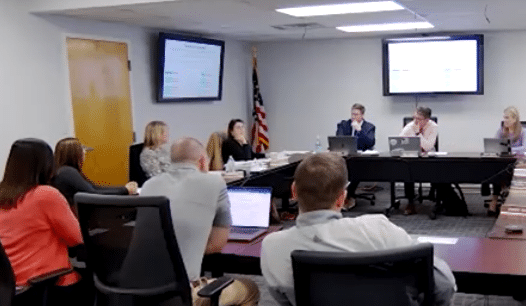
ELHS Principal Frank Paige and Assistant Principals Anne Blain and Gary Wright present the winter status update to the East Longmeadow School Committee.
Photo credit; ELCAT01028
EAST LONGMEADOW — The East Longmeadow High School winter status update revealed some new changes coming to the math department after a concerning dip in 10th grade math achievement levels.
The East Longmeadow School Committee heard the winter status update from ELHS Principal Frank Paige and Assistant Principals Anne Blain and Gary Wright at its meeting on March 9.
The school set a teaching and learning goal to see continued academic growth and increased achievement in students. The IXL diagnostic is a universal screener done to identify students who need extra support and to inform teachers of the progress their students are making over the course of a school year.
Paige said there were some issues in the diagnostic within the math and English department, which are being asked to continue with the curriculum and identify five priority standards for each content area where there is overlap between deficiencies and potential areas of focus on MCAS to try to remediate skills going into the spring.
Paige said he had concerns for some of the numbers, such as with 10th grade math being 15% at or above grade level, which was down significantly from 65% in June 2025. In ELA, 10th grade is 35% at or above grade level.
“If you’re looking holistically when you jump to ELA, you do see an improvement,” Paige said. “But, we still have a good chunk of students who are scoring below grade level on the IXL diagnostic.”
To address some of the issues going into next year, the school has made steps, such as in mathematics by expanding the ninth grade Algebra 1 course from four credits to six, with the hope it will provide additional instructional time to explore concepts in greater depths and reinforce key math skills. The English department may also implement the IXL diagnostic directly into the curriculum to address areas of weakness.
“The math department came to me with this idea of how to address some of these needs,” Paige said. “When we’re talking about those students transitioning into the high school, and our department saying those kids who might be in that group, who need a little bit more support on the math side, if they’re advocating for that and they’re asking for more time and we can build it into our schedule, I’m going to support it all day.”
With such a large drop in the math percentages, some committee members questioned the validity of the data or the seriousness with which students are taking the assessments, given they don’t count toward grades.
Committee Chair Greg Thompson asked if there was a way to contact IXL to see how accurate the diagnostic tool is, or to compare the results with other school districts to see if anyone else is seeing similar results.
“If we’re going to continue with IXL, even if we don’t use the diagnostic tool, we should know if it’s a valid tool or not,” Thompson said.
For the goal of “supporting the whole child,” the high school went into this school year with a plan to approve attendance data. As of Feb. 4, the school was at a 96.6% attendance rate. Wright said there was also a shift in period by period attendance.
“I took on last year really broadcasting to parents the number of individual classes that kids were missing,” Wright said. “There are just significantly fewer warnings and loss of credit notifications this year, so I think that in addition to this piece of our goal, that step has helped a lot in this area.”
The school received a silver honor roll award from College Board, which is based on a few indicators, such as 55% of the graduating class taking at least one AP course with 42% passing the exams to earn college credit. Wright said an interesting piece of that data is 19% of the students successfully took five or more AP courses over their high school careers.
Paige said that he’d love to be able to offer as many AP courses as possible, and the school is at or near capacity in terms of staff and student availability for AP courses. He said the school is in the “high-teens” for the number of courses offered, with a new AP physics course being brought in as well.
Blain discussed the school’s goal of creating an inclusive and supportive culture and climate, where all staff, students and community members feel a sense of belonging. The action step towards this is to “develop authentic partnerships with students and families that elevate their voices in decision making,” the status update said.
“We do this through the DEI committee, the athletic leadership council and also the school council,” Blain said. “It’s nice for us because the DEI committee and the athletic leadership council is basically made up of students, but our school council also has parents who come on a regular basis.”
The students are surveyed three times a year, and this set of data stayed fairly consistent with the fall’s. About 90% of students said they have a teacher or adult at school that they can count on to help them, 90% said they believe the school is inclusive of all backgrounds and identities and about 80% said they feel like they are a part of the school community.
“From some of the feedback we’ve gotten, we’ve actually had some new clubs that have been formed this year,” Blain said. “We have best buddies, we’ve got an Asian culture club, and it all came from student feedback that we need to offer more and connect with different groups of people.”
She added that the departments are being asked to survey students at the course level. About 94% of students said their teachers check to make sure they understand the material.
“Each department will be developing their own discussion protocols once they collect that data,” Blain said. “The goal is to take those student responses, break them down and collate the responses, interpret that data and then discuss the implications that come from that information.”
She added that, hopefully, each department will be reflective in their practices from the information they get.
“It will provide teachers with understanding of learning needs,” Blain said. “It will improve instructional practices, strengthen student voice and engagement, monitor classroom climate, support reflective practices and also inform instructional adjustments during that course instead of waiting until the end and making those adjustments.”