
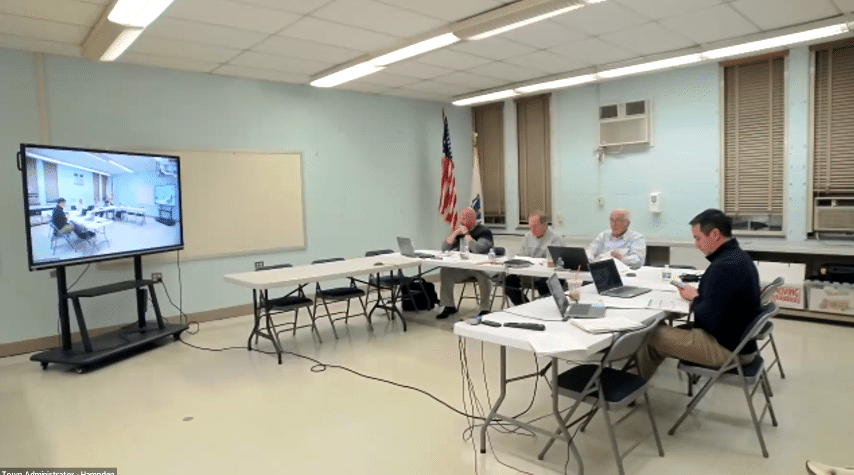
The Hampden Selectboard discusses revisions to the regional agreement on Feb. 17
Photo credit: Town of Hampden, MA YouTube
HAMPDEN — At the Hampden Selectboard meeting on Feb. 17, discussion continued on the regional agreement for governing the schools in the Hampden-Wilbraham Region School District and recent changes made.
One of the proposed changes made to the draft of regional agreement was to remove the section which states “when the district assigns students from any grade(s) from both member towns to a single school building, which single school building is a leased building, that building will be treated as a district-owned building and capital costs will be apportioned on the basis of the ratio that the number of students from each member towns bears to the total foundation enrollment from both member towns in the grades served by the school.”
In replacement of that section, the agreement now states in subsection E that “capital costs of district owned equipment and properties shall be apportioned to the member towns based on the ratio which that member’s town’s foundation enrollment, calculated on the basis of the member town’s combined three year rolling average of foundation enrollment for grades served by that property for the member town, bears to the total foundation enrollment for all member towns in the district, calculated on the basis of a combined three-year rolling average of foundation enrollment for grades served by that property for all member towns.”
The agreement initially stated specifically for grades 9-12, but was revised to grades served by the property.
Selectboard member Donald Davenport said a concern that Wilbraham has is being responsible for the capital repairs in the Massachusetts School Building Authority core program with Wilbraham Middle School because it is a town owned building.
He said that Wilbraham thinks Hampden’s position of not wanting to pay for capital costs deferred over the course of 10 years is “holding them hostage.” Chair John Flynn said he thought two things are being conflated.
“We never said, if they got into the core program and the core program said, ‘we’re going to totally renovate the Wilbraham Middle School for a new regional middle school,’ we never said we wouldn’t pay our part in that,” Flynn said. “Of course we would, it would be like getting a new school.”
Flynn said Hampden’s only problem has been the deferred maintenance cost of the middle school. Davenport said the rhetoric being used is “creating a narrative that Hampden isn’t paying its fair share for students in that building, when in fact we are.”
“We pay 21% assessment to the region,” Davenport said. “So that means we pay 21% of the teachers’ salaries, the custodial salaries, the utilities, the lights, the insurance, the routine maintenance, the snow plowing and everything else in the building. Our only complaint or concern is, why should we pay for capital costs that should have been done 10 years ago on a building we don’t own?”
Another subsection of the agreement states the district will manage and pay for emergency capital projects that are not budgeted in the current year’s general fund budget.
Flynn said he doesn’t have a problem with subsection E per se because it discusses regional owned properties, but he wondered how it “moved the goal line at all.” Davenport said it’s because the middle school isn’t a regional owned property, to which Flynn said was his point.
“To whatever argument they think we have here, that doesn’t change anything,” Flynn said.
Davenport added that not changing anything is what concerns Wilbraham, because they want it changed and want Hampden to pay for things. The concern is that Hampden won’t partake in the core program or feasibility study.
Flynn made a point that the middle school program at Green Meadows closed officially in 2021, with all students moved into Wilbraham Middle School at that point. He compared it to renting a house and how you shouldn’t have to put in a new driveway that’s been there for 25 years just because you’ve been there for four years. It was noted that the only change seems to allow for a district owned middle school.
Flynn read a letter from former Selectboard member Craig Rivest in reference to a discussion centered on the regional agreement during the Wilbraham Select Board meeting on Feb. 9. Rivest wrote that the Wilbraham Town Administrator Nick Breault referenced the possibility of removing Hampden students from the middle school because of their position on capital costs, suggesting that Wilbraham may need to say, “enough is enough.”
Rivest said that Wilbraham Select Board member Marc Ducey expressed that Wilbraham feels as though it is being “held hostage,” while also acknowledging that Hampden is not at fault for the situation, as it was the School Committee to allow Hampden transfers into Wilbraham. Flynn noted that it was the regional agreement that allowed it and the School Committee implemented it with both towns agreeing to.
He added that his position, as a former Selectboard member, is that “Hampden should not invest significant capital dollars to band-aid repairs for a building and property owned by another municipality, particularly one that had known deficiencies prior to its use as a regional facility.”
Flynn said he agreed with Rivest’s letter and that it did a good job summarizing where the Selectboard stands.