
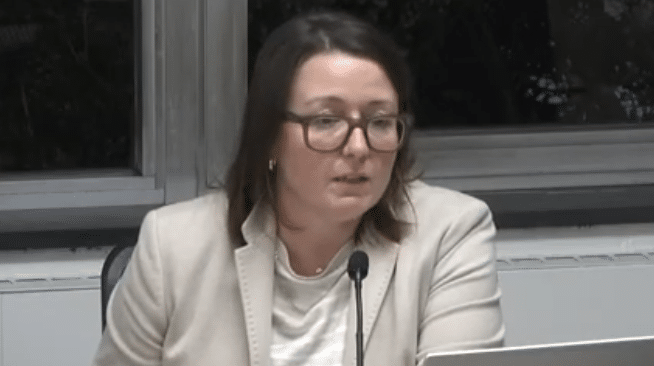
Town Manager Lyn Simmons presents the FY27 budget at the March 23 meeting
Photo credit: LongmeadowTV
LONGMEADOW — With town expenses increasing at a higher rate than revenue, Longmeadow Town Manager Lyn Simmons said the town is “unable to find new revenue” during her fiscal year 2027 budget presentation to the Select Board on March 23.
Budget preparations began in December 2025 at a joint meeting with the Select Board, School Committee and Finance Committee.
Simmons said the budget is balanced without the use of reserves and added it was important to note that first because “this was a really challenging budget.” According to Mass.gov, reserves are “used to hold money for specific future purposes, to finance unforeseen or emergency needs, sustain operations during difficult economic periods, or in limited instances, to provide revenue sources for the annual budget.
The FY27 will maintain current service levels and currently uses the full allowable levy limit of a 2.5% property tax increase under Proposition 2 ½, according to the budget presentation. The current operating budget is $83,220,896, a 3.68% increase from FY26. The total recommended budget is $93,377,135, a 5.66% increase from FY26.
“You’ll see as I go further on, we had to make some pretty serious decisions on projects we really wanted to keep moving forward, but did have to put a pause on in order to not tap into those one time funds,” Simmons said.
The breakdown shows revenue increases at a total of $2,556,659 from things like property tax and state aid, while non-negotiable expense increases are at $2,949,687 from insurance, retirement contributions and the schools. As a result, $393,028 needs to be cut from the general fund to balance the two.
“Off the start, we did not have any surplus to work from,” Simmons said. “We were looking at cuts to offices and where we could make this work.”
Simmons made several items of note, such as entering a fleet leasing program for new DPW and Fire Department vehicles rather than purchasing in full to turnover outdated vehicles at a much faster rate.
“Previously, we were only funding these vehicles through capital or free cash,” Simmons said. “There is just not enough capital to make all of this stuff work, and the fleet was aging at a rate that we just could not support ,and the cost of vehicles since really coming out of [COVID-19] has just increased so drastically that one truck is $100,000 and that’s just not sustainable.”
The cost of living adjustments for non-union town employees is going to be built into the operating budget, instead of being a stand-alone warrant at the town meeting and applied after the start of a fiscal year. The health insurance rates from Scantic Valley Regional Health Trust were also an 11.2% increase, substantially higher than the 7.5% originally projected.
“That was not any fault of ours with that projection number,” Simmons said. “Our health insurance increases have always been 7% or below. We have not had anything even close to 11.2%.”
Simmons said there were challenges in the process, the first being the School Department increase. She said the schools get ‘a lot of flak’ for high budgets, but noted the 2.6% increase for FY27 is the smallest since FY21.
In FY26, the DPW received “significant investments,” according to Simmons, at about $700,000 to further work on reports, studies and infrastructure needs. For FY27, the investments will be rolled back to balance. She said that in coming years, it will become increasingly difficult to guarantee current service levels will be maintained.
The presentation adds that the “cost of doing business” is far outpacing the revenue collected for the town and limited revenue sources will continue to be a challenge while operating costs grow.
“This isn’t a Longmeadow problem, this is a municipality problem across the state,” Simmons said. “There are just so few revenue sources that don’t go after the same people over and over, that just can’t keep pace with the actual cost of running a business. We’re a municipality but we still have employees and we still have overhead, and we still have employee benefits that we have to pay, and those are going up at a rate that our revenue is not keeping pace with.”
Future considerations that are being watched are potential increases or decreases to the state budget, unrestricted general government aid and Chapter 70 aid, along with changes to programs and grants with federal funding.
Finance Director Ian Coddington said that when looking at state aid as a whole, it has been on a steady decline over the last 20 years on an inflation basis when it comes to the dollar amounts that communities are getting from the state.
“It’s something that our advocates are looking at and are pushing our state legislators to give us additional funds,” Coddington said. “We know how important it is, as local leaders, to have funds available for us to take care of projects.”
The FY27 budget will be voted on at a joint meeting with the Finance Committee on April 6 and then in Town Meeting on May 12.