
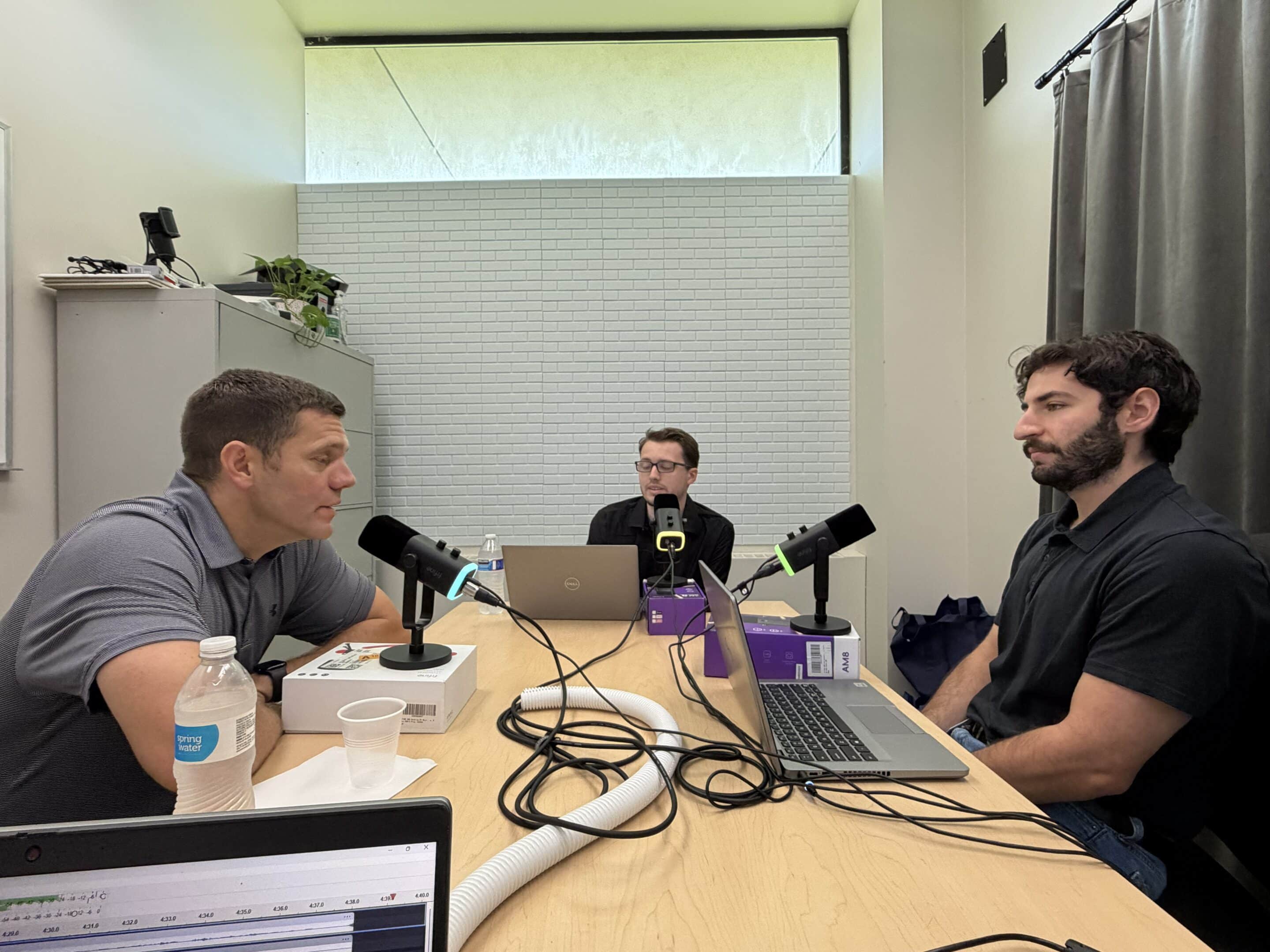
State Sen. John Velis sat down with hosts Ryan Feyre and Tyler Garnet to talk about a wide range of issues on the most recent episode of “So That Reminds Me.”
Reminder Publishing photo by Dennis Hackett
On the latest episode of “So That Reminds Me,” state Sen. John Velis sat down with co-hosts Ryan Feyre and me to discuss data centers, cellphone and social media policies, upcoming ballot questions and opioid settlement funds.
Velis, whose current term ends in January, is running unopposed for reelection. He represents nine communities throughout the Hampden and Hampshire districts and has been in the Senate since 2020.
He also previously served as a state representative from 2014.
Velis was recently deployed for six months on a confidential mission along the southwestern border of the U.S. He said he couldn’t provide specifics about the trip, but he credited his office for helping him stay connected and serve his constituents during that time.
He also commended his colleagues who stepped up and filed bills and items on his behalf.
“One of the things that’s really, really important to me is hiring staff that’s good,” Velis said. “It was constantly checking in with my team, from when I could get away from what I was doing and see what was out there, but I have to be honest with you, I can’t take credit for it. My chief of staff … and then my entire operation was a seamless operation.”
One issue that Velis discussed, which has been prominent in many of the communities he serves, is data centers. Holyoke recently approved a ban on future development of the centers, while Agawam approved a 270-day moratorium and Westfield approved a 12-month moratorium.
In the past, Velis demanded that the data centers, not residents, should pay for any energy and water strain. He also emphasized that many data centers across the country are much larger than some of those proposed and operating in Massachusetts.
Velis agreed that there is an opportunity for jobs, but in many cases, data centers lead to an increase in electrical bills, increased water usage and contamination. He also agreed with the idea of a moratorium to give each town time to learn about potential pros and cons of a development proposal.
“I think what’s happening throughout the commonwealth is a beautiful thing, like, give the towns the ability,” Velis said. “[Data centers] need to pay their own way. Any uptick in electric costs is on them, any water usage above and beyond what they represent is on them, any disturbance to the environment is on them, and if they check all of those boxes in a local community through their City Council, their planning boards, their mayor, decide that we realize all the risks and the contracts are very firm that anything that goes above and beyond what you’re representing is on you, not the residents, than have that vote.”
Velis also discussed regulations on youth social media use and cellphone use in schools. In July, the state Senate passed a bill that essentially regulates youth social media use.
“What the data tells us is that straight bans don’t work,” Velis said, comparing the Senate bill to the House bill passed in April, which bans children under 14 from using social media platforms and requires that platforms obtain consent for users ages 14 and 15.
Velis explained that if you institute a ban, teenagers affected will find ways to get around it. He said the driving force is algorithms, which is why the Senate bill gives people under 16 the ability to stop, pause and say, “Do I want to continue reading, do I want to continue watching these videos, or maybe do I want to go outside?”
Velis explained that the third-party audit could allow the attorney general’s office to ask a company like Facebook to explain its algorithms and how they work.
“It’s about getting rid of these algorithmic feeds by the default settings; they’re not allowed for certain people under that age demographic, but we need to get at these algorithms, and I’m a really big believer in that the best way to do that is something that we still need to continue to do, is by having what we call third-party audits,” Velis said.
On the topic of cellphone usage in schools, Velis said he often visits high school students in his communities who all admit they use their phones during the school day instead of paying attention to what is going on in class.
Velis said that although bans don’t usually work, he thinks there should be little to no exception regarding cellphone usage during the school day.
“When we had this debate, I was really the lead proponent of, ‘look, if we’re going to do this, we need to do it.” And variably, what comes up is exceptions,” Velis said. “My position was we need to make the exceptions so few and far between because at some point in time, if you have all these exceptions, the exceptions swallow the rule. If 30 kids in the schools have their phones, the rest of the kids are going to say, ‘hey what’s Mikey, what’s Sarah or what’s everybody doing with their phones, I want my phone.’”
In response to parents’ concerns about the possibility of not reaching their kids during an emergency, Velis said many law enforcement members told him that cellphones could create more chaos during a major emergency because the students would be too distracted to listen to the adults or law enforcement personnel.
“When cellphones weren’t a thing, we got by just fine. If a kid was sick, if there was an emergency, if something was happening,” Velis stated. “There’s no perfect solution, but with the distraction from the reading, writing, arithmetic, we have to do better. If we can do something to give that kid a fighting chance to excel in school, to engage, to maybe prevent some type of behavioral health issue, then I think we should do that; I think we owe it to them.”
Velis also discussed the current and future Veterans Home in Holyoke, opioid settlement funds that cities have received, the recent economic development bill that just passed in the Senate, housing issues in Massachusetts and a ballot question that looks to eliminate political party primaries for state elections.
In the case of opioid settlement funds, a recent investigation revealed municipalities have spent less than 20% of the $115 million distributed to them since 2023.
Velis recently said he is prepared to file legislation to have the state reclaim unspent funds and redirect them to communities with bigger needs.
“This notion that I hear from municipalities was, ‘we’re trying to figure out how to use this.’ I have no patience for that anymore for the very simple reason that they’re sitting on their tails trying to figure this out; we got people that are dying out there,” Velis said.
Speaking on the economic development bill, Velis said the goal is to stop people from leaving the state for opportunities elsewhere.
“Massachusetts is on the precipice, and I would argue we are already down that path of becoming a state that lacks competitiveness for any number of reasons,” Velis said. “This economic development bill was an attempt to do was to stop the bleeding.”
To hear the full episode with Velis, visit thereminder.com/our-podcast or search “So That Reminds Me” on your favorite podcasting platform.