
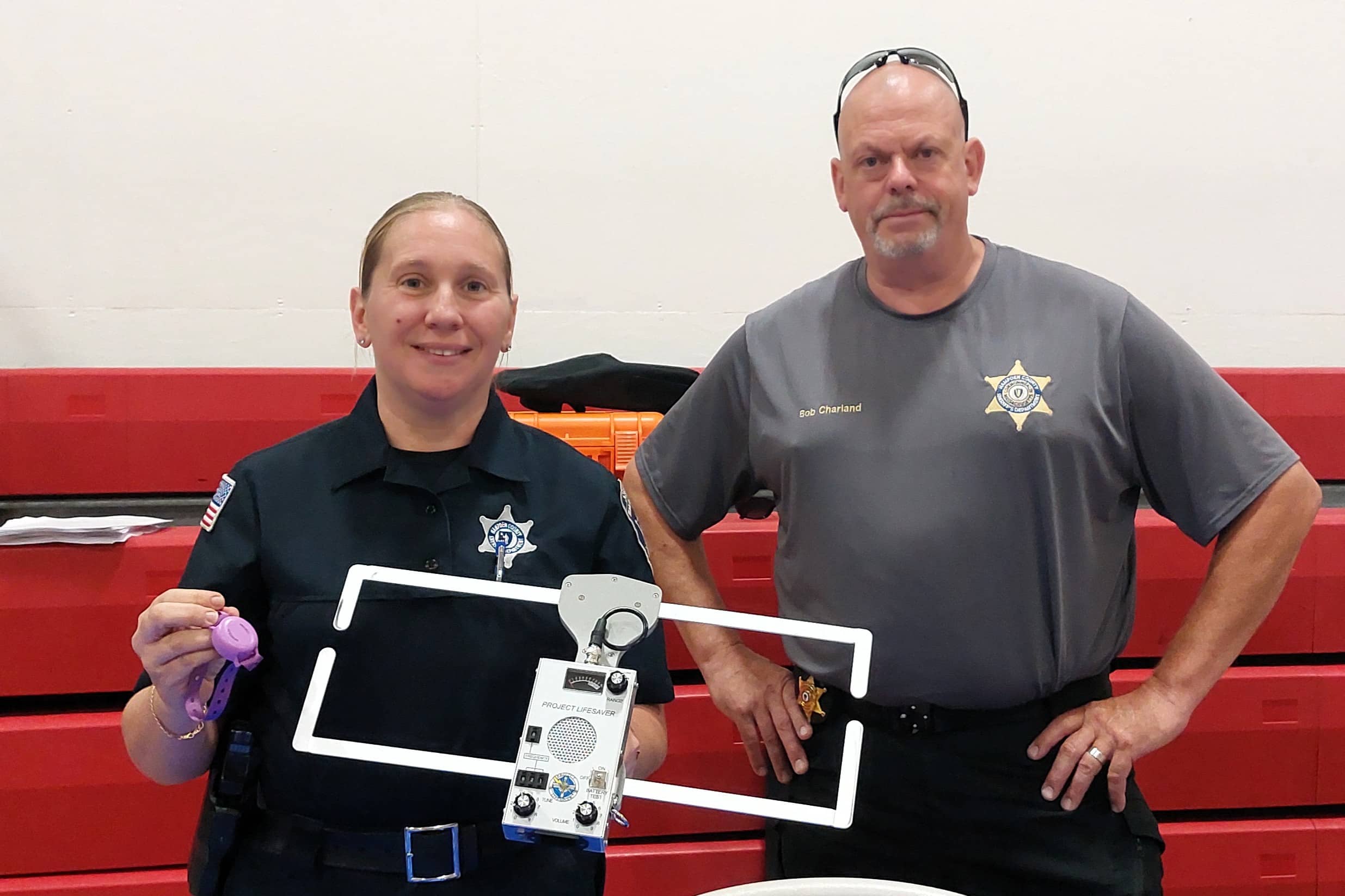
Elizabeth Rodrigues and Bob “The Bike Man” Charland, both of whom work with the Hampden County Sheriff’s Department’s Triad Division, display the Project Lifesaver wristband transmitter and receiver.
Reminder Publishing photo by Sarah Heinonen
SPRINGFIELD — Half a dozen experts working in the field of autism spectrum disorder gathered for a symposium on wandering among the young people with the condition. The event was organized by state Rep. Angelo Puppolo and hosted at Greenleaf Community Center in Springfield.
The symposium was open to the public and brought together individuals with autism, down syndrome, their families, caregivers, educators, advocates, first responders and healthcare professionals. Speaking at the event were experts from the state Department of Developmental Services Central/West Region, Autism Society, Hampden County Sheriff’s Department Autism Safety and Outreach Resources, Service Net and Autism Connections, Massachusetts Developmental Disabilities Council and Office of the Child Advocate.
“Our goal is simple … it’s to ensure that every family member leaves here tonight with new knowledge, valuable resources, contact information … and connections,” the Springfield Democrat said. “My office is always available.”
Cathrine “Cat” McEachern, research and professional training coordinator with Service Net/Autism Connections, said wandering, or “elopement” is “super common.” She said, “The behavior is a communication of a need.” Youth who elope may be trying to escape an overwhelming stimulus or situation. McEachern, who is autistic, said that when she was a child, she used to hide in clothing racks in department stores because it felt less overwhelming than the store’s large, open space.
The other reason young people with autism often wander is in search of an interest. McEachern said that when she was 5 years old, she nearly drowned because she was able to wade into a pool when her parents were not looking.
The Office of Child Advocate has been working in conjunction with the Department of Developmental Services to create an awareness campaign around the increased risk of drowning among autistic youth. She said that for many people with autism, light sparkling off water can be attractive. Water can also be soothing, akin to a waited blanket. Because of these reasons, many autistic people are drawn to water.
Meg Crowley of the Office of the Child Advocate said being in or near water unsupervised is always dangerous, but adaptive swimming lessons are one tool families can employ to help protect their child or teen. She said every YMCA in the state offers adaptive swimming lessons.
Knowing a child is prone to wandering can allow families to take proactive steps to minimize danger. Crowley said alerting first responders is important and can include face-to-face meetings with local police and fire officials. Otherwise, a disability indicator form can be filled out and submitted to the local 911 municipal coordinator. This alerts emergency services that a vulnerable person lives at the address. To find the local 911 municipal coordinator, call the city or town’s emergency services administrator.
Mayor Domenic Sarno said Springfield Public Schools is working to create a day school for students with autism who require substantially separate programming. He assured families that their student would not be required to switch schools, but said, “You give the opportunity to families to have some common and lasting effects, to know that their child … or adult has the opportunity to enter the world positively.”
Sarno said rates of autism diagnosis have increased in recent years. Sarno said, “But just because maybe he or she has autism does not mean they cannot achieve. They can achieve.”
Among those who spoke at the symposium was state Rep. Jay Livingstone, the House chair on the Joint Committee on Children, Families and Persons with Disabilities. While introducing him, Puppolo said his colleague “not only advocates, but listens. And he gets it.”
While he thanked Puppolo for his introduction, he said, “One of the things you learn in this, is no one knows it. No one can know it. You need a village.” Livingstone, a Boston Democrat, praised the symposium for bringing together experts from different governmental and community organizations. “Events like this bring these great service providers in the area together.” Livingstone urged people to contact him and the committee to share the service gaps they see and how the state can help.
Hampden County Sheriff Nick Cocchi shared that he lives with his brother, who “struggles tremendously with mental health.” He said, “For families caring for someone who is prone to wandering, an ordinary day can become an emergency in seconds. A door opens, somebody gets distracted, a child becomes overwhelmed and they take off through the door. Suddenly, a family is facing one of the most frightening situations imaginable.”
The Sheriff’s Department’s Triad Division works with Project Lifesaver International, a nonprofit that outfits people at risk of wandering, whether due to autism, dementia or another cause, with a wrist- or ankle-worn device that transmits a radio signal. If the person elopes, families call 911 immediately and first responders report to the person’s last known location with a receiver that can pick up the device’s signal within a two-mile radius.
Cocchi emphasized that the technology is not GPS, nor is it a replacement for other safeguards. It is a tool, used along with canines and drones, to help search teams locate a missing person. He said six in 10 people found while using the device are recovered within 20 minutes. “When someone is missing, every minute matters,” he said. “Hope isn’t a public safety strategy. Preparation is.”
The radio transmitter costs about $400 with some continuing costs, but Cocchi said the Sheriff’s Department uses money seized through drug forfeitures to cover the cost for families. “There should never be haves and have-nots when it comes to protecting and caring for a loved one,” Cocchi said. Triad’s Elizabeth Rodrigues said about 100 people have obtained the device through the Sheriff’s Department.
Wandering is not the only dangerous situation people with autism may find themselves in. Puppolo authored the Blue Envelope Law, which was recently signed into law. It provides for people with autism to carry a special blue envelope as a driver or passenger in a motor vehicle. During a traffic stop, the person can alert the officer that they have a Blue Envelope, on which is written the behaviors or responses they can expect from people with autism. Inside the envelope are instructions for the driver on what to expect during a traffic stop. Massachusetts Developmental Disabilities Council Deputy Director Jennifer Bertrand called the Blue Envelope Law one of the year’s “really good wins.”
Gyasi Burks-Abbott, with the Leadership Education in Neurodevelopmental and related Disabilities program at Boston Children’s Hospital, shared a story from his own life illustrating why such programs are essential for those with autism and communication challenges. When Burks-Abbott was 13, he went to the store by himself for the first time. The grocery manager mistook him for someone who had previously stolen shopping carts. When approached by the police, Burks-Abbott was confused and broke out into “a Cheshire Cat-like grin,” a common reaction when he is nervous. The police took that as an admission of guilt. Had the police known Burks-Abbott has autism, his response may not have been misunderstood, saving him and his family undue stress.
To learn more about the drowning risk among youth with autism, visit mass.gov/autismwatersafety. For more information about Project Lifesaver, call the Triad Division at 413-858-0060. More about the Blue Envelope Law can be found at mass.gov/info-details/blue-envelope-program.
