
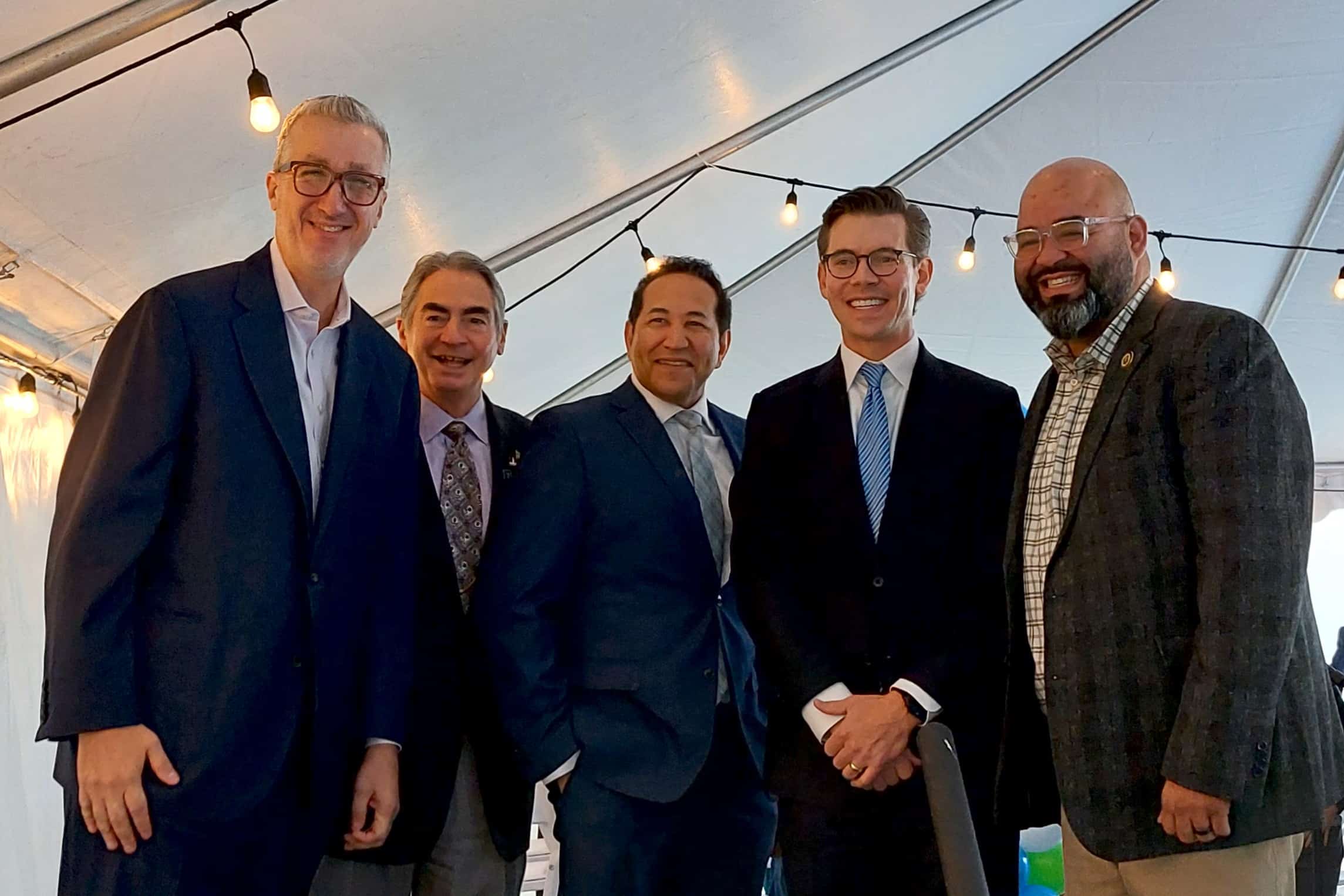
Baystate Health President and CEO Peter Banko, Springfield Mayor Domenic Sarno, state Rep. Carlos Gonzalez, Baystate Mercy Hospital President Andrew Ritz and state Sen Adam Gomez gather for a photo after officially opening Baystate Mercy Hospital under its new name.
Reminder Publishing photos by Sarah Heinonen
SPRINGFIELD — Since the 1870s, Greater Springfield has been home to two hospitals that have continually evolved to serve the growing population and the changing nature of medicine. On Nov. 2, Baystate Health completed its acquisition of Mercy Medical Center, renaming it Baystate Mercy Hospital and ensuring Springfield will continue to operate two hospitals.
“We have two well-respected hospitals in the city of Springfield,” Mayor Domenic Sarno said. “Both these places are near and dear to my heart.” He spoke about the care his parents received as well as his own care during his recent bout of cancer.
Similarly, state Sen. Adam Gomez said he grew up in the neighborhood with both his childhood pediatrician and his children’s pediatrician located at Mercy. He also had a kidney transplant three years ago and spent time at both Baystate and Mercy.
“Baystate Mercy Hospital must remain a community resource for generations to come. Mercy must be thriving and growing to continue to serve the community here,” Baystate Mercy Hospital President Andrew Ritz said, adding the continued operation of Mercy provides “opportunities for expanded access to care for all” and a commitment to “keeping high-quality care local.”
Sarno said, “I made it imperative … that the city of Springfield and Western Massachusetts could not go with one hospital.” He pointed out that Baystate Medical Center is the only level one trauma center in Western Massachusetts, while the team at Mercy is invaluable.
The mayor said that without Baystate stepping in to acquire Mercy, the smaller hospital would have closed its doors. In absorbing the staff at Mercy, Baystate now employs a total of 15,000 people in the Pioneer Valley.
“It was always … not about the money, it was about ‘let’s do the right thing,’” Baystate Health President and CEO Peter Banko said. The Sisters of Providence, which began the organization that became Mercy, “created the social fabric of Western Massachusetts,” and filled a need in the community. “It’s about care for all — all people — and it’s about caring for each other,” Banko said. “It’s about access. It’s not about financials.”
Banko expressed frustration at some media accounts regarding the amount of money that was spent on the merger. Baystate Health later released the following statement regarding the cost of the merger: “Any suggestion that Baystate Health paid anything close to $293 million is incorrect. That figure is a state regulatory valuation based on Mercy’s annual revenues, not the purchase price. The purchase price will remain confidential between the two parties, and the actual consideration was modest. Baystate was the only organization to step forward to preserve the hospital and essential services for our community.”
Gomez said the merger was more than two years in the making. “This was a complete team effort working with the administration to find ways to make sure that not another hospital in the commonwealth of Massachusetts will go down,” he said. Gomez recalled the “extraordinary” wait times at hospitals during the coronavirus pandemic as one of the reasons Springfield needs two hospitals. He said, “Imagine the individual that would have to drive 50, 60, over 100 miles because we could not serve them.”
Among the dignitaries at the event recognizing the merger were representatives from U.S. Rep. Richard Neal’s and U.S. Sens. Ed Markey’s and Elizabeth Warren’s offices, state Reps. Brian Ashe, Carlos Gonzalez, Angelo Puppolo and Orlando Ramos and state Sens. Jo Comerford, Jake Oliveira and John Velis, along with Gomez. Ritz thanked all of them for their support.
Praising the other representatives in the Western Massachusetts delegation, Gonzalez said, “It was they that led the charge to making sure that when the first call was made … We rushed to make sure that the leadership of the House heard that call.” He said that because of that leadership, the state House of Representatives approved $10 million for Baystate Mercy in the supplemental budget. Gomez later added that the state Senate is proposing $17.5 million for the hospital.
Ritz said the staff and medical professionals at the hospital had been working to ensure a seamless transition. Moving forward, Sarno said Baystate would continue to honor the religious traditions of Mercy, which was begun by the Sisters of Providence.
Gonzalez said, “It takes a village, not only to make the merger successful, but to ensure that the quality of employment opportunities for local residents and to continue to support the local staff.”
Banko said he had been on the other side of a merger twice when hospitals he worked for were acquired. “I want to assure everyone at Mercy, we’re local — our board, our leadership, our team efforts, all of our decisions. You know where we live and we’re your neighbors. We get our care here.” Banko noted that he can see Mercy from his office six blocks away.
Banko said Mercy has been underutilized. “We need those beds to be full. We need this campus to be thriving. We need to be all As and 5-stars quality,” he said. “We need to grow the two campuses six blocks apart. We’ve been competitors since the Civil War … we need to work together and avoid competition.”
Seth Gemme, chief physician executive of Baystate Health and president of Baystate Medical Practices, said Baystate and Mercy will work hand-in-hand, and that Baystate Health is working to let patients know that Mercy now offers the same quality of care as Baystate. He also said that patients in Baystate’s emergency department may be transferred to Mercy if there is an open bed at the latter campus before one opens at the former. When it comes to maintaining all of Mercy’s services, Gemme said, “The future of obstetrics here at Mercy is unknown at this time,” but “the Cancer Center is here to stay.”
Banko finished his remarks by saying, “We’re here for the community and our neighborhood, we’re here for Springfield, we’re here for Western Mass.”
