
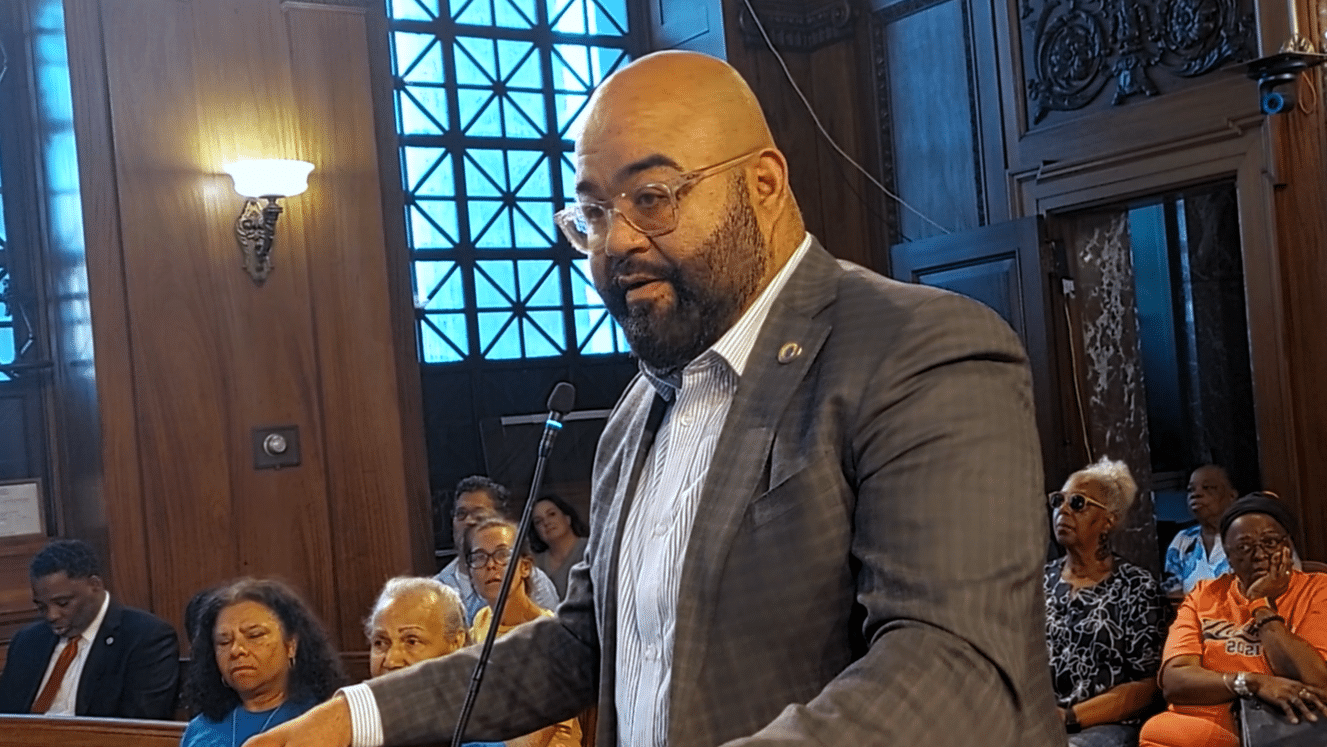
State Sen. Adam Gomez urges the Springfield City Council to pass a resolution supporting rent control legislation in the State House.
Reminder Publishing photo by Sarah Heinonen
SPRINGFIELD — At the urging of state Sen. Adam Gomez and outcry from financially strapped residents, the Springfield City Council voted 10-0 in favor of a resolution supporting legislation that would allow municipalities to opt into rent control.
Rent control was banned in a 1994 statewide referendum.
Hurst said that at the time of the ballot vote. Senate bill S. 1447 filed by Gomez and state Sen. Patricia Jehlen and House bill H. 2328 from state Reps. David Rogers and Samantha Montaño would limit rent increases to 5% or the annual change in the Consumer Price Index, whichever is lower. There would be carve-outs for owner-occupied buildings with four or fewer units and those in housing authority-owned buildings. The rent control restrictions would not affect rental units in a newly constructed building for five years.
The legislation would also require evictions to be based on just cause. Just cause includes nonpayment of rent, refusal to accept a legal rent increase, substantial violation of lease, criminal behavior by tenants, public nuisance or damage to the unit. It also allows eviction if the owner seeks to demolish the unit or convert the unit to a cooperative or condominium.
At the June 9 General Government Committee meeting, Hurst cited 2023 data that showed 24% of Springfield residents were cost burdened, paying more than 30% of their income to housing costs. Of those people, 31% were severely cost burdened and paid more than 50% of their income to housing costs.
Hurst emphasized that the legislation would give the city and its residents the power to decide whether to adopt rent control. During the committee meeting, he said that if the legislation passes, a local option would need to either pass a vote of the City Council, a home-rule charter change or a Springfield municipal ballot.
A resident at the committee meeting commented, “I understand why landlords also bring up their rent, because property taxes are going up, but I think it’s important for the city to also consider, stop raising property taxes.”
Another person remarked, “Do we want the developers who are afraid of rent control, do we want them developing in our communities?”
Ahead of the June 14 meeting, community groups, including Springfield No One Leaves, Neighbor to Neighbor and MA Senior Action gathered on the steps of City Hall for a rally and press conference. Many of those activists gave public comments during the meeting. One after another, they said that wages have not kept pace with rental increases.
Nicole Coakley said that over the 10 years she has lived in her apartment, the monthly rent has increased from $900 to $2,000. “What about the people whose wages have not doubled?” she asked. She then urged the City Council to “send a message that our community is not for sale to the highest bidder.”
Nevah Cruz said people are making “impossible choices” between rent, prescription medicines, utilities and feeding their families.
In a written statement, one resident said that their sister and her autistic child are staying with her because they cannot afford rent. This is the third time in six years she has opened her home to family or friends in that situation. Meanwhile, another resident said she hides in the bathroom so that her children do not see her cry over worry about rent.
Katie Talbot said about 90% of rental units in Springfield are owned by corporations. Stephen Howard agreed, saying that corporation buy residential properties inexpensively from people who are struggling financially and then charge “astronomical prices. He remarked, “If this isn’t gentrification, I don’t know what is.”
The problem is widespread, said Gomez. “It exists in every single neighborhood that we all know. Springfield has 22 neighborhoods, 14 of those neighborhoods fall below the federal poverty level. It exists in Brightwood. It exists in the North End. It exists in Old Hill. It exists in Upper Hill. It exists in Forest Park. It exists in the South End. It exists in Indian Orchard. It exists even in Ward 7, Ward 6. These neighborhoods contain census tracks where poverty rate exceeds 20% and where generations of residents have faced systematic barriers in economic mobility.”
Gomez said, “These are neighborhoods filled with hardworking people, families, veterans, seniors, immigrants, children, small business owners, people who contribute every single day to the fabric of our city. And yet these are often the same neighborhoods most vulnerable to displacement when housing costs rise.”
The senator explained that the problem has far reaching consequences. “Housing is not simply a roof over someone’s head,” Gomez said. “Housing is healthcare. Housing is public safety. Housing is an educational opportunity. Housing is economic stability. And housing is human dignity. And when housing becomes unaffordable, everyone of those pillars begin to crack, especially in front of this city hall.”
Gomez said, “Government has the responsibility to stand with working people… And while Springfield’s economy continues to grow, to many residents, they’re asking a simple question. Will there be a place for me when it’s all said and done?”
At Large Councilor Brian Santaniello asked Gomez about the rent control question expected to be on the November ballot. Gomez said that is a “one-size-fits-all” solution, whereas his legislation allows municipalities to the craft rent control policy that best fits their community. He said Gov. Maura Healey has stated that she is open to a compromise on rent control, and he believes this is the best compromise.
Ward 2 Councilor Michael Fenton remarked that it was a wonderful compromise, while Ward 5 Councilor Lavar Click-Bruce noted that his 26-year-old daughter lives at home because she cannot afford to rent an apartment.
Ward 8 Councilor Zaida Govan, who co-sponsored the resolution with Hurst, said, “This is about our values.” To meet the long-held federal guideline that no more than 30% of a person’s income should go to rent, Govan said that someone paying $2,500 per month would need to make $90,000 annually. She remarked that new teachers and police officers — jobs the city relies on — do not make $90,000.
Gomez said the goal is to maintain momentum on the subject and have a vote on the Senate floor before the formal session ends on July 1.
