
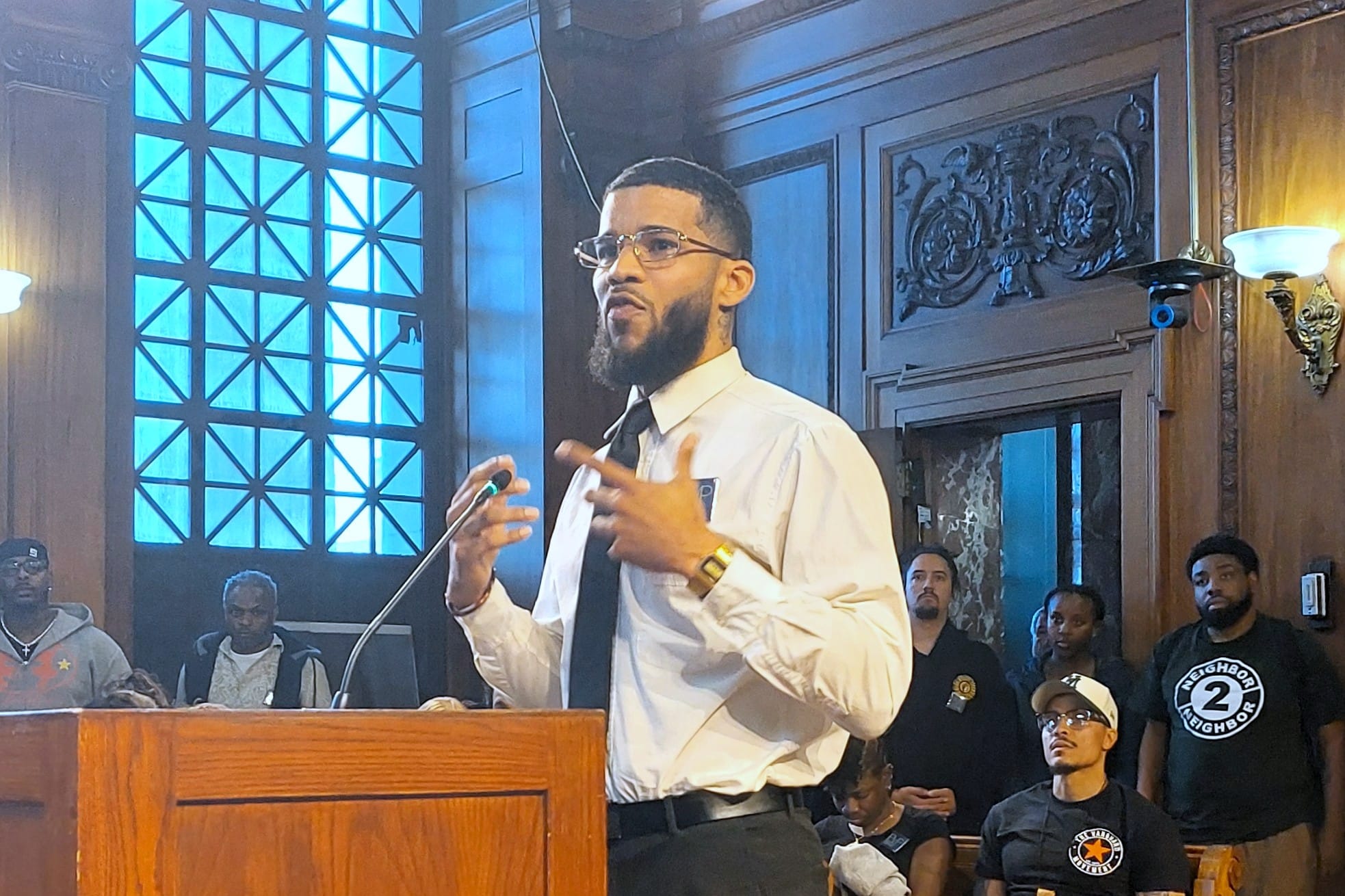
Dominique Boyd speaks in favor of participatory budgeting in Springfield.
Reminder Publishing photo by Sarah Heinonen
SPRINGFIELD — City residents crammed into the City Council Chambers for the Public Speak Out portion of the June 1 council meeting.
Residents passionately advocated for several issues, including rent control, in-person meetings and a transparent budget process.
Joseph Bonilla and Nevah Cruz, both representing Neighbor 2 Neighbor, urged councilors to adopt rent control.
“Here in Springfield, nearly half of residents in Springfield are rent-burdened, spending more than 30% of income on housing alone,” said Bonilla.
Some spend as much as 50% of their income on housing, he said. At the same time, the cost of everything from groceries to child care. He said it is pushing younger people out of Springfield and the state. He made the case that the loss of residents will translate to the loss of economic participation. Bonilla said, “Housing policy is workforce policy.”
Cruz said, “We believe housing is a human right, not a luxury.”
She said families are being pushed out of Springfield because of unaffordable or unsafe housing conditions.
“Working families, seniors, immigrants and long-time residents are struggling to remain in the community they helped build,” Cruz said. She said rent stabilization is a tool to “create balance, accountability and protections that allow people to stay rooted in their neighborhoods.”
Many of the people in the room were representing the Pioneer Valley Project. Chris Brown said that, in January, the organization requested meetings with all 13 councilors regarding this year’s budget process, which culminated in a May 28 vote to approve the $1.04 billion budget. Brown thanked the eight councilors who took time to meet with PVP.
Brown said councilors told PVP members they were committed to a transparent city budget process and engaging with residents. However, he said being engaged in the process was often difficult. “If it’s challenging for organized residents to even get a meeting with our councilors, what does that say about the accessibility of the budget process for residents who aren’t organized?” Brown asked. Mayor Domenic Sarno’s budget hearings were at 11 a.m., while the council’s hearings happened at 5 p.m. Brown said for people who work during the day, attending those meetings was not an option. He also said notice of the hearings is posted in the City Hall’s “basement.” Agendas for the hearings were available on the city’s website, and Focus Springfield recorded and posted the meetings on YouTube.
“We still believe the city is down for a community-driven budget process,” Brown said. He acknowledged that the council already passed the budget. He said, “Some of you might tell us we’re too late, but we’re not. We’re right on time.” Brown said PVP was advocating for participatory budgeting.
Another PVP member, Alejandra Morales, said the lack of accessible hearings “creates a barrier between the public and the decisions that shape our city. It causes us to question if our elected officials really want us to be a part of the process.” Meanwhile, she said, residents often hear that they do not care and do not “show up.”
Morales said the budget documents are difficult to parse, pointing out that a $98 million category listed in the budget as “other” and ranged from the Springfield Parking Authority to the Springfield Museums. “This is not just a technical issue. It is a trust issue,” she said. “When budgets are hard to read, when meetings are hard to attend and when information is not clearly organized or explained, the result is that residents are excluded from the process.”
Dominique Boyd, another PVP organizer, said, “The people of Springfield deserve a real voice on how public money should be spent.” He called for Springfield to dedicate 1% of the budget “directly to the people.” He said “everyday people” should put forth ideas on how to improve their neighborhoods. He said participatory budgeting gives city leadership “direct insight into the hearts, minds and needs of the people.”
Moving on, three residents spoke in favor of Ward 7 Councilor Gerry Martin’s proposal to require councilors to attend meetings in person when possible. Martin’s resolution was debated in May and sent to committee.
Nicole Coakley said being able to physically see one another and read body language “strengthens communication, collaboration and accountability.” She said residents are expected to come to the meetings to participate in Public Speak Out. “Seniors take buses, families arrange childcare and working people show up in person after long shifts because they care deeply about what happens in this chamber,” she said, adding that councilors should make the “same effort.”
Corrine Durham, a Ward 7 resident and rehabilitation counselor, said Martin’s proposal includes reasonable accommodations for hardships and disabilities. She said in person meetings are more effective for group communication and mutual trust.
Erica Cruz, another Ward 7 resident, said in-person attendance is “an issue about public trust, transparency, accountability and civic engagement.”
She said technology provides flexibility for genuine emergencies and hardships, but in person attendance should be the norm. She also said in person attendance offers opportunities for residents to interact with their representatives.
