
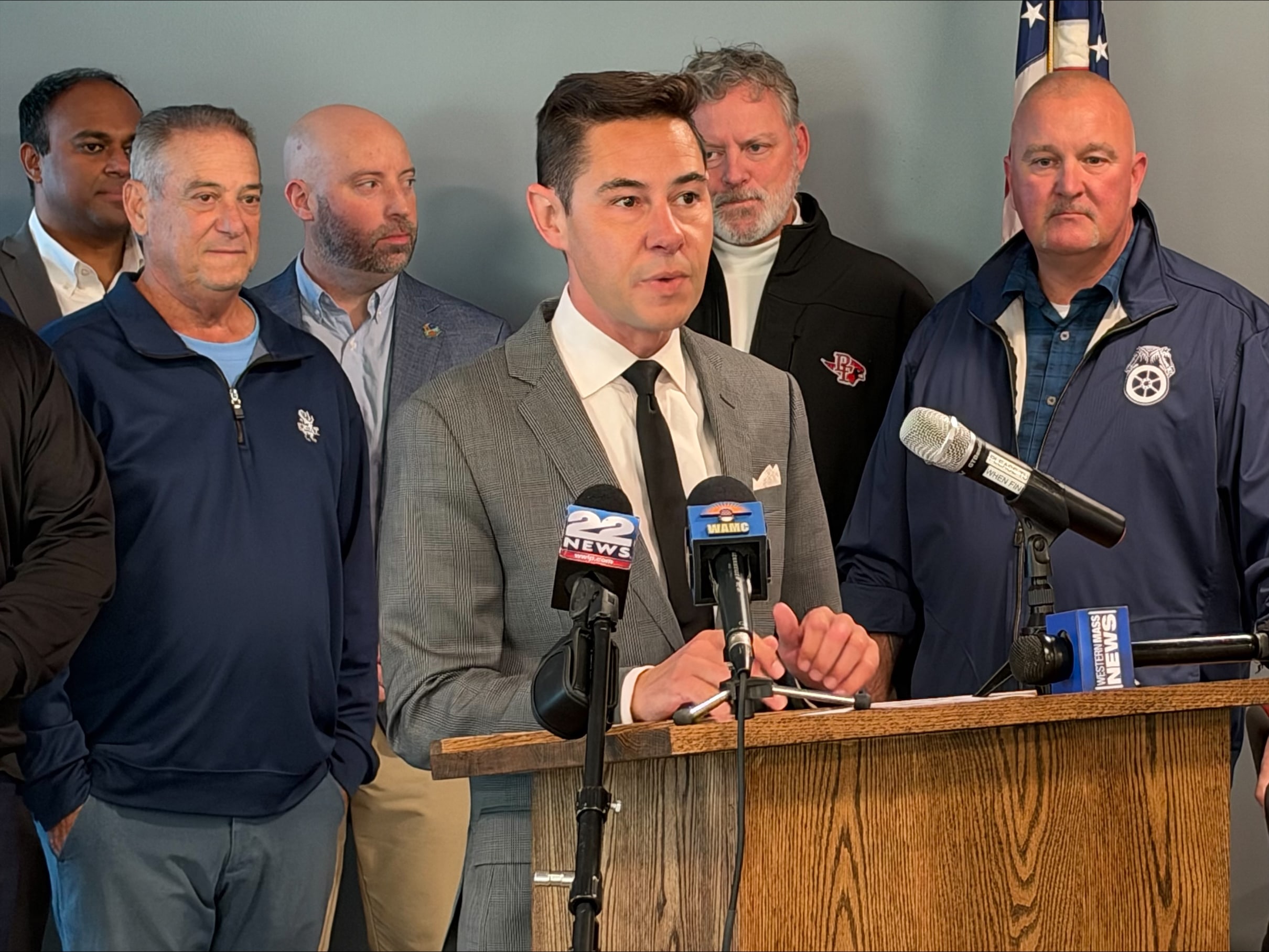
State Sen. Jake Oliveira’s Nov. 9 press conference called to move forward with the Mass Ready Act.
Reminder Publishing photo by Peter Tuohy
SPRINGFIELD — Regional leaders and municipal officials joined state Sen. Jake Oliveira for a press conference on Nov. 9, where he laid out his plan to give local communities a seat at the Springfield Water and Sewer Commission table.
The commission is the exclusive provider of drinking water and wastewater services across 10 communities, including Southwick, Agawam, East Longmeadow and Longmeadow. The commission also provides partial, peak demand or emergency service to Chicopee, West Springfield and Wilbraham.
The Springfield Water and Sewer Commission is currently composed of three members, all Springfield residents. An amendment to the Mass Ready Act, an infrastructure and resiliency bill, would expand the Springfield Water and Sewer Commission to seven seats, three of which would go to representatives from the suburban communities that buy water from Springfield. Versions of the bill from the Senate and House are being reconciled by the Legislature’s Joint Conference Committee. Springfield’s House delegation requested this item be removed, but state Sen. Jake Oliveira, who represents Ludlow and Longmeadow, as well as a sliver of Springfield, sent a letter to the committee on Oct. 27 asking that the section remain.
While providing its services to around 250,000 people, the commission’s governing board does not include members outside of Springfield. It includes three members, selected by Springfield Mayor Domenic Sarno and confirmed by the City Council.
Oliveira’s press conference called on the House-Senate Conference Committee negotiating the Mass Ready Act to retain a Senate-approved provision allowing voices outside of Springfield to join the commission’s governance.
The change would shift the board from three members to seven, with four appointed by Sarno and three by a regional advisory board. Springfield would still retain a majority voice with four members, as four votes would be needed for board action.
The purpose is to ensure a fairer balance, greater accountability and meaningful regional input while maintaining strong, reliable water and sewer services for the region.
Oliveira said the commission is the second largest water and sewer system in the state, and the services are fundamental to public health, economic development and quality of life for the communities.
“I think all of us have seen horror stories in other parts of a country when access to clean water is threatened,” Oliveira said. “When that happens, the economy of that area grinds to a complete halt. That’s why the regional nature of this system and its governance structure has not kept pace with the communities it’s served.”
He said communities outside of Springfield contribute to the commission’s operating costs, help pay for infrastructure improvements and share in financial consequences from decision making but have no direct representation.
“If our communities are helping to pay those bills, our communities deserve a seat at the table,” Oliveira said. “This is not about Springfield giving away control, and it’s not about the suburbs taking control. It’s about protecting a public asset, respecting every ratepayer and making the system stronger for the next generation.”
He said the system has evolved and investments have grown since the commission was established in 1996 and the approach to governance needs to “recognize that reality.”
“The commission can remain financially independent while becoming more accountable to the communities it serves,” Oliveira said. “Springfield can retain its governing majority while neighboring municipalities gain a voice.”
State Sen. John Velis said it doesn’t make sense to him how rate-paying communities don’t have a seat at the table and voice in how their rates are impacted.
“We talk in Massachusetts about Western Massachusetts, in many respects, being disregarded,” Velis said. “We try on a daily basis to prevent that from happening … There are so many communities that are impacted by this that just do not have a stake in this, and I think that needs to change.”
Western Mass Building Trades Unions President Colton Andrews said his message was simple — if the communities are expected to pay, they deserve a say.
“The communities helping to support the system do not have a meaningful voice in its governance,” Andrews said. “That is outdated, that is unfair and it needs to change. You cannot call yourself a regional utility when it’s time to collect the money and then act like the region doesn’t exist when it’s time to make the decisions.”
Agawam Mayor Christopher Johnson said Agawam is arguably the largest community participating in services because of Bondi’s Island wastewater disposal.
Johnson said the largest complaint is about raising water and sewer rates based on costs passed along by the commission.
He said a seat at the table is needed so the town won’t need to say it doesn’t have any control over the commission’s water and sewer costs.
Oliveira told Reminder Publishing the commission originally took no stance on the measure, but reports and lobbyist filings have shown a potential change of heart toward opposition.
According to lobbyist public records, the commission spent $42,500 in 2026 toward lobbying efforts with J Wagner Strategies, owned by former state Rep. Joseph Wagner, and Smith Costello & Crawford Public Policy Group.
Wagner’s disclosure reports show the commission employed the entity in April to oppose Senate Bill 3064 — the Mass Ready Act. Smith Costello & Crawford’s disclosure report shows a neutral position on the bill.
Oliveira said when the bill is hopefully passed with the final version of the Mass Ready Act, the conversation on bringing each community in to work together with the commission can begin.

Springfield Mayor Domenic Sarno speaks at a press conference against giving customer towns representation on the Springfield Water and Sewer Commission.
Reminder Publishing photo by Sarah Heinonen
Following the Nov. 9 press conference, Springfield city leaders including Mayor Domenic Sarno, City Council President Tracye Whitfield and members of the city’s house delegation hosted another press conference on Nov. 12 to push back against potential changes to the board’s composition.
Springfield would retain a majority of seats on the commission, but state Rep. Orlando Ramos said the four towns would have 43% of the vote, despite only representing 15% of ratepayers.
Sarno said Springfield taxpayers have paid billions of dollars to make Springfield’s water system “one of the best water systems in the United States of America. Period.” The city began creating reservoirs and water lines in 1873, he said. He was adamant that the towns are customers and are not entitled to “own” any part of Springfield’s water system. “We built this thing. We own this thing. We assume all the risk. They assume none,” he said.
The mayor pointed to the water crises in Flint, Michigan, and Jackson, Mississippi, 2014 and 2022, respectively. He said they occurred because the system became political. “Decisions weren’t made, investments weren’t made, infrastructure wasn’t improved,” he said. He also noted that some of the communities that “are trying to muscle us here in the city of Springfield” fought against Boston’s use of the Quabbin Reservoir, “because that’s their water. Our water and sewer is Springfield’s.”
Sarno said the Springfield Water and Sewer Commission is building infrastructure to manage quality and overflow issues. The portion of those infrastructure improvements that is included in the towns’ assessments are “contractual obligations,” he said. “This is all enhancing and improving the water system, so you don’t have a Flint, Michigan, you don’t have a Jackson, Mississippi.”
Whitfield added that she has not seen representatives from the towns when water issues are discussed at City Council meetings.
State Rep. Carlos Gonzalez was vehement in his opposition. “The suburbs will not dictate what Springfield is able to do,” he declared. Gonzalez said he respected his colleagues in the Senate but disagreed on this matter.
State Rep. Bud Williams, who served on the 1996 commission that restructured the Springfield Water and Sewer Commission, said, “This is a no brainer … We foot all the bills. We pay all the money. They want to come to the table; you come with your checkbook and pay your way into a corporation to get some kind of ownership so you can have a say.” He added, “We’re going to fight the suburbs.”
Ramos said, “For me to be up here defending the Water and Sewer Commission says a lot, because I have fought against these guys for year, against their rate hikes.” But he said defending the commission was “the right thing to do.” He added, “I will stand firmly to make sure it doesn’t come out of the Conference Committee.”
The speakers reiterated that Springfield’s taxpayers and ratepayers built the system. “We are tag-teaming on this one,” said Whitfield. “The way to get a seat at the table is not by bully it by legislation. It’s to come to the city and speak with representatives of the city … We will not back down on this,” she said, adding that she and Perez would bring a resolution before the City Council to send to the State House.
Gonzalez said Ludlow, despite being smaller, pays the same rate as Springfield does. He said, “Whether you’re on the board or you’re not, you’re not going to get a better rate.”
The Conference Committee must vote on finalized language by Jan. 5, 2027. The bill will then go to the House and Senate for final votes.


You must be logged in to post a comment.