
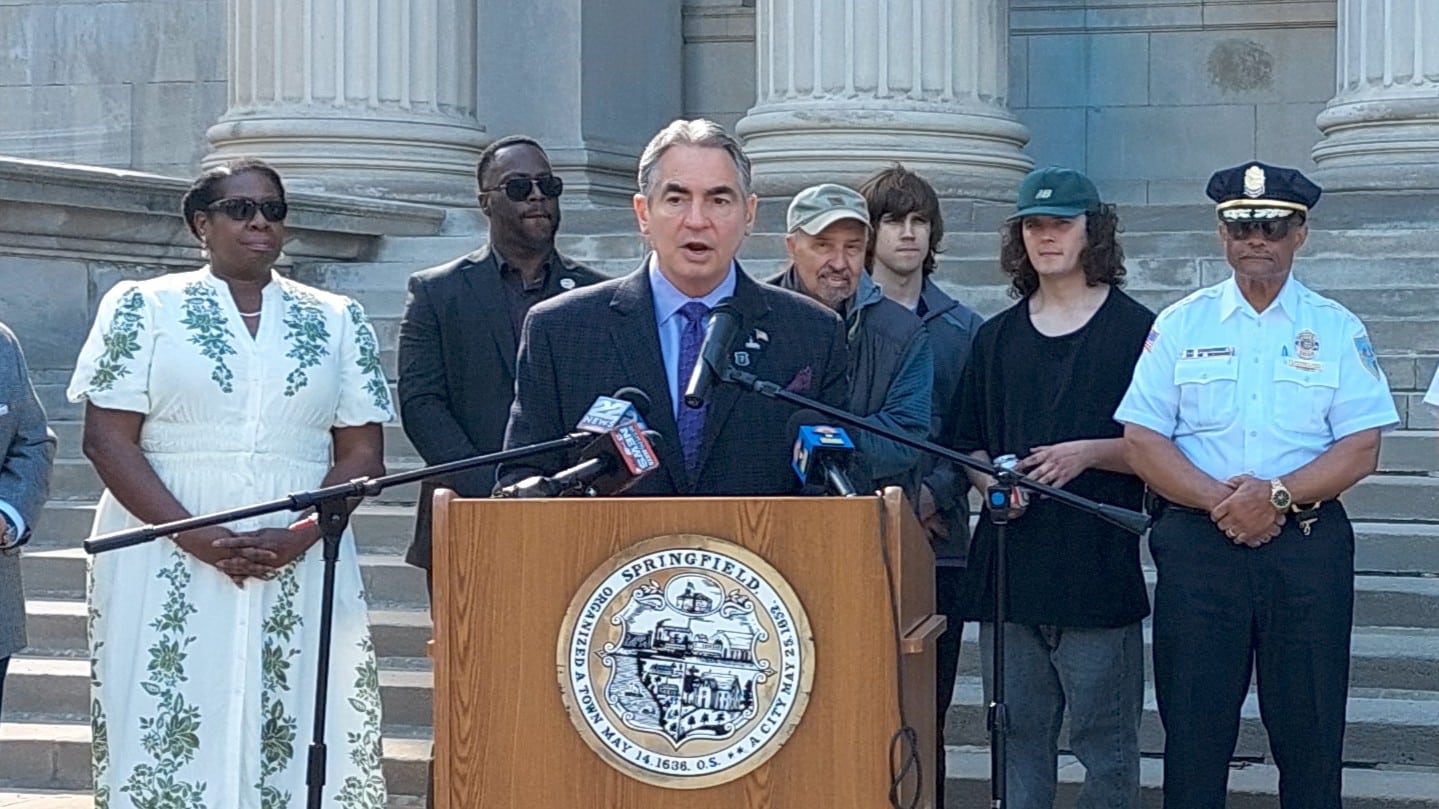
Springfield Mayor Domenic Sarno makes remarks about the 2011 tornado before a bell tolls in commemoration.
Reminder Publishing photo by Sarah Heinonen
SPRINGFIELD — At exactly 4:38 p.m. on a pleasant and sunny June 1, the bell of Old First Church in Court Square rang 15 times, one for each year since a devastating EF3 tornado carved a path of destruction through the city of Springfield and nine other communities.
Tornadoes are common in the Midwest and southeastern states, like Tennessee and Alabama, but they are nearly unheard of in New England, where weather conditions are generally not right for such events. In the days leading up to June 1, 2011, however, meteorologists had been tracking a storm system coming east over Canada and the Great Lakes, drawing warm, moist air, while a cold front moved north. Together, these factors created instability in the atmosphere. When an upper-level jet stream brought significant wind shear over New England, all the ingredients were present to form a tornado.
A tornado warning was issued by the National Oceanic and Atmospheric Administration at 3:28 p.m. for parts of the Pioneer Valley. Another warning was issued less than an hour later for the greater Springfield area.
The tornado first touched down at 4:17 p.m. in Westfield, before cutting a trail through northern Agawam and West Springfield. When it crossed the Connecticut River into Springfield, a news camera atop Monarch Place caught video of the cyclone wending its way between Memorial Bridge and the North End Bridge.
The tornado tipped a tractor trailer on Memorial Bridge onto its side like a child discarding a toy truck. More than 500 homes and businesses were destroyed, with roofs pierced by trees and buildings knocked off their foundation. The winds, which were estimated to have peaked at 160 miles per hour, sucked the mattresses out of dormitory windows at Springfield College. People sustained injuries from flying glass and debris. The South End, East Forest Park and Sixteen Acres neighborhoods suffered extensive damage. In total, about one-third of the city was affected.
The funnel left the city behind, spreading damage and disaster through Wilbraham, Monson, Brimfield, Sturbridge, Southbridge and Charlton, before evaporating at 5:27 p.m. In just over one hour, it caused three deaths, hundreds of injuries and millions of dollars in property damage. It left a scar on the landscape and the memory of Western and central Massachusetts.
At the ceremony on the City Hall steps marking the 15th anniversary, Mayor Domenic Sarno said, “God works in mysterious ways. If this had occurred at 2:38 in the morning, there would have been no warning whatsoever. And if this occurred at 2:38 in the afternoon, all our kids, our students, including mine, my own daughters, were in school at that time. So, think of what could have happened.”
Police Superintendent Lawrence Akers was a motorcycle patrol officer at the time of the storm. He and his wife were watching “Die Hard” on television, and he remembered being irritated that the weather alerts kept interrupting the movie. Then, he received a call from a friend asking if he was all right. That was when Akers turned the news on and saw what had happened.
“I was shocked. What actually hit me the hardest was when I went up on Island Pond Road. I looked and there were no trees, there were no nothing, and I became very emotional,” he said. “To just look at it and see nothing there and homes destroyed, and just — no trees. That’s when it really set in.” Akers recalled the immediate aftermath of the storm. “People were out there just, not knowing what in the world to do,” he said. “People were just shook, you know, as I was.”
Sarno recalled the oppressive humidity that hung over everything that day. He was driving back to City Hall after taking his daughter to an appointment when he heard that the tornado had touched down. He described the damage as “unimaginable,” and said the “devastation in certain areas was unrecognizable.” He spoke about the monumental task of clearing rubble and wreckage from sites across the city. People put debris on the tree belt for the city to collect. Sarno said teams were working for up to 18 hours per day during the weeks after the storm. All the while, the city had to continue providing services for the parts of the city that had been spared from destruction.
The mayor praised the tireless efforts of the city’s first responders and the kindness of neighbors helping neighbors. “It was the people that kept us going. My team and with help from the state” and Congressional delegation, he said. “Everywhere we went, it was really the people, who said, ‘Mayor Sarno, it’s going to be okay.’” Sarno said he built relationships during the challenging times that continue today.
Akers had similar memories. He said, “You saw everyone coming with chainsaws and cutting trees in front of people’s homes. People would just have people coming over. I had a few people come to my house because I didn’t lose power or anything because our lines were underground up there, and people would come to my house.” Akers noted that he had 13 rooms and space to temporarily house friends. “I saw that all over the city. People just helping people, bringing food and everything.”
Sarno said he doggedly pursued funding from the Federal Emergency Management Agency and other government departments to cover the roughly $138 million of cleanup. Over the following six years, the city was rebuilt. Today, there are only a few left vacant since the storm.
2011 was a tumultuous year for Springfield. “First we had the ice storm in January, then you the tornado, same year, then we had a microburst and freak nor’easter that occurred pre-Halloween in October,” Sarno said. The city also suffered a gas explosion the following year. “We dealt with it so well that we were the only standalone city to receive the resiliency grant in the United States of America,” Sarno said. As a leader in times of crisis, he said, “You got to let people know what happened, what you’re going to do about it, and just as important, hope — we’re going to get through this together.”
Akers said, “Springfield and her residents are resilient. We’ve proven that time and time again.”
