
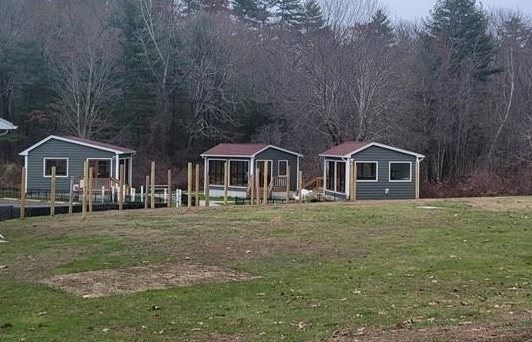
Art Ribinskas, the owner of Crepes Tea House at 157 Feeding Hills Road, Southwick, has applied to the Planning Board to modify its special permit to allow it to use the outbuilding, also called a gazebo, for outdoor dining.
Reminder Publishing file photo
SOUTHWICK — There are concerns about the distribution of seating and the capacity of Crepes Tea House’s aging septic system.
Becuase of this, the Board of Health decided it needed more time to provide a formal letter to the Planning Board approving the restaurant’s request to offer patrons outdoor seating in one of the three outbuildings on the property.
“In all likelihood, we’re going to come back with another compromise but we need to discuss that among the board and we will do our best to have something for the Planning Board by their [next] meeting,” said Board of Health chair Terry Putnam after discussing ways to resolve the seating issue at the restaurant at 157 Feeding Hills Road during the board’s meeting on Jan. 6.
Since last July, the Planning Board has held open public hearings on Crepes’ application to allow it to use one of its three outbuildings for outdoor dining by removing 20 seats from its dining room to use in the outbuilding while not exceeding its 93-seat capacity.
Several issues have proven to be obstacles for the restaurant to get the Planning Board’s approval, including issues of trust with its owner, Art Ribinskas, how to ensure the restaurant doesn’t exceed its capacity when it moves seats for outdoor diners, how the Fire Department might classify the outbuilding for safety purposes and minimizing the stress on its septic system.
During the Planning Board’s meeting in late December, most of its members were satisfied with assurances from Steve Salvini of Salvini Associates that they would be comfortable with moving the 20 seats back and forth between the dining room and outbuilding between April 1 and Oct. 1, and that the building would only be available by reservation on Fridays, Saturdays and Sundays.
However, at that meeting, Planning Board Chair Jessica Thornton invited interim Health Director Caileen Simonds to present the town’s former health director’s opinion of moving the seats back and forth, after consulting with the state’s Department of Environmental Protection.
She said that Tom Hibert, the town’s former health director, thought the 20 seats that would be used in the outbuilding, or gazebo, should be removed permanently from the dining room or bar area.
With that information, Thornton said that before the board handed down its decision, they needed a “clarification” of the former director’s opinion, which prompted the Board of Health to take up the issue at its meeting on Jan. 6. Salvini provided the restaurant’s position on its request and a synopsis of meetings over the last three months.
“It all comes back now to capacity. How many seats can you have,” Salvini said at the BOH meeting.
“There’s absolutely no increase in seating capacity at all for Crepes Tea House. [The permit modification application] wasn’t intended to be an increase in seating capacity,” Salvini said.
About the possibility of stressing the septic system, which has a capacity of 3,500 gallons per day, Salvini said he pulled water use billings for the restaurant, and it never exceeded 1,200 gallons per day.
“You don’t have 93 people going to the bathroom and using the bathroom in a restaurant. It’s from washing dishes,” he said.
He said he was hoping the board would rule that because the seating capacity won’t increase, there’s no additional stress on the septic system.
“So long as there’s not an increase in [septic system] capacity, does it really matter where those seats are?” he asked.
About how the BOH might monitor that the restaurant doesn’t exceed its seating capacity, Salvini asked if other restaurants in town are monitored.
Putnam said, “No … [only] when they are inspected.”
Simonds then said that when the former director preferred the seating distribution to be permanent, it was after “extensive” discussions with the Department of Environmental Protection, and that, “he was told that there really would be no way for us to efficiently and effectively police that 20 seats were being flip-flopped from the gazebo to inside, to the deck, to back.”
She then said policing the seating was not an issue of trust.
“That’s not it at all. Mostly what it is … it’s a very old septic system,” she said, adding that it was impossible to measure the stress on a septic system.
Board member Erika Prouty confirmed with Salvini that seating diners in the outbuilding wouldn’t be last-minute.
“Planned events only,” she said.
“That’s exactly right,” Salvini said, who then floated a compromise.
He suggested notifying the BOH when the outbuilding would be used.
“I would think that this would be a good compromise — you’re aware of what their use is, and they’re aware that you know what their use is, and it keeps everybody honest,” he said.
Prouty asked if notifying the BOH would “open up a can of worms?”
Putnam said requiring that would be something that no other restaurant in town must do, which Simonds said was also a concern for her.
“If you’re not doing this for other restaurants, then how can you not trust this restaurant?” Salvini asked.
Prouty suggested that the restaurant keep a log of when the seats were moved.
Putnam, again, said that would mean holding Crepes to a different standard.
Simonds then suggested keeping 10 seats permanently in the outbuilding, and if 10 more were needed, they could be moved.
Later, Putnam recognized that what the Planning Board might decide “hinges” on what the BOH rules, which Salvini responded to.
“That’s what we’re in the process of, and now the Planning Board has said, ‘well, we’re going to kick it over to the Board of Health and stress them out,’” he said.
“We are very appreciative of that,” Putnam said.
After a bit more discussion, Putnam said the board would continue to discuss what its recommendations might be.