
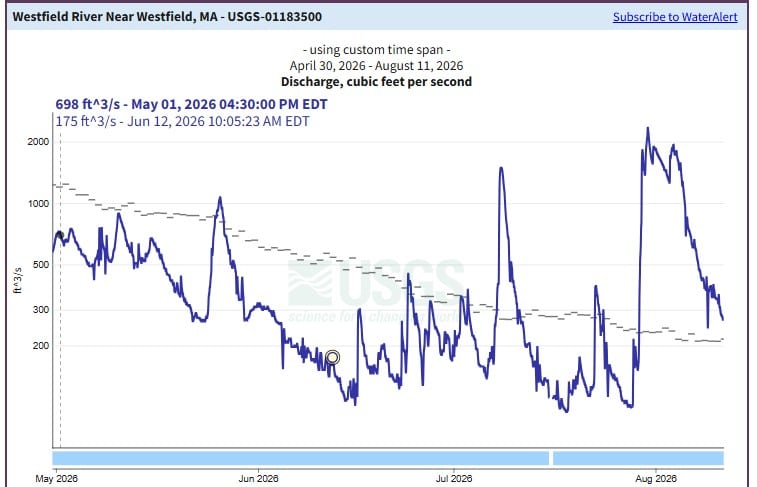
This graph shows the flow rates of the Westfield River between May 1 and Aug. 11. The steep spikes show when rainfall increased the flow rate.
Photo credit: U.S. Geological Survey
SOUTHWICK — In the years before the state tied municipal water use to the state’s drought status, the town’s mandatory water ban would have already been lifted.
“It’s well above,” said DPW Assistant Director Jon Goddard, referring to the flow levels in the Westfield River.
For over a decade, the decision to implement a water ban was based entirely on the river’s flow rate and its effect on fish habitat.
According to the town’s water withdrawal permit, between May 1 and June 30, the river must have a flow rate below 502 cubic feet per second for three consecutive days to implement restrictions.
Between July 1 and Sept. 30, the flow must be below 174 cfs for seven consecutive days for the restrictions to be implemented. Lifting them requires a flow above 174 cfs for seven consecutive days.
If the town had still relied on the flow rate, mandatory water-use restrictions would not have been implemented since July 1, according to the U.S. Geological Survey’s river flow data.
However, using the 502-cfs threshold from May 1-17, water use would have been unrestricted.
On May 17, the ban would have been implemented and then lifted again on May 26. It would have been implemented again on May 30 and continued through June 30, when the flow rate threshold dropped to 174 cfs, according to USGS data.
Starting on July 1, water use in town would continue unrestricted through Aug. 11 if the town still used the river flow rates, according to the data.
Goddard said the rain in July helped the surface conditions of the soil because of increased moisture. That correlates with the rainfall totals measured at the Westfield-Barnes Regional Airport, which is the closest National Weather Service station.
In July, 7.24 inches of rain fell, which was 3.2 inches above the normal monthly precipitation of 4.15 inches, according to the NWS.
While the rain helped, Goddard said, “it was not relative to the longer-term trend.”
That trend is the ongoing drought, which began in October 2024.
Each month, the state’s Drought Management Task Force meets to assign the severity of drought conditions in six regions across the commonwealth.
When it released the drought status last week, it declared four regions, including the Connecticut River Valley, to be at a Level 2 significant drought despite the recent rains.
“Massachusetts received between 4.5 and nearly 9.5 inches of rain during July, with most of the state receiving more rain than is typical for the month. The rainfall helped replenish rivers, streams and soil. Even with that improvement, drought conditions remain in parts of the state because groundwater, which supplies wells, rivers, and wetlands, recovers more slowly than rainfall,” according to the monthly report from the task force.
The task force recommends that residents and businesses minimize overall water usage; follow local water use restrictions; fix indoor leaks, such as from toilets, faucets and showers, which account for more than 60% of indoor water use; and, for larger buildings and businesses, conduct water audits to identify areas with leaks and potential water conservation opportunities.
For municipalities, the task force recommends limiting or prohibiting washing hard surfaces — such as sidewalks, patios, driveways and siding — and personal vehicle and boat washing.
The task force also recommends establishing water-use reduction targets for all water users, identifying top water users and conducting targeted outreach to curb their use.
Southwick and Westfield have implemented restrictions that follow the state’s recommendations.
In Southwick, residents are permitted to use non-essential outdoor water one day per week and only before 9 a.m. and after 5 p.m.
The daily schedule of permitted non-essential outdoor water use is as follows:
• Monday – North Region, odd-numbered properties
• Tuesday – North Region, even-numbered properties
• Wednesday – South Region, odd-numbered properties
• Thursday – South Region, even-numbered properties
• No non-essential water use is allowed on Friday, Saturday and Sunday.
In Westfield, all non-essential water use is banned except by drip irrigation, a handheld hose or a watering can before 9 a.m. or after 5 p.m.
Examples of non-essential use include irrigating lawns by sprinklers or automatic irrigation systems; washing vehicles, except in a commercial car wash or as necessary for operator safety; and washing exterior building surfaces, parking lots, driveways or sidewalks, except as necessary to apply surface treatments such as paint, preservatives, stucco, pavement or cement.
In Westfield, fines for violations of the water ban are $50 for the first violation, $100 for the second and $150 for the third and each additional violation. Each day on which a violation occurs constitutes a separate violation.
In Southwick, violators can be fined $50 for the first violation and $100 for subsequent violations.