
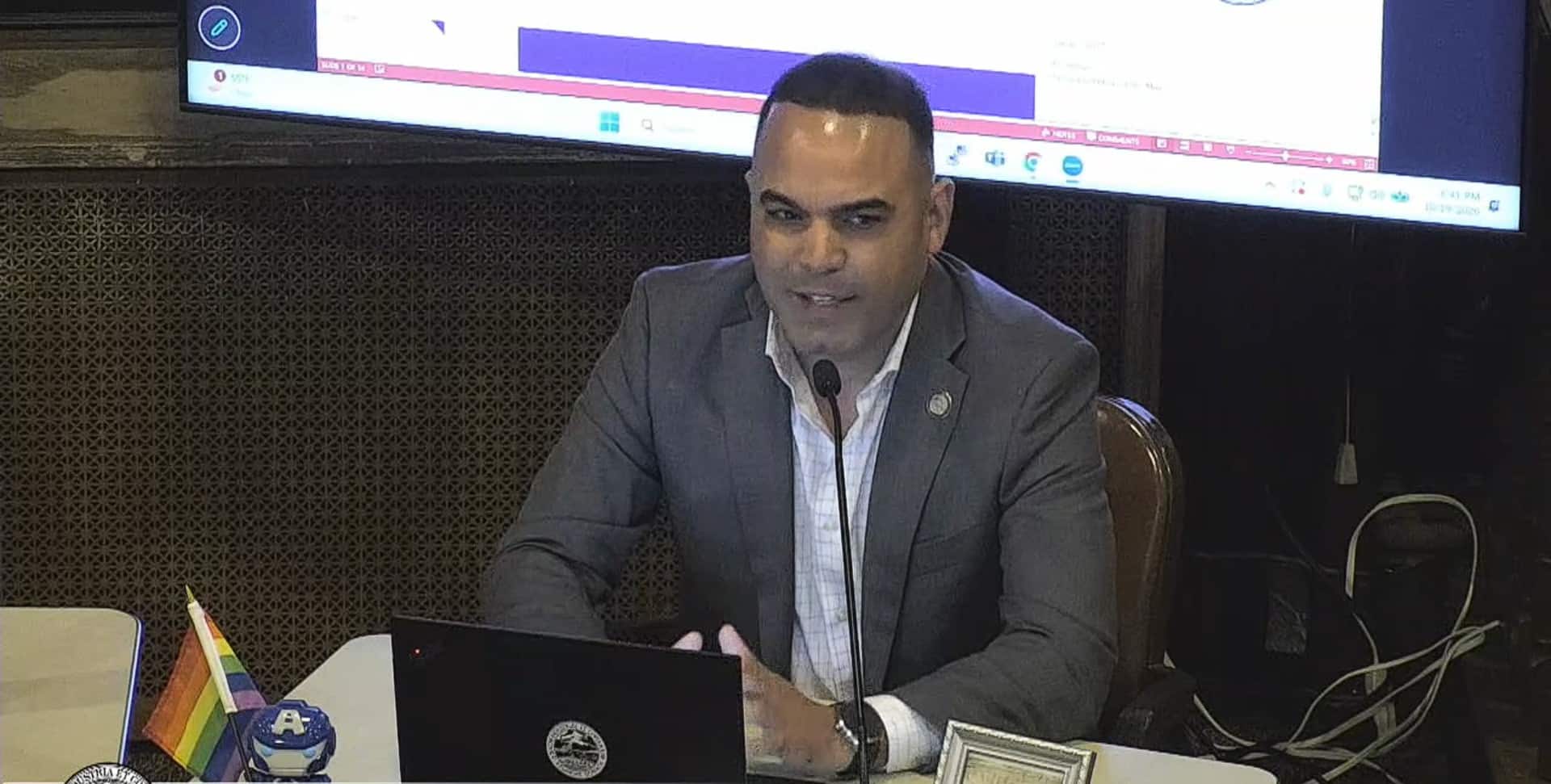
Mayor Joshua Garcia presents Ezekiel’s Plan 2.0 to the Public Safety Subcommittee and the public during its Oct. 19 meeting.
Photo credit: Holyoke Media
HOLYOKE — After public questions and concerns, the Holyoke City Council’s Public Safety Committee tabled its Oct. 19 discussion of Mayor Joshua Garcia’s comprehensive neighborhood stabilization initiative.
According to the mayor, the initiative aims to reduce violence and illegal activity, address blight and problem properties, improve housing conditions, expand prevention efforts and restore residents’ confidence in their neighborhoods.
The funding for the proposed plan was first introduced during a Sept. 15 City Council meeting when City Councilor Patti Devine proposed a $750,000 transfer from the Marijuana Impact Fee Stabilization Fund to the plan.
Garcia said the impact fee is one funding source along with Community Development Block Grants, opioid settlement funding, HOME-ARP, Shannon grant, local appropriation and county state and federal funding partnerships.
The proposed plan looks to build on the original Ezekiel’s Plan introduced by Garcia in 2023 following the shooting that resulted in the death of eight-month-old Ezekiel Ramon Garcia. An altercation between several men, which escalated into gunfire, resulted in a bullet striking a passing PVTA bus, hitting an eight-month-pregnant woman who was riding the bus.
She was critically injured, transported to the hospital and delivered her baby. Despite efforts to save him, Ezekiel did not survive. Garcia’s original 2023 proposal called for a $1 million investment, but the City Council did not pass the order.
At the Oct. 19 Public Safety Committee meeting, Garcia presented the framework which included six connected areas of intervention; enforcement, housing, blight/problem properties, prevention and capacity.
Before the Public Safety meeting, Holyoke residents gathered outside City Hall, seeking more transparency and a public hearing on the plan.
In a statement, Neighbors to Neighbors Massachusetts, a grassroots community-organizing group spanning the state, demanded that the mayor and City Council choose programs to help people over punishment and to invest in services for access to housing and tenant protections as well as services for mental health, substance use and community-based solutions to address violence, rather than expand policing and overtime funding.
“The mayor is proposing that Holyoke invest more of our taxpayer dollars in police overtime while families are struggling to afford rent, gas, groceries, childcare and other basic needs,” Holyoke resident Ariel Feliciano said. “We cannot police our way out of a housing crisis, a mental health crisis, or a substance use crisis. We need to house people, not handcuff them. We need care and accountability, not more surveillance and punishment. We need investments that keep our communities safe without criminalizing the people most in need of support.”
The organization argues that the City Council and mayor should reject increased police overtime funding and prioritize investments that address the root causes of community harm, invest in community-based solutions, transformative justice and restorative justice, release a detailed line-item budget and support safe consumption sites.
They also want funding reentry services for people returning from incarceration, including those connected to the Franklin County House of Correction, expand access to affordable childcare and commit to meaningful community participation in decisions about public safety, housing and social services.
Other residents expressed similar sentiments after Garcia’s presentation and during public comment. Their concerns centered around how funding might be distributed among public safety initiatives, youth programming, housing stability, and community services; how the administration would identify unmet needs, track performance and adjust programs when they do not achieve their intended results.
Residents also mentioned surveillance technology and civil liberties, fairness and accountability in policing, access to mental health and recovery services, homelessness and the need to reach young people who may not be connected to existing programs.
According to City Councilor and Public Safety Committee Chair Anne Thalheimer, the item was tabled on Oct. 19 to continue the work and discussion in the coming months. She did not specify when the discussion will return to the agenda.
After the meeting, Garcia posted a statement on his Facebook reflecting on the Public Safety Committee discussion, emphasizing transparency, accountability and comprehensive solutions. He said he will continue these conversations with the community and use the feedback to strengthen the plan.
“The questions raised about funding, accountability and measurable results are important,” Garcia said. “We need to identify where the gaps are, direct resources where they can have the greatest impact, and build a strategy that is coordinated and sustainable. We may not agree on every approach, but we share a responsibility to keep working toward a safer Holyoke.”