
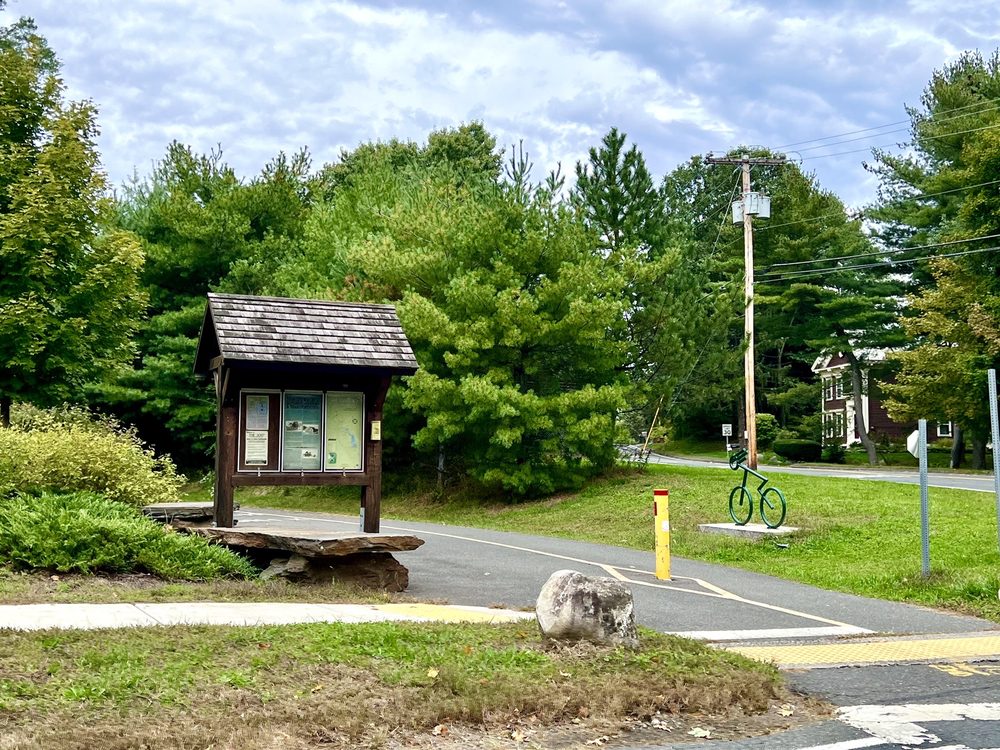
The town’s Economic Development Commission approved sending a request to the Select Board to form a committee to determine if the town should participate in the state’s Complete Streets Program. The commission would like that committee to study building a connector from the Rail Trail to College Highway.
Reminder Publishing submitted photo
SOUTHWICK — A request by the Economic Development Commission to the Select Board prompted a discussion by its members about whether the town should participate in the state’s Complete Streets program.
“I think all our concerns were, what are we signing up for when we do that? You might gain something here if it costs you something up there,” board member Russ Anderson said, referring to a presentation made in September by the DPW about the program.
Board member Diane Gale agreed with Anderson for a similar reason.
“I’m cautious of that thing of, here’s some grant money [and] all you’ll have to do is this,” she said.
The discussion was kicked off by a request from the EDC for the board to create a subcommittee or ad hoc committee that would determine if the program is the right fit for the town, and with an eye towards potential projects it believes could spur economic development and quality of life.
For the board members, naming an ad hoc or subcommittee was a hard no.
“I personally would be against another ad hoc committee,” Anderson said, which board member Douglas Moglin agreed with.
“I agree, I don’t think we need another subcommittee on a very narrow, focused issue like that,” Moglin said, with Gale agreeing.
The state’s Complete Streets Funding Program provides technical assistance and funding to municipalities to build streets that are safe, accessible, and comfortable for all users, regardless of age, ability, or mode of transportation, according to the state Department of Transportation.
It also encourages local governments to design their roadways for pedestrians, bicyclists, public transit riders and motorists alike, according to MassDOT.
If the town committed to participating in the program, it would only have to create a Complete Streets policy and immediately be eligible for a $38,000 state grant to fund technical assistance to develop a detailed prioritization plan.
With that step done, the town would then qualify for grant funding to carry out the initiatives.
Gale’s skepticism was based on “feedback” from “DPW people” that “some past jobs were very close to complete street requirements and were going to be disastrous if we hadn’t pushed back.” She wouldn’t “name the project.”
“Oh yeah,” Moglin said, who said the state was partially to blame.
“If you call a dog over and you kick the dog, [it] runs away. And then a month or three or a year later, the dog comes back to you, and he’s kicked him in the face again … eventually the dog stops coming,” he said.
“Well, this is just like every other state program. Here’s some grant money if you sign up for this and you take it … and all of a sudden the grant money’s gone … but you signed up for all the rules and regulations. And now, you’re left holding back on the cost.”
He said the town could design a “complete streets-like” project without the grant funding.
Despite that view, he said there were some benefits of the program.
Moglin and Anderson said they both wanted DPW Assistant Director Jon Goddard to attend a meeting to offer them additional details about the program.
Goddard was asked by the board to do some additional research on it in September.
Moglin suggested that when Goddard and DPW Director Rich Bosak return to invite residents, for and against, to hear their thoughts.
“We’ll take that input,” he said.
After Goddard — who Moglin said was advocating for the program — presented the program, he tried to allay the members’ fears about strings being attached to the program, as did Chief Administrative Officer Nicole Parker.
“I was not able to find what [might be] wrong with Complete Streets … there was no negative feedback that I could find,” she said at the September meeting.
Gale said she wasn’t sure Parker’s assessment made the board “anymore secure about our local control and design.”
“Not me,” Moglin added.
At the EDC meeting in December, Commissioner Greg Deily said one project he wanted the town to focus on for a Complete Street grant was connecting the rail trail to College Highway.
The idea has bounced around for over a year, but no real steps have been taken to make it a reality.