
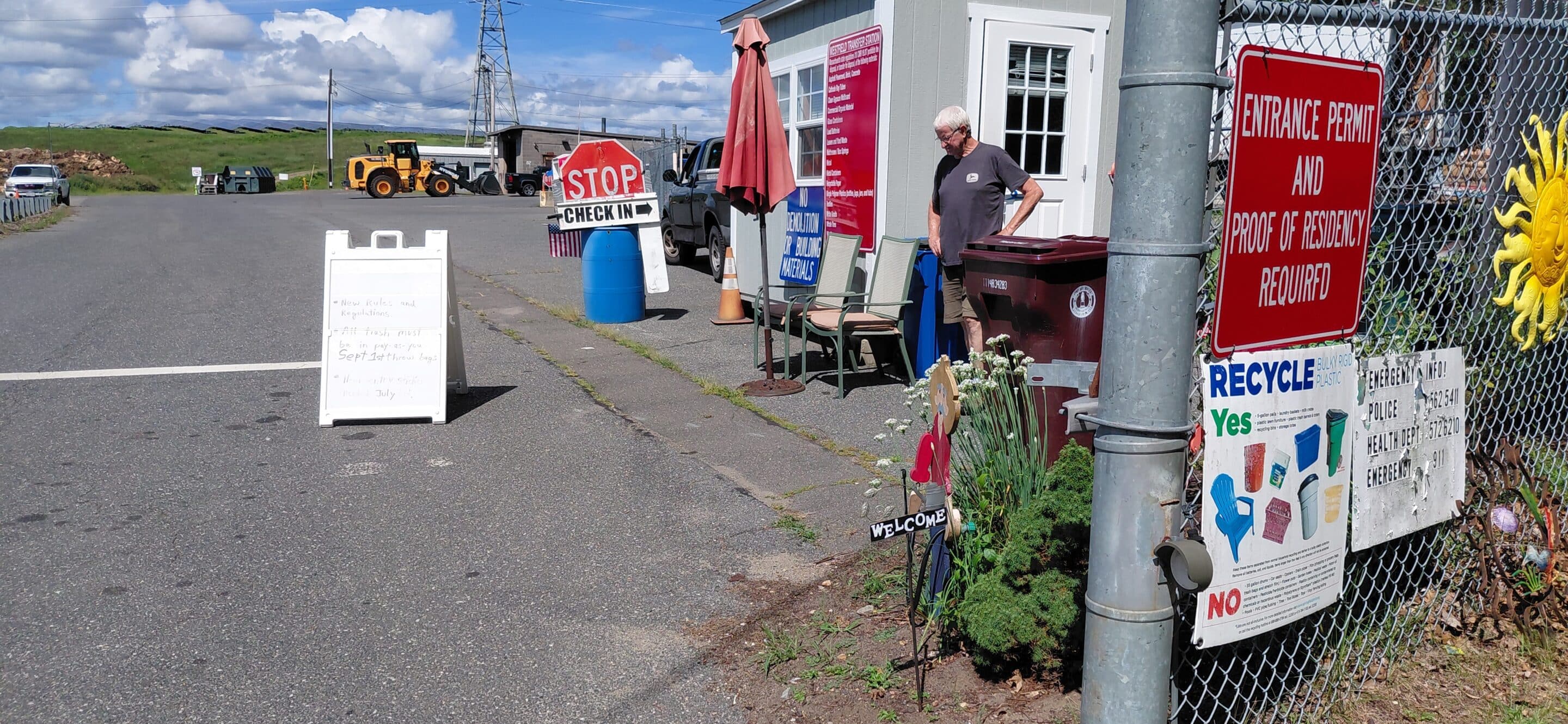
The entrance to the Twiss Street Transfer Station in Westfield.
Reminder Publishing photo by Cliff Clark
While the grant amounts are modest, every dollar directly offsets the cost of operating Westfield and Southwick’s municipal recycling programs.
“It helps us get some of the things we need,” said Cheryl McMordie, the office manager at the city’s Twiss Street Transfer Station, about the two grants the city received in late October from the state’s Sustainable Materials Recovery Program.
Westfield was awarded $12,600 from the state’s Recycling Dividends Program, which rewards municipalities that adopt proven recycling, reuse and waste-reduction policies.
It’s a program that awards points for municipal efforts to recycle specific items, like charging a fee to collect bulky items such as wooden and upholstered furniture and carpet; accepting hard-to-recycle items like mattresses, appliances or fire extinguishers; and holding hazardous household waste events several times a year.
The money must be used specifically for equipment that helps keep recyclables out of the municipal waste stream.
McMordie said the city has used the RDP to purchase a mattress container and a 30-yard container for recyclables.
The money also repaired the security fence, and the city plans to use it for a fluorescent-bulb shed.
A second $5,000 grant was awarded for a universal waste shed.
McMordie said the program also used money before the city rolled out the pay-as-you-throw program.
The program was designed to encourage recycling by residents who use the transfer station and to reduce the municipal waste stream, which in turn lowers the amount the city pays each year to have its trash hauled to a waste-processing facility such as a landfill.
It requires every resident who throws away household trash to buy and use orange bags in two sizes: 33-gallon bags for $15 and 15-gallon bags for $7.50.
Before it started, the city had to spend $14,000 to purchase the bags that are now available at the Big Y at 1 East Silver St., the Big Y at 475 East Main St., the Sunoco at 88 South Maple St. and the Stop & Shop at 57 Main St.
So far, she said, the Pay As You Throw program is delivering the results the Health Department and city taxpayers hoped for.
McMordie said that since the program started on Sept. 1, the fees the city pays to have its municipal waste hauled to local and regional landfills have been cut in half.
“We’re hoping the trend continues,” McMordie said.
She said the city was paying about $11,000 each month in hauling fees.
In September, the amount dropped to $3,000, which she attributed to the program starting and residents still having questions about how it works.
“It should mean substantial savings for our taxpayers and the city,” she said.
Southwick also received the RDP grant, which it has qualified for several years, said DPW Director Rich Bosak.
This year’s grant was $2,940. Bosak said past grants have funded new recycling bins, which cost nearly $120 each.
“We hand them out to new residents,” he said.
He said the grant money has also been used to purchase equipment for the transfer station at 22 Industrial Road.
The Sustainable Materials Recovery Program, administered by the Massachusetts Department of Environmental Protection, provides funding for recycling, composting, reuse and source reduction activities that will reduce the amount of waste disposed of in landfills and incinerators.
In addition to minimizing solid waste, SMRP projects boost resiliency and reduce greenhouse gas emissions by capturing the embodied energy in everyday products and packaging materials and converting it into new products.
The program has awarded more than $65 million since 2010. This year, 270 communities qualified for the Recycling Dividends Program and will receive more than $3.2 million in funding. The grant award announcement says the program recognizes municipalities that have implemented policies and programs proven to maximize materials reuse and recycling, as well as waste reduction.