
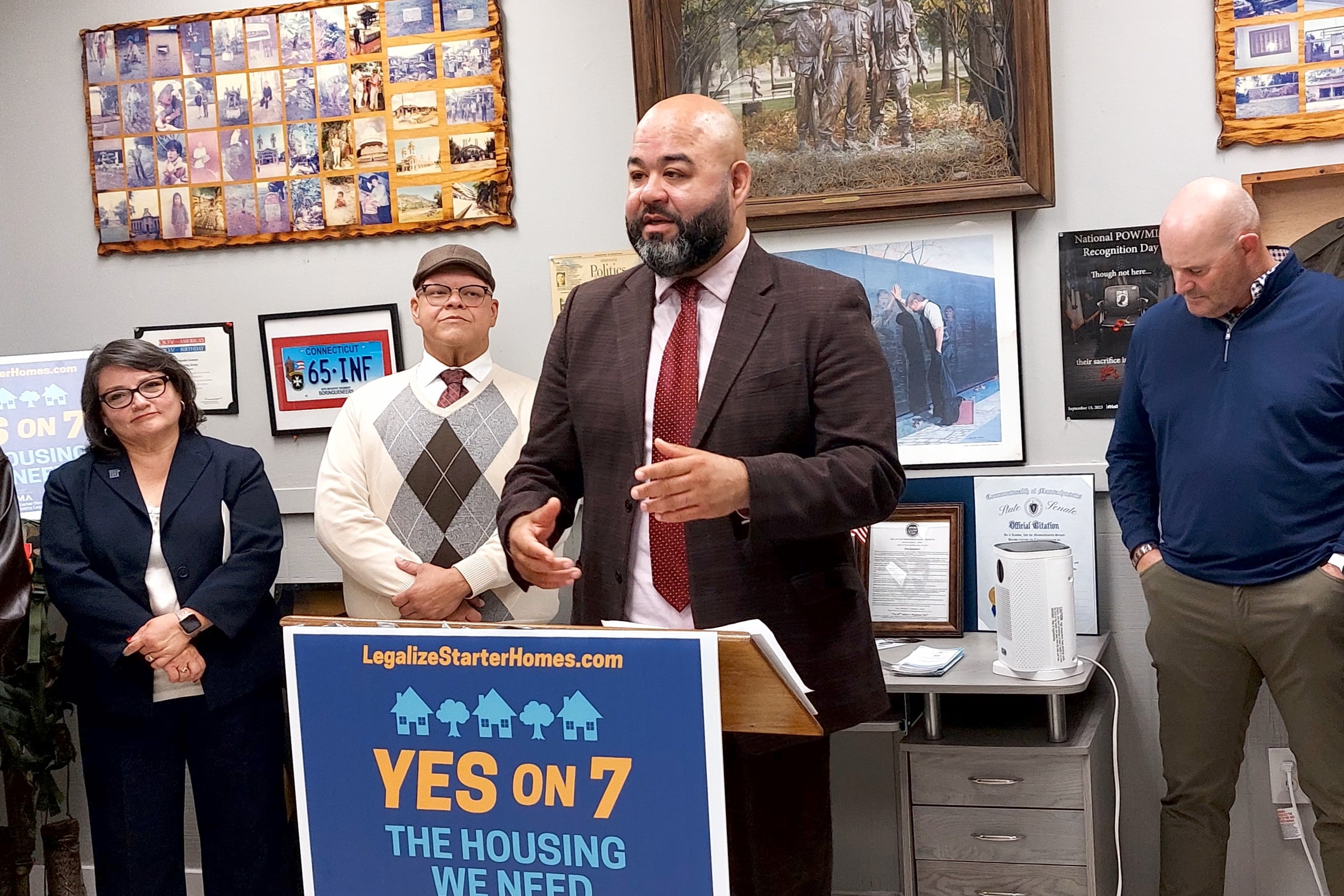
State Sen. Adam Gomez speaks in favors of Question 7 on the state election ballot, which would allow building on smaller residential lots.
Reminder Publishing photo by Sarah Heinonen
SPRINGFIELD — While there are nine questions on the Nov. 3 ballot, a group of elected officials, industry leaders and housing advocates gathered for a press conference on Oct. 6 to urge voters to pass Question 7.
Question 7 would set minimum property lot sizes in the state. Cities and towns would be required to allow single-family homes in residential zones provided the lot is at least 5,000 square feet in area, has at least 50 feet of frontage on a street and is access to public sewer and water utilities.
Jesse Kanson-Benanav, executive director of Abundant Housing Massachusetts, said polling by his organization shows 63% of surveyed voters approve of Question 7. He said Massachusetts is among the top third of states in terms of lot size.
Gumersindo Gomez Sr., who hosted the press conference at the Bilingual Outreach Veterans Center, said, “We are here because we want people to have the opportunity to find a home in Massachusetts.” He cited the Massachusetts State Housing Plan, which estimated that 222,000 homes must be added to the housing stick between 2025 and 2035 to meet demand and prevent runaway home prices. He said that in his position as the executive director of the Bilingual Outreach Veterans Center, he often sees veterans struggle to find a home. Some are seeking their first home, while others are looking to downsize later in life. He said Question 7 will provide more opportunities to build these smaller homes.
Vineeth Hemavathi, executive director of the Massachusetts Fair Housing Center, said that over the past 40 years, housing stock has not kept pace with need. “That image that is so ubiquitous in America — the house with the white picket fence — that image is the foundation of the American Dream.” He said without an affordable home, people do not have the security to dream about starting a business or launching a career. Hemavathi said, “This question will not only impact those chasing the American Dream, it will also impact those who have already lived the American Dream, our seniors who now want to live the rest of their lives with dignity and with ease.”
According to the state Department of Education, in the 2024-25 school year, 33,679 students experienced some form of homelessness, including living “doubled up,” with multiple families in one apartment or house.
“Kids don’t have places, sometimes, like a table to do their homework. Kids don’t have their own bedrooms,” said Gumersindo “Manny” Gomez Jr., a member of the Springfield School Committee. “We have families that are conjoined together living in apartments … Why do I know that? Because it’s happening in my own family, people that live still connected with me. They did everything right. They went to school, they got the job, they had a family, and somehow, someway, they’re still hitting a door that’s not open. There’s no opportunity.”
Fran Beaulieu, owner of Beaulieu Home Improvement and former president of the Massachusetts Homebuilders’ Association said the association has been discussing the issue of overly restrictive lot sizes for two decades. He said smaller lot sizes will allow for more square footage per lot and bring down the cost of homes. “You can let the market solve the problem without any massive state funding,” he said.
Beaulieu said the boost in housing construction will lead to more jobs. He also said there are empty lots in Springfield, Chicopee and Holyoke that are no longer buildable due to lot size restrictions. These are the type of lots that could be built on if Questions 7 passes.
Representing the Realtors Association of the Pioneer Valley, Judy Nevarez said the state-level Massachusetts Association of Realtors has expressed “strong support” for Question 7. “Prices keep rising and there simply aren’t enough homes to go around,” she said, adding that young families and empty nesters are routinely outbid or face moving out of their community to afford a house.
“This is one piece of a much bigger puzzle. No single measure will solve a housing crisis decades in the making. But removing barriers to building homes is a practical step forward,” Nevarez said.
State Sen. Adam Gomez said he bought his first home just three years ago, but with his second child going to college in a couple of years, is already considering downsizing. He admitted that he was a member of the Springfield City Council when it set the minimum lot size at 8,000 square feet. However, he said, “times do change.”
“This is about creating a real pathway to home ownership for working families,” Gomez said. “We cannot say we want more starter homes … while keeping unnecessary barriers that make it harder to build a modest single-family home.” He said state government has a role in removing overly restrictive regulations that limit housing production. “Requiring substantially more land than is needed for a single-family home can put home ownership is father out of reach,” he said.
Ryan McCollum, the principal and owner of RMC Strategies, a political consulting firm, spoke to the idea of smaller lots creating higher density. “First, let’s be clear about the kind of density we’re talking about,” he said. “Question 7 isn’t putting apartment buildings in single-family neighborhoods … What changes is that a community can’t require a huge piece of land just to build one single-family home. We have older neighborhoods all across Massachusetts where homes sit closer together on smaller lots, and nobody looks at those neighborhoods and says they’ve been ruined by density.”
If Question 7 passes, it would be the latest state-mandated change to zoning laws in an effort to address the housing crisis. In 2024, passage of the Affordable Homes Act made accessory dwelling units, such as tiny homes and in-law apartments, a by-right use in residential zones. Municipalities were left to create bylaws with reasonable conditions governing these units. Planning Boards and town officials expressed frustration at what many described as state mandates run amok and the erosion of the character of various communities.
While Gomez emphasized Question 7 would not eliminate local zoning, he said, “The cities have had their restrictions for a long time … I’m not saying there would be no local control, but I think we have to be realistic … we don’t have enough space and there’s no more for us to build on.” He added, “Not everyone is going to have a child and need a huge lot.” Gomez said putting smaller lots back on the tax roll is good for municipalities.
Gomez pointed to the depopulation of Berkshire County as the result of a growing cost of living and housing. He cautioned that the creation of West-East Rail, a passenger rail system from Boston to Albany via Springfield, could lead to housing speculators pushing prices higher over the next decade.
Hemavathi said, “Question 7 still allows local control and allows communities to have a conversation about how to retain its character.
Communities will still be able to regulate the height of these buildings, distance from neighboring buildings, open space, parking requirements, and whether they can be short-term rentals.”
Hemavathi continued, “The inability for young people to buy homes or for seniors to downsize in the communities they love have been negatively affecting the character of our communities for decades now. This passage of this question will help folks live in the communities they love and retain its character.”
