
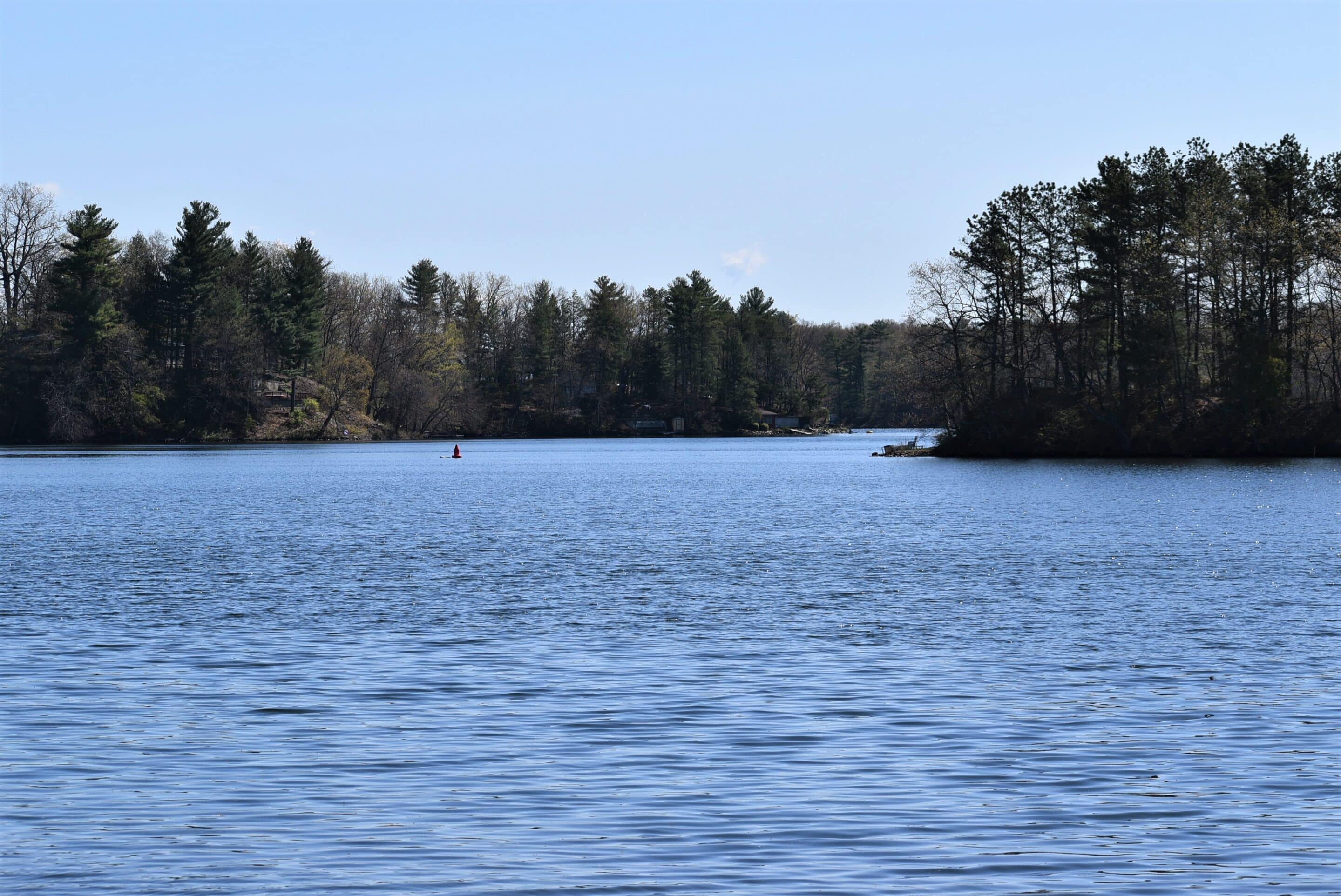
Middle Pond of Congamond Lake in Southwick.
Reminder Publishing file photo
SOUTHWICK — It was announced at the most recent Lake Management Committee meeting that the state’s Department of Environmental Protection will fund the continued development of a plan to improve water quality in the three Great Ponds.
“We were selected as one of two in the commonwealth to get funding for the watershed-management plan,” said Richard Grannells, the chair of the LMC, during the meeting.
“Mass DEP is waiting for the funding to be released and then we’ll get CEI [Comprehensive Environmental Inc.] started on the work,” Grannells said.
In May, the Select Board approved the LMC’s request to formally apply for a DEP grant that would fund Comprehensive Environmental Inc. to continue developing a watershed management plan to improve the water quality of the Congamond Lakes.
Last November, at the DEP meeting held in town to explain the process for developing a plan to improve the ponds’ water quality, one of the agency’s environmental analysts announced that the ponds had met the state’s definition of pollution.
However, it’s not polluted in the traditional physical sense— no industries or manufacturers are using the ponds to dump waste byproducts. It is the product of 14,000 years of plant and tree matter decaying and settling to the bottom of the ponds — what Grannells calls “muck.”
That decaying material is loaded with phosphorus, a nutrient that drives the growth of “chlorophyll a,” which creates conditions for algae to grow.
Because of the high levels of phosphorus and chlorophyll in the ponds, the state classifies them as a Category 5 impaired water body and requires a mitigation plan, which the representatives from the Department of Environmental Protection and two engineering firms discussed at that November meeting.
Once the funding is released, Grannells said CEI will conduct an extensive evaluation of four alternatives developed by the Holyoke-based Pare Corporation, which have already been identified as possible solutions to improve water quality.
Alternative 1 aims to limit backflow into the ponds. This would be accomplished by replacing the weir gates on Canal Brook and Great Brook with an automated control structure.
It also includes regrading 2,600 linear feet of the rail trail and raising it by 3.5 feet.
The estimated cost of Alternative 1 is between $3 million and $6 million.
Alternative 2, which includes the alterations proposed in Alternative 1, includes altering Canal Brook, dredging 6,000 linear feet, removing 50,000 cubic yards of earth, lowering the brook’s bed by up to 3 feet and widening it by 10 to 25 feet.
It also includes replacing the bridge crossings at Quarry, Notch, Brookside, Griffen and Phelps roads, as well as two access points on the Rail Trail.
The estimated cost of Alternative 2 is between $53 million and $88 million.
Alternative 3 would alter Great and Canal brooks by adopting the alterations proposed in Alternatives 1 and 2. This includes altering 15,000 linear feet of Great Brook, which would involve clearing woody vegetation, lowering the stream bed by 3 feet and widening it by up to 22 feet. It also means replacing the crossings at Sheep Pasture, South Longyard, Feeding Hills, Shaker roads and Industrial Drive.
The estimated cost is between $135 million and $222 million.
Alternative 4 would include the alteration in Alternative 1. It would mean a 6-foot outlet on North Pond at an estimated cost of $9 million, and a weir gate at the outlet at an estimated cost of $15 million.
Grannells said CEI will conduct an in-depth examination of each alternative and suggest which alternative, or combination of alternatives, would mitigate the ponds’ pollution.
Once a solution is chosen, the LMC and town will be eligible for S319 and 604-B grants.
Those are U.S. Environmental Protection Agency grant programs authorized by the U.S. Clean Water Act designed to help states and communities reduce water pollution from diffuse, nonpoint sources. These grants fund projects such as agricultural runoff controls, stream restorations and green infrastructure to improve overall water quality.
“This will allow us to access those grant funds,” Grannells said.
He said there is a meeting planned for October where the alternatives will be announced.