
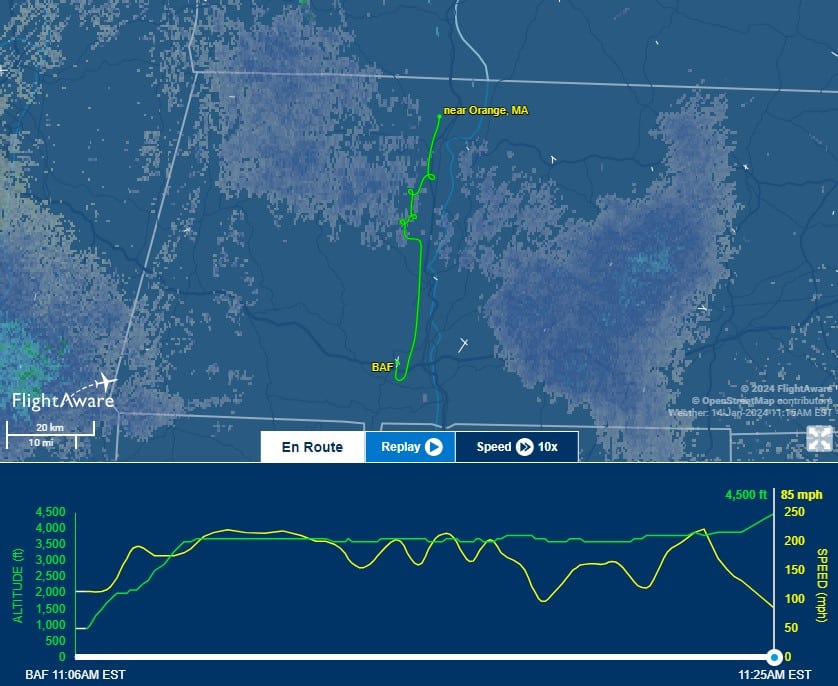
The flight path of the twin-engine Beechcraft 95 that crashed near Greenfield on Jan. 14 is shown on flightaware.com. The bottom chart is the plane’s altitude and airspeed during the flight. All three people onboard, including Southwick resident and Westfield flight school owner Fredrika Ballard, were killed in the crash.
Reminder Publishing file photo
In a final report on the January 2024 crash of a twin-engine plane near Leyden that killed all three on board, the National Transportation Safety Board indicated that several prescription medications that were in the flight instructor’s system may have contributed to the crash.
The NTSB determined the probable cause of the crash to be “the flight instructor’s failure to maintain airplane control during a stall, which resulted in an inadvertent spin from which the airplane was not recovered. Contributing to the accident were the overall effect of the flight instructor’s use of multiple central nervous system depressants, the associated underlying conditions they treated, or both,” according to the final report issued in March.
Those killed in the crash were Fredrika Ballard, 53, of Southwick, who was the president and lead instructor for Fly Lugu flight training school based at Westfield-Barnes Regional Airport; the plane’s single passenger, Chad Davidson, 29, of Woodstock, Connecticut, who was a student pilot; and William Hampton, 68, of Indian Orchard, the flight instructor on the fatal flight.
The plane took off from the Westfield-Barnes Regional Airport at about 11:25 a.m. Sunday, Jan. 14, 2024, and reached an altitude of about 4,000 feet. It made four alternating left and right 360-degree turns before rapidly descending and crashing about 20 minutes later.
In the days after the crash, the NTSB issued a preliminary report that didn’t pinpoint the exact cause of the Beechcraft 95-B-55 crash but noted there was ice on the airplane’s wings, horizontal stabilizers, rudder and one propeller blade.
However, in its final report, the federal agency wrote, “there was no evidence that airframe icing contamination adversely affected the airplane’s stall speed or other aerodynamic characteristics.”
The NTSB also found there were no mechanical issues with the airplane owned by FLY LUGO LLC.
Eyewitness accounts suggest that the plane was in a spin because of an inadvertent or deliberate stall.
In a study of the crash, investigators determined the airplane entered two stalls in the minute before impact.
“The airplane was successfully recovered from the first stall but not the second, during which the spin developed and continued to ground impact,” according to the report.
While purposely stalling an airplane is a required and fundamental part of learning to fly, the NTSB report found that both stalls using computed engine power were “inconsistent” with a demonstration for a student pilot.
The report said the spin “may have resulted from improper stall recovery technique, possibly involving an excessive or inadvertent rudder input.”
When the investigators reached the crash site in the Leyden Wildlife Management Area, they described the aircraft’s wreckage as relatively flat with little forward movement, consistent with the plane being in a spin.
Both wings, along with their engines and propeller systems, remained attached to the fuselage. The tail section had broken off, but the control cables for the rudder and horizontal stabilizers were still attached.
The report went into great detail about the various medications Hampton was taking and his background.
Toxicology testing performed during Hampton’s autopsy found several prescription drugs in his system.
Those included the Federal Aviation Administration’s “do not fly” medications: alprazolam — for anxiety and commonly known as Xanax — and amitriptyline, which can be used to treat major depression, chronic nerve pain or insomnia.
Also detected were nortriptyline, used to treat depression and nerve pain, and the antidepressant citalopram, also known as Celexa, for which the FAA requires a pilot to be medically certified, with an assessment of the pilot’s cognitive function and response to the medication.
Zolpidem, commonly known as Ambien, is allowed by the FAA for treating insomnia as long as it is not taken daily.
The statin medication Lipitor, the blood-pressure medication lisinopril and the painkiller indomethacin were also detected in Hampton’s system. Alcohol was not detected.
The report qualified that the use of the medications does not “reliably predict specific impairing effects in this case … the adverse effects of his substance use, the associated underlying conditions, or both likely diminished his capacity to act in a timely and appropriate manner (pull the plane out of the second stall), although a more specific determination of the individual contributions of specific medical factors is not possible based on the available evidence.”.
The report also included the FAA’s medical certification of Hampton. It read that Hampton had been arrested and convicted multiple times for driving under the influence, the last being in 2004. He lost his pilot’s license, but it was renewed in 2007 after rehabilitation and close medical monitoring.
Hampton was involved in a car crash in 2023. When he was evaluated in an emergency department, he was found to be intoxicated, according to the report.
Included in the report was a photograph taken by Ballard inside the plane about 10 minutes before the crash.
The image shows the student pilot, Davidson, seated in the airplane’s left-front seat with his hand on the throttle control levers and Hampton seated in the right-front seat.
“Neither of the flight instructor’s hands appears to be near the engine controls or on the control yoke,” according to the report.