
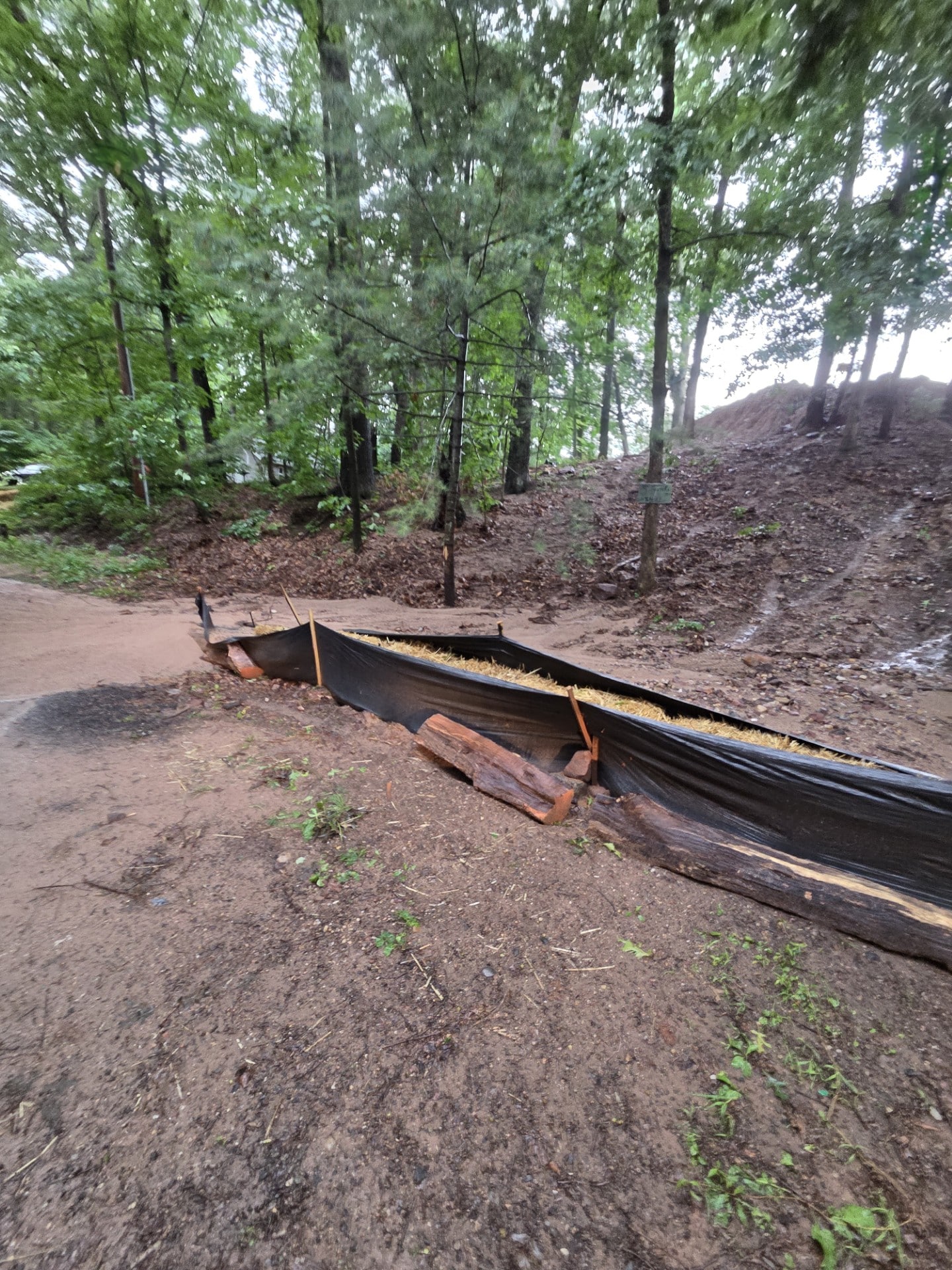
This photograph shows the slope on Ed Hepburn’s property piled with new fill dirt. In the top right corner. In the center is the silt fence that was overwhelmed by water and silt during the heavy rainstorm on Monday, Aug. 3.
Reminder Publishing submitted photo
SOUTHWICK — The owner of a home on South Road was issued an enforcement order by the Conservation Commission after sediment from his property inundated a protected wetland area following a heavy rainstorm on Aug. 3.
“And now that there’s an actual violation that had happened overnight because of the rainstorm, sediment is now in the wetland. So, we’re going to talk about that,” said Conservation Commission Coordinator Sabrina Pooler during the commission’s Aug. 3 meeting.
She answered Edward Hepburn, who owns a home and property at 5 South Road, after he asked if he was at the meeting because of sediment and erosion issues from dumping fill dirt on a portion of his property.
“When we spoke, you said the issue was a driveway. You want to address that first?” Hepburn said, referring to Pooler.
“We’re going to address the sediment that’s now in the wetland first because that’s our biggest concern at the moment,” she said.
Pooler explained that between Thursday, July 30, and the commission’s meeting on Aug. 3, sediment from the erosion had crossed South Road and streamed from Hepburn’s property into a protected wetland area, despite Hepburn installing a silt fence to stop its progress.
Hepburn installed silt fences after it had come to Pooler’s attention three or four weeks ago that he had possibly dumped fill dirt in the buffer around the wetland that covers a significant portion of an abutting property at 1 Iroquois Drive.
During the meeting, Hepburn said that he was putting the fill dirt along the edge of a slope to increase the width and length of his property.
“I was trying to make a little more length [and] width on the property. So I was putting it there, letting it settle,” he said.
Hepburn said that he had been putting fill on the slope for nearly 30 years, but more this summer, which prompted a response from his neighbor.
“A drastic amount of fill,” said Lauren Bolduc, who lives at 5 South Road below Hepburn’s property and is now dealing with silt infiltrating the crawl space of her home due to erosion.
To limit sediment runoff from erosion, Hepburn placed the silt fence below the slope, but the heavy rains at the end of last week, on Aug. 1 and especially the morning of Aug. 3, were too much for the fence.
“This heavy rain and the other rain … just got ahead of me,” he said.
Pooler and Commission Chair Norm Cheever visited South Road before the meeting and took several photographs. One showed the original silt fence installed, and another illustrated the most recent, which had been reinforced.
One of the photographs showed where water flowing off the slope had blown out one side of the fence.
While discussing the issue, Pooler said there were two issues caused by erosion at the Hepburn property, and they involved two jurisdictional authorities.
In addition to the Conservation Commission, the Building Department was involved because the sediment was seeping into the crawl space of Bolduc’s home below the slope.
“[While] there’s sediment now in the wetland, there’s also sediment in her basement,” Pooler said, referring to Bolduc.
Bolduc said she’s been dealing with water seeping into the crawl space under her home and that it has been getting worse with the more frequent rains over the last several weeks.
She had been considering installing a French drain around her home because the water infiltration was the only thing she could “control.”
“Then it became silt matter coming into my crawl space,” Bolduc said.
She said the town’s building inspector came to her home in early June and suggested installing a silt fence between her property and Hepburn’s property, which she did using her own money.
Hepburn said he believed most of the sediment from the slope was sand.
“Most of that sediment that comes down [is] mixed with that [clay color] is sand. That whole hill [is a] sand pit,” Hepburn said.
However, a man who didn’t identify himself but was speaking on behalf of Bolduc said all the sediment washing down the slope was clay.
“That’s all clay. I walked on that thing. It’s hard as a rock right down the hill,” said the man.
The discussion then turned to the fill that had been dumped at the top of the slope.
Commissioner Kevin Solek asked if the fill dirt affected how the water ran down the slope.
“Is the new fill causing all this water to run that way?” Solek asked.
Clark asked whether the increase in water coming off the slope had been different before Hepburn began dumping the fill.
“Is it a new problem?” Clark asked.
“This is a new problem,” Bolduc, who acknowledged that her home’s crawl space had always been damp, said.
“It became a problem once it wasn’t one or two loads being dumped. You’re well past 40 loads of material. Like that’s a huge difference of material being dumped and not having a plan or nothing to hold it,” she said, adding “I don’t want to mess up what you guys have going on, but I also have to protect my house.”
Clark said the commission aims to stop the silt but not the water.
Bolduc said she understood that.
Commissioner Andy Reardon told Hepburn he needed an engineer to figure out how to “keep [Bolduc] happy.”
How to keep the piles of fill dirt from sliding down the slope was then discussed.
Commissioner Jerry Patria suggested putting tarps over the piles, but that would cause other issues, including preventing vegetation from growing and increasing water velocity.
If tarps were used to cover the piles, Clark said, it would only be a temporary solution.
Hepburn acknowledged he needed to come up with at least a temporary solution.
“I’ll have to do something. If it’s going to rain again soon, I have to make sure I get something done before,” Hepburn said.
Cheever recognized that and said that the situation was “unique” because the commission couldn’t wait two weeks for corrective action.
Pooler drafted an enforcement order that included placing tarps over the exposed fill dirt piles within 48 hours; keeping the silt fences clear and rebuilding them as necessary; installing silt fences to prevent runoff from flowing into the wetland area; hiring an engineer to evaluate the site and prepare a restoration plan within 30 days; and completing all restoration work by Nov. 1.
It was approved unanimously by the commission.