
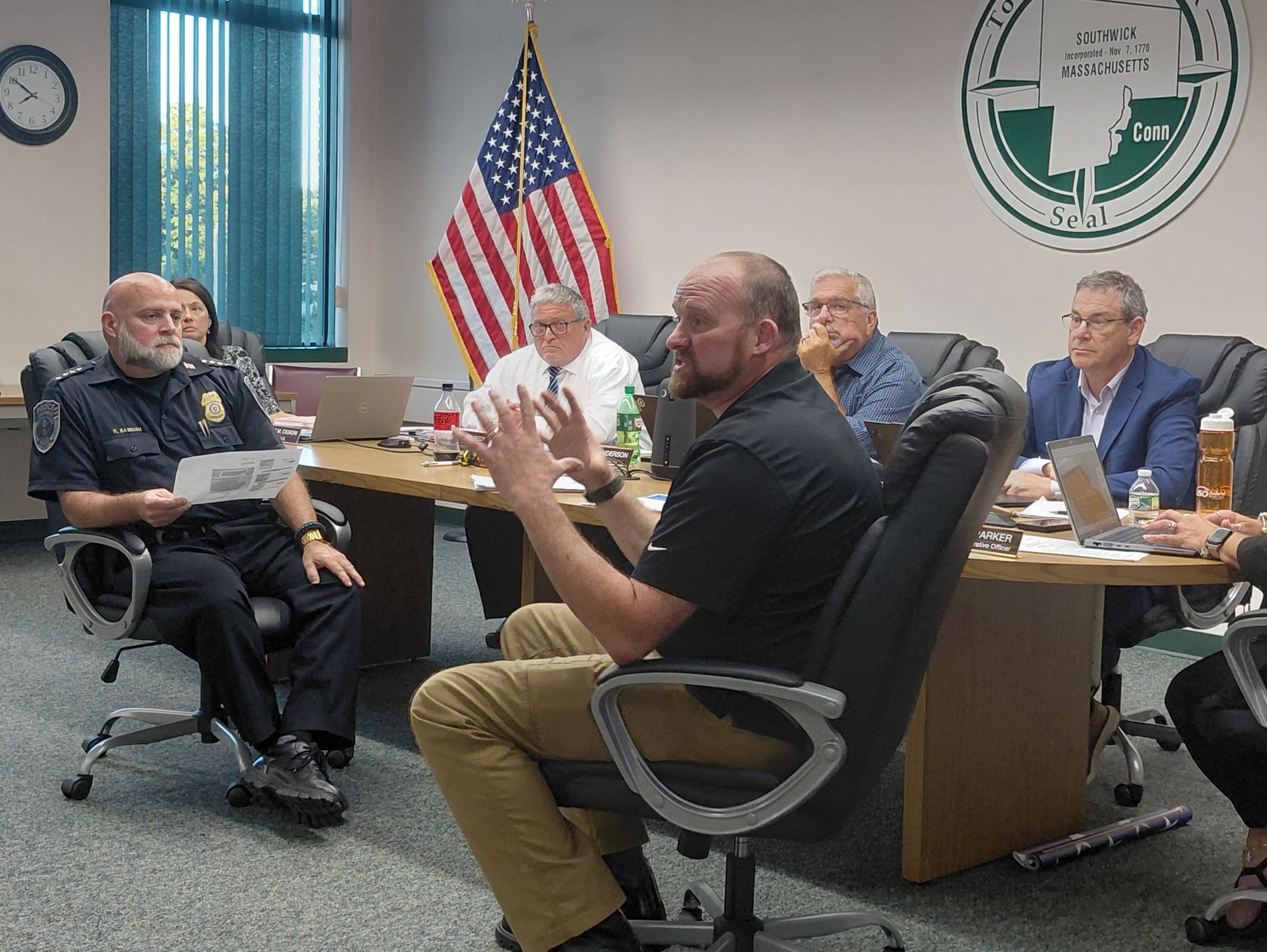
Police Sgt. Michael Westcott (center) attended the Southwick Select Board meeting with Police Chief Rhett Bannish on July 20 to explain how automatic license plate readers would be deployed in town.
Reminder Publishing photo by Cliff Clark
SOUTHWICK — At the Select Board’s meeting on July 20, David Methe perhaps summed up the tension between public safety and individual privacy as the board discussed the police department’s potential deployment of three automatic license plate readers in town.
“There’s no doubt in my mind that this would be a good tool for the police. My concern is that I just don’t want to live in a town where I feel I’m under constant surveillance,” Methe said when the board asked for public comments, which came after Police Chief Rhett Bannish and Sgt. Michael Westcott gave a presentation about the controversial cameras.
“And believe me, my car was stolen out of my driveway in Southwick. I know it would be a good tool for you, but I’ll take my chances on that. [I] feel like I can live in a nice, peaceful area without being watched by Big Brother,” Methe said.
Bannish and Westcott appeared before the board during its meeting to explain why they believed automated license plate readers — or ALPRs — would be important tools for locating stolen vehicles, finding missing people and assisting with investigations.
Their appearance and presentation marked the first step in drafting a policy regulating the use of the cameras in town.
Over the last several months, there has been a growing movement to remove the readers from the public square.
Those opposed to the state conducting mass surveillance have often taken matters into their own hands and destroyed the cameras. At least 90 communities across dozens of states, including the Connecticut towns of Windsor and Meriden, have cancelled or rejected contracts with Flock Safety, the primary supplier of the cameras, according to deflock.org.
However, recognizing the mounting issues with the Flock cameras and how the company shares its data, Bannish explained why the department chose to purchase ALPRs from Motorola earlier this year by using nearly $30,000 from an Edward Byrne Memorial Justice Assistance Grant.
“We looked at several different suppliers. We obviously looked at Flock, which is the one most of you have probably seen online,” Bannish said. “We also looked at Motorola, and after exploring each one of those groups, we decided to go with the Motorola cameras.”
Westcott explained why the department chose Motorola.
“Motorola gave us the most secure [system]. We own the data. We own the cameras. We can delete the data whenever we want. It’s set to automatically delete in 60 days. We can reduce that. We can expand it. So, that’s why we went with them,” Westcott said.
He said, without referring specifically to Flock Safety, other companies have problems.
With Flock Safety, according to the American Civil Liberties Union, when a license plate is read by a Flock ALPR, it is stored in the company’s cloud database and can be accessed by any law enforcement agency that has a contract with the company.
“That’s the other thing with Motorola and Flock. [With] Flock, everybody has access. That is not how the Motorola system works,” Westcott said.
“All the data comes directly to us. Motorola cannot access it … It’s ours,” he added.
In fact, if an officer in the Police Department wants to search the license plates scanned in Southwick within the 60 days before they are automatically deleted, dual authentication is needed, “so we know who logs in, we know when, and what they run,” Westcott said.
“For us to even search it, we have to have a case number, a reason, and it’s gotta be approved. So, we can’t just have …anybody on the street [that] can log in and say, ‘hey, I want to know where my girlfriend’s been every week?’ They can’t do it. It’s highly restricted. It’s protected information,” he said.
He said the policy that is being drafted will include language that calls for terminating an officer for violating it.
“We are trying to keep it very secure and regulated the best we can,” he said about the information gathered by the ALPRs.
Local municipalities can decide if records from Motorola cameras can be shared.
When and if the policy is adopted, Westcott said the department will share it with Westfield and with departments in Connecticut as needed.
He said the department can currently access the data collected by the nine ALPRs it has around the city, but Southwick will only access the data from the south side of the city.
The proposed policy can also include dictating the terms under which other departments use it.
“We also can write a policy saying, ‘hey, if you use our data, here’s the terms.’ And they have to agree to that before they can even look at our data,” Westcott said.
The department’s grant allowed it to buy the ALPRs and use five years of analytics and data.
Westcott said his goal, if a policy is adopted, is to apply for another grant for additional cameras if it’s decided they are a “great tool.”
However, “if we find out, ‘hey, this doesn’t work, it’s caused more headaches than it’s worth,’ then we can drop the program,” he said.
As they finished the presentation, Bannish said he thought the benefits outweighed the negatives.
Residents questioned the daily cost of operating the cameras.
Westcott said, which Select Board member Douglas Moglin confirmed, that the cameras are connected wirelessly to the network, so the department would use the town’s data plan.
“It’s a SIM card for the camera,” Moglin said.
Town resident Rachelle Randall said that many of her fears about the cameras were assuaged.
However, she was concerned about a surveillance system called SignalTrace, which is a controversial signal-intelligence and surveillance system developed by defense contractor Leonardo that upgrades ALPRs to track people and their smart devices. It captures ambient Bluetooth, Wi-Fi, and RFID signals from their phone, smartwatch, wireless headphones, and car systems to link passing vehicles with specific individuals.
“It raises a red flag, so I just want clarification — there is nothing in your contract that you’re sharing data with the company?” she asked.
Westcott said he would check on it, but was certain the data generated in town could only be shared with other departments that agreed to the town’s terms.
Bannish, responding to her concern, added that the type of surveillance sounded like a clear violation of the Fourth Amendment, which protects citizens from unreasonable government searches and seizures.
Before the presentation by Bannish and Westcott, Kimberly LaMarche made it clear to the Select Board that she was against installing the cameras.
The presentation changed her view.
“I came in very antagonistic because I felt violated, but you guys have eased my conscience a little. I’m glad we’ve had this talk,” she said.
However, Joanne LeBlanc was not swayed.
“I’m not a fan of this at all, and I’m not buying the sales pitch. I’m 100% in agreement with Mr. Methe. This town is not the same town we moved to. I don’t feel that it’s big enough to get involved with this,” she said.
Moglin said that after the Police Department drafts the policy, it will come before the Select Board for approval.
“I will make this commitment to you as the chair; when that policy is ready to come in front of the board, we will carry it as an agenda item, and we will take a vote up or down,” Moglin said.
Just before the discussion ended, Select Board member Joseph Deedy said he had one last thing to say: “I am not ready to give up the town’s liberties for this, personally.”