
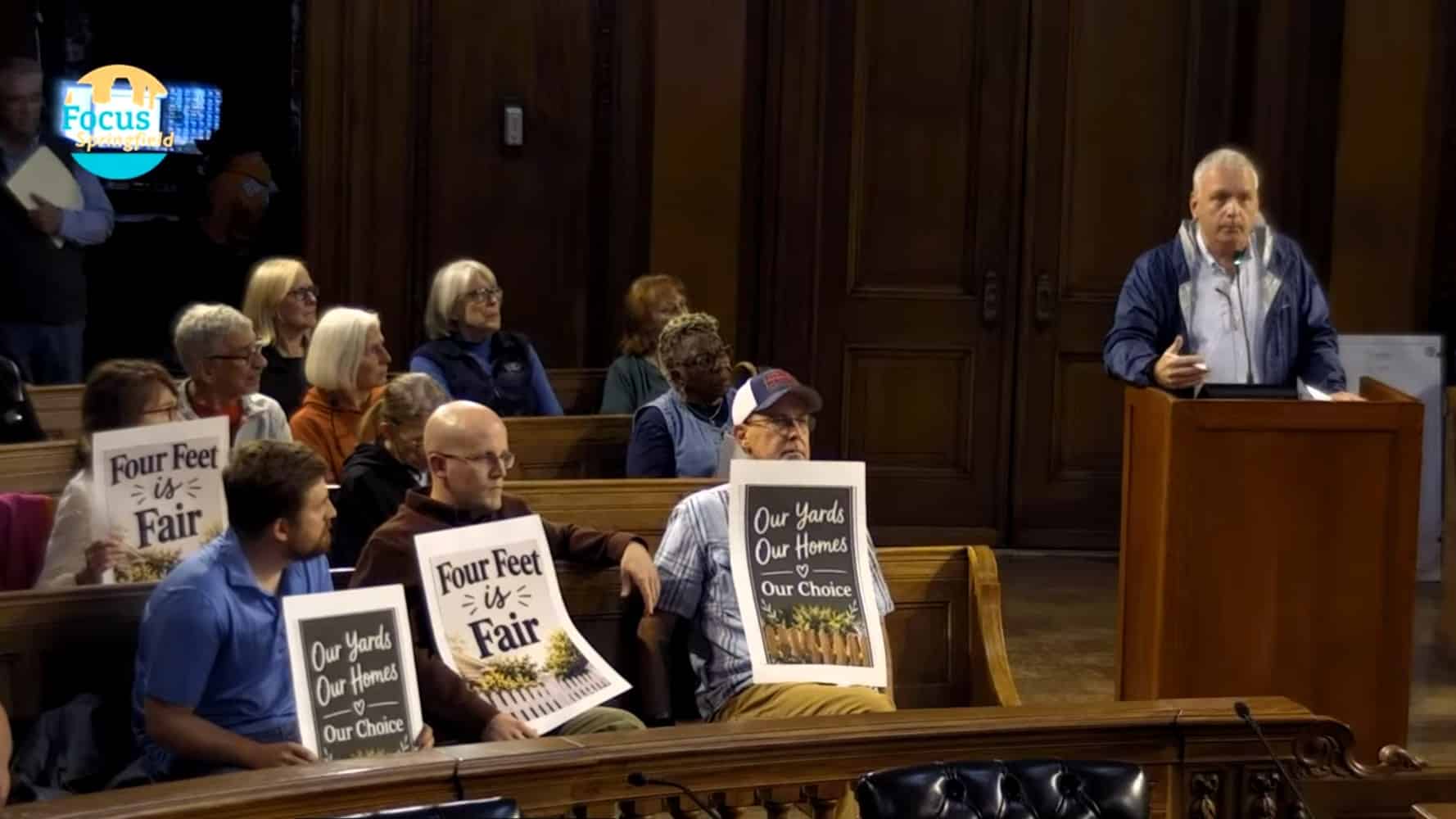
People at the Sept. 28 Springfield City Council meeting hold signs in support of front yard fences.
Photo credit: Focus Springfield
SPRINGFIELD — After two hours of public comments and debate, Springfield’s City Council voted to allow fences in front of homes in the Residence A and Residence A1 zones of the city — something that is already allowed in the Residence B and Residence C zones.
Many people spoke in favor of the change, holding signs that read “Our Yard, Our Homes, Our Choice” and “Four Feet is Fair” — a reference to the height of eligible fences in the proposal. However, not everyone was happy about the idea of fences in front of single-family homes.
The amendment allows fences up to 4 feet tall in front yards in Residence A and A1 zones, provided they are no more than 25% solid. Fences more than 25% solid must be no more than 3 feet in height.
Ward 7 Councilor Gerry Martin proposed the amendment, which eliminated language from 2013 prohibiting front yard fences in specific zones. He took issue with allowing some homeowners to put up fences while barring others from doing so unless they obtain a variance from the Zoning Board of Appeals.
“In practice, it is discriminatory,” Martin said. He also pointed out that Springfield and Longmeadow are the only municipalities in the area that prohibit front yard fences. “Ultimately, you should be able to do whatever you want with your property,” Martin said.
Adding to the issue is the cost associated with obtaining a variance, as much as $1,000. Even after paying the fee, there is no guarantee that the variance will be approved. Several councilors questioned the high price and wondered about reducing the fee. Philip Dromey, deputy director of planning, said the lion’s share of the cost is associated with newspaper advertisements informing residents of the petition so they may attend and speak for or against the variance. The city is required by law to advertise the variance hearing. Dromey said the ad price is set by the newspaper, he said.
During the public hearing, Patrick Sullivan said Springfield should be encouraging young families with children to move to the city, but the cost of the variance is a barrier.
Maria Midura built her fence in 2010 and is facing a $100 per day fine until she receives a variance or removes the fence. She said she needs the fence because her mother has dementia and wanders. Further, she said, an unleashed dog came into her yard and attacked her dog. Finally, she said she worries about street racing and is afraid a “car will come crashing through” her home without a fence to stop it. Another resident facing a $100 per day fine is Carlos Matos. He said his son is disabled and will elope from home. The fence is for his safety, Matos said.
Kelly Lareau wondered if residents know there is a reasonable accommodation exception to the fence issue and how to pursue it. She said it is the city’s responsibility to share information with the community. She also wanted an explanation as to why Residence A and Residence A1 zones wire excluded from the fence allowance.
For Tony Taylor, the issue was a simple one. He said, “I pay my taxes continuously. I should be able to do what I want.”
Meanwhile, multiple neighborhood associations spoke against the fences. Don Roberts, president of the Sixteen Acres Civic Association said his organization voted against the proposal as written. It was concerned that, where there are no sidewalks, a resident could put the fence at the edge of the street. Roberts said the civic association also felt 4 feet was too tall.
Kathleen Brown, of the East Springfield Neighborhood Council, said that the lack of specifications around fencing materials would result in people creating fences from pallets and pieces of metal. She said her group was worried about fences lowering property values and damaging the aesthetics of the neighborhood. Kathy Post, co-president of the Forest Park Civic Association shared similar fears.
During the rebuttal, a resident in the fencing industry said 3-foot fences are considered decorative and easy to climb. Four feet is the minimum height for a safety fence. To those who were worried about property values, he said he installs fences at homes in the area that are worth more than those in Springfield. He said he would be less bothered by property values and more concerned about a neighbor’s child or grandchild being hit by a vehicle.
Like many of the residents, councilors also shared concerns about safety. Ward 5 Councilor Lavar Click-Bruce recalled when his then-young son ran into the street as a child and was nearly hit. Ward 3 Councilor Melvin Edwards shared a story about his wife and dog being seriously injured when attacked by another dog that had entered his yard.
While Edwards said he was inclined to vote for the amendment, he acknowledged the concerns from residents and recommended sending the matter to committee to be worked on. “I don’t think it’s ready for primetime,” Edwards said of the proposal. A vote on the recommendation failed.
Aside from the safety issue, Ward 8 Councilor Zaida Govan said she was uncomfortable with the city having different standards depending on where the house was located. Historically, she said zoning has been used as a weapon of class discrimination and racism. While Govan recognized that the fence matter is not such an issue, she said it is important to consider that lens when discussing the zoning. Edwards agreed and commented that most of the pushback was coming from more affluent areas of the city.
Ward 4 Councilor Malo Brown and At Large Councilor Kateri Walsh each said they supported fences as a matter of safety for children, seniors, people with disabilities and pets. For Ward 2 Councilor Michael Fenton, there were credible arguments from both sides of the issue. He said he was uncomfortable with higher fences in the Residence A and A1 districts than the three-foot front fences allowed in Residence B and C. He tried to reduce the fence height in the proposal to three feet, but the other councilors balked because of safety concerns.
The vote was 10-1 to allow front yard fencing in the zones where it had been prohibited. Fenton was the only councilor to vote against the amendment.
