
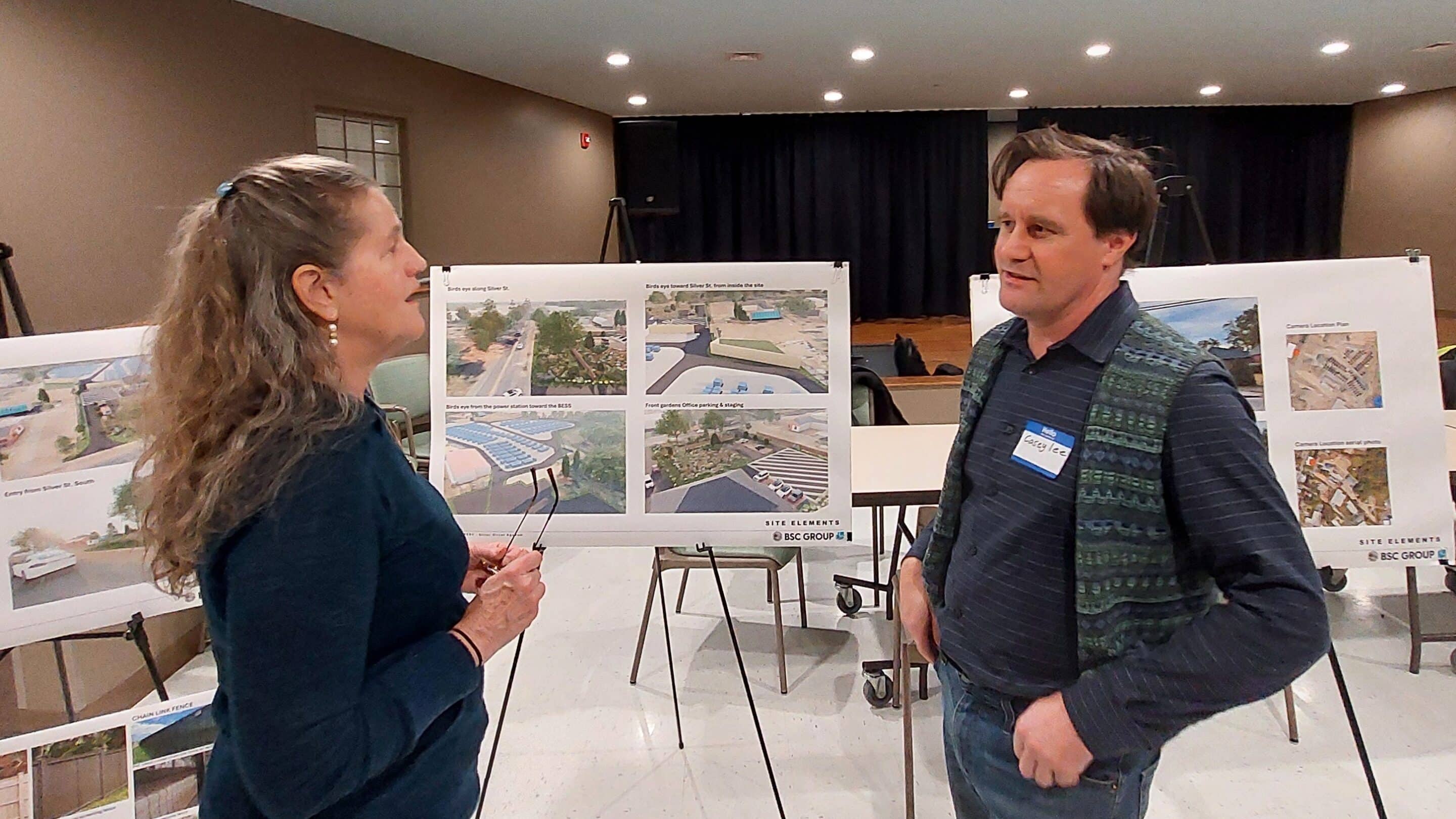
Caseylee Bastien of BSC Group answers a resident’s questions about the proposed battery energy storage site.
Reminder Publishing photo by Sarah Heinonen
AGAWAM — Agawam residents came to a set of presentations on the proposed Longroad Energy battery storage facility armed with questions and a fair amount of skepticism.
Each session at the Agawam Senior Center had more than 100 attendees, who reviewed the plans and asked questions of the Longroad team, as well as landscape architects BSC Group and fire safety consultant Ken Scanlon.
The battery units will occupy 8 acres of the 17-acre property at 769 Silver St. Each of the roughly 200 units contains lithium-iron-phosphate battery cells, wired into modules, similar to an electric car battery, and housed in a cabinet. The cabinets are connected to equipment that converts the DC energy to AC current. The energy will be fed into a substation on the property, near the property line, then travel a short way to the Eversource substation. The facility will produce 250 megawatts of electricity every four hours, enough to power 285,000 homes.
The project is still in its early stages, with construction not beginning until mid-2027. Chad Allen, director of development at Longroad Energy said the public will have multiple opportunities for input over the next year. Allen said the facility will provide Agawam with employment during construction and operation, revitalization of a vacant property and the tax revenue that comes with it and limited pressure on town services.
Allen emphasized that Longroad Energy’s model is to operate the sites it builds. This is a multi-hundreds of millions of dollars investment,” he said. Speaking to concerns about safety and abandoned equipment, he added that it is in the company’s best interest to maintain the facility.
Mayor Christopher Johnson took the microphone to address the crowd. “This project is coming whether you want it or don’t want it,” he said, explaining that the land is zoned for the use, and under state law, the city cannot block it or impose unreasonable restrictions. “This is part of a state plan to bring energy storage to Massachusetts,” he said. With the ever-increasing demand for electricity, Johnson said it would only be a matter of time before residents saw rolling blackouts, adding that he had been informed of that from the state Department of Energy Resources.
The company chose to follow the municipal permitting process, which Johnson called, “The strictest in the industry.” Agawam will benefit from a community-host agreement through this process, unlike the state permitting process. He added that the cost of the new high school will impact the tax rate at the same time the facility will begin generating tax revenue. Referring to Longroad Energy, Johnson said, “When they started knocking at the door two years ago, I had to do what I though was best for the town.”
Allen explained that the site, a former lumber yard, was chosen because it had previously been developed, was in the industrial zone and adjacent to an Eversource substation with the capacity to connect to the project. The proximity to the substation limits the infrastructure, and therefore the cost, needed to transmit the energy to the grid.
Allen said the project was pushed back as far from Silver Street as possible, while also maintaining the 100-foot buffer around the wetlands at the rear of the site. The existing building on the site will be used as an office. A solid fence and native vegetation will visually block the units from the street. Chain-link fence will encompass the remainder of the property.
The only non-permeable surface will be the access road that will loop the property, said Tom Hennigan, a member of the team. The units will be set on crushed stone. This will limit water runoff and, combined with surface gradings and a retention pond, will protect surrounding properties and the wetlands. A small portion of the property is classified as natural heritage land, as there is a population of endangered reptiles inhabiting the site. Melissa Kaplan of BSC Group said Longroad is working with the state to adhere to all restrictions.
Scanlon reviewed the safety of the units, the main concern for most residents. He explained that the units will have multiple safety features and adhere to the main national standards of safety for such facilities. Testing forced the units to fail at each stage of energy production to ensure the safety features were satisfactory. There will be an emergency response plan for first responders. Each cabinet will have its own audible and visual fire alarm, and employees will be on site to monitor them. Because an electric battery fire releases hydrogen, the cabinets will be fitted with a system to vent the gas, limiting the danger of explosion. The units are designed to contain any failures.
“The old ones didn’t have that,” Scanlon said, “The rest of the country got to learn from California’s mistakes.”
One resident asked, “Why should Boston tell us we have to have it?” Kaplan explained that rising energy demand is a “global issue” not limited to eastern Massachusetts, or even New England.

- Sarah Heinonen
- Sarah Heinonen
- Sarah Heinonen
- Sarah Heinonen
- Sarah Heinonen
- Sarah Heinonen
- Sarah Heinonen
- Sarah Heinonen
- Sarah Heinonen
- Sarah Heinonen
- Sarah Heinonen
- Sarah Heinonen
- Sarah Heinonen
- Sarah Heinonen
- Sarah Heinonen
- Sarah Heinonen
- Sarah Heinonen
- Sarah Heinonen
- Sarah Heinonen
- Sarah Heinonen
- Sarah Heinonen
- Sarah Heinonen
- Sarah Heinonen
- Sarah Heinonen
- Sarah Heinonen
- Sarah Heinonen
- Sarah Heinonen
- Sarah Heinonen
- Sarah Heinonen
- Sarah Heinonen
- Sarah Heinonen
- Sarah Heinonen
- Sarah Heinonen
- Sarah Heinonen
- Sarah Heinonen
- Sarah Heinonen
- Sarah Heinonen
- Sarah Heinonen
- Sarah Heinonen
- Sarah Heinonen
- Sarah Heinonen
- Sarah Heinonen
- Sarah Heinonen
- Sarah Heinonen
- Sarah Heinonen
- Sarah Heinonen
- Sarah Heinonen
- Sarah Heinonen
- Sarah Heinonen
- Sarah Heinonen
- Sarah Heinonen
- Sarah Heinonen
- Sarah Heinonen
- Sarah Heinonen
- Sarah Heinonen
- Sarah Heinonen
- Sarah Heinonen
- Sarah Heinonen
- Sarah Heinonen
- Sarah Heinonen
- Sarah Heinonen
- Sarah Heinonen
- Sarah Heinonen
- Sarah Heinonen
- Sarah Heinonen
- Sarah Heinonen
- Sarah Heinonen
- Sarah Heinonen
- Sarah Heinonen
- Sarah Heinonen
- Sarah Heinonen
- Sarah Heinonen
- Sarah Heinonen
- Sarah Heinonen
- Sarah Heinonen
- Sarah Heinonen
- Sarah Heinonen
- Sarah Heinonen
- Sarah Heinonen
- Sarah Heinonen
- Sarah Heinonen
- Sarah Heinonen
- Sarah Heinonen
- Sarah Heinonen
- Sarah Heinonen
- Sarah Heinonen
- Sarah Heinonen
- Sarah Heinonen
- Sarah Heinonen
- Sarah Heinonen
- Sarah Heinonen
- Sarah Heinonen
- Sarah Heinonen
- Sarah Heinonen
- Sarah Heinonen
- Sarah Heinonen
- Sarah Heinonen
- Sarah Heinonen
- Sarah Heinonen
- Sarah Heinonen
- Sarah Heinonen
- Sarah Heinonen
- Sarah Heinonen
- Sarah Heinonen
- Sarah Heinonen
- Sarah Heinonen
- Sarah Heinonen
- Sarah Heinonen
- Sarah Heinonen
- Sarah Heinonen
- Sarah Heinonen
- Sarah Heinonen
- Sarah Heinonen
- Sarah Heinonen
- Sarah Heinonen
- Sarah Heinonen
- Sarah Heinonen
- Sarah Heinonen
- Sarah Heinonen
- Sarah Heinonen
- Sarah Heinonen
- Sarah Heinonen
- Sarah Heinonen
- Sarah Heinonen
- Sarah Heinonen
- Sarah Heinonen
- Sarah Heinonen
- Sarah Heinonen
- Sarah Heinonen
- Sarah Heinonen
- Sarah Heinonen
- Sarah Heinonen
- Sarah Heinonen
- Sarah Heinonen
- Sarah Heinonen
- Sarah Heinonen
- Sarah Heinonen
- Sarah Heinonen
- Sarah Heinonen
- Sarah Heinonen
- Sarah Heinonen
- Sarah Heinonen
- Sarah Heinonen
- Sarah Heinonen
- Sarah Heinonen
- Sarah Heinonen
- Sarah Heinonen
- Sarah Heinonen
- Sarah Heinonen
- Sarah Heinonen
- Sarah Heinonen
- Sarah Heinonen
- Sarah Heinonen
- Sarah Heinonen