
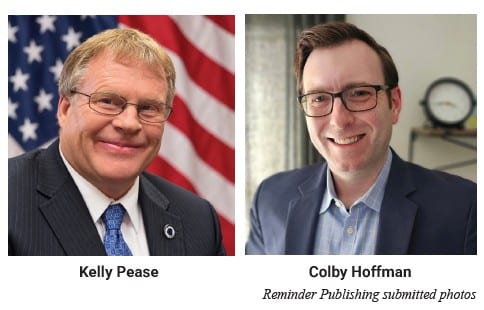
WESTFIELD — The Nov. 3 general election is just days away, so candidates are wrapping up their campaigns and preparing for a long day at the polls.
One of the major contests in our region is for the 4th Hampden District state representative seat, which covers Southampton and most of Westfield
Republican incumbent Kelly Pease, who first won the seat in 2021, is seeking his fourth term. He will face a Democratic challenger in Colby Hoffman, a seven-year Westfield resident who currently works as a customer service specialist for a regional supermarket in the city.
In preparation for their faceoff, Reminder Publishing asked each candidate the same questions. Their answers are below, and the names are listed alphabetically.
Reminder Publishing: Please say a few words about yourself and why you are running for state representative in the 4th Hampden District.
Hoffman: I am running for office because ordinary Americans are struggling through an affordability crisis while the rich continue to get richer. We need a strong state government with accountable, working-class lawmakers like myself who will fight to make life more affordable for all Massachusetts families and will pass laws to protect our communities from dangerous advances in technology.
Pease: It is a privilege to represent Westfield and Southampton. I have never missed a vote on the House Floor, and I show up for committee hearings. I would be honored to continue serving you on Beacon Hill to advocate for funding for Schools, roads, our seniors, and safe drinking water.
RP: With new growth at a low point locally and statewide, what type of business development do you think would most benefit Westfield and Southampton?
Hoffman: Westfield and Southampton are unique communities where a one-size-fits-all approach will not be successful. We must seek out business development that will protect our water aquifer and keep our municipal electricity affordable for the average individual, family and small business. Hyperscale AI data centers would NOT fit this criteria and should not be built in this district. Instead, we should seek out more small businesses such as retail, service industries, and restaurants to fill empty storefronts in downtown Westfield, as well as small- to medium-sized precision manufacturing facilities that utilize our educated workforce and transportation infrastructure.
Pease: Unfortunately, it continues to get harder to attract new businesses. Massachusetts is ranked among the worst states for affordability, and I will continue to advocate for more local aid from the state house to help our communities. Westfield and Southampton are in a unique position to be more affordable than other parts of the state, and we sit in a great location near the Mass Pike and I-91 corridor. As for the types of businesses that would be preferred, I don’t think there is any one type of business, more manufacturing is always good, but so is restaurants, medical facilities, and a few others. You never know what kind of business would like to call our district home, or how they might impact our communities. Westfield and Southampton do a great job of putting out the welcome mat but also making sure it is what our community wants or needs.
RP: Many Western Mass. communities sought Proposition 2 ½ overrides this past year due to rising costs, especially impacting public education. What do you think is the answer to adequately funding schools without overly burdening communities?
Hoffman: I proudly attended public schools growing up, so I understand how important it is to keep these institutions funded and thriving. These rising costs for local budgets have been devastating and the resulting Prop 2 1/2 overrides have been divisive and not often successful. My answer is that I support the legislature reviewing the Chapter 70 (education funding) formula to make it more equitable to Western Mass. communities like ours that are often afterthoughts on Beacon Hill. I also believe we can push for more state and local funding for education requirements such as transportation, which would help the budget situation in general. The Fair Share Amendment (millionaire’s tax) has been funding education priorities since being passed by voters in 2022. Western Mass districts like ours deserve a greater share of this funding source and I will fight to secure it.
Pease: I believe and will continue to fight and advocate for more local funding from the State. What the state provides cities and towns as a percentage of their budget has continued to decrease over the last two decades. Not just in Western Mass, but throughout the Commonwealth, more cities and towns put 2 ½ overrides forward for a vote. Most votes were just to maintain their current funding for schools, roads, and other infrastructure improvements. With reduced money from the state and increase cost of healthcare, and energy, cities and towns can’t keep up under Proposition 2 ½. The state must do a better job of prioritizing local communities in the state budget, to help local communities from having to raise our property taxes. I will continue to submit and support legislation that adequately funds our cities and towns.
RP: Housing is becoming out of reach for many families due to rising costs and lack of availability. What do you think are the best solutions to the housing crisis?
Hoffman: My wife and I spent years saving every last penny before we purchased our wonderful home in Westfield in 2019. This was made possible through the assistance of the Mass Housing Agency and their First-Time Homebuyer Down Payment Assistance Program. We need to protect and expand these vital programs that help residents of modest financial means to obtain an affordable mortgage and to build equity. Massachusetts must also move forward with building new housing stock, including tiny homes as well as to allow localities to ease their zoning rules for smaller home lots. This is why I support Yes on Question 7 which would provide more flexibility to builders to build smaller homes on smaller lots. Until a form of rent control is passed in this state, we need to expand housing opportunities so fewer residents are at the mercy of greedy landlords who raise rents unfairly and treat their tenants like piggy banks.
Pease: Housing affordability is a major issue in our state, and we need to do a better job of making Massachusetts more affordable. I would begin by looking at the regulations that have been imposed over the last few years. A lot of the requirements have had a huge impact on the cost of building homes. I believe that some of those regulations have gone too far, and eliminating those requirements would help with the cost of housing. Another affordability issue is the cost of energy. Massachusetts has one of the highest energy costs in the country, and I would look at reducing the surtax on energy bills that drive up the cost of living. There are things we can do, but I would begin by looking at what we can control and that is regulations and additional taxes that impact for everyone.
RP: Any closing thoughts?
Hoffman: Massachusetts is the greatest state in the country yet we have been treated very unfairly by a current administration that despises our decency and envies our achievements. If elected, I will fight for the values of freedom, opportunity and security for everyone in our commonwealth, not just the rich and powerful.
Pease: I would like to thank the people of Westfield and Southampton for trusting me to represent you at the State House. It is an honor and privilege, and I ask for your vote so I can continue to fight for common sense on Beacon Hill. Thank you.