
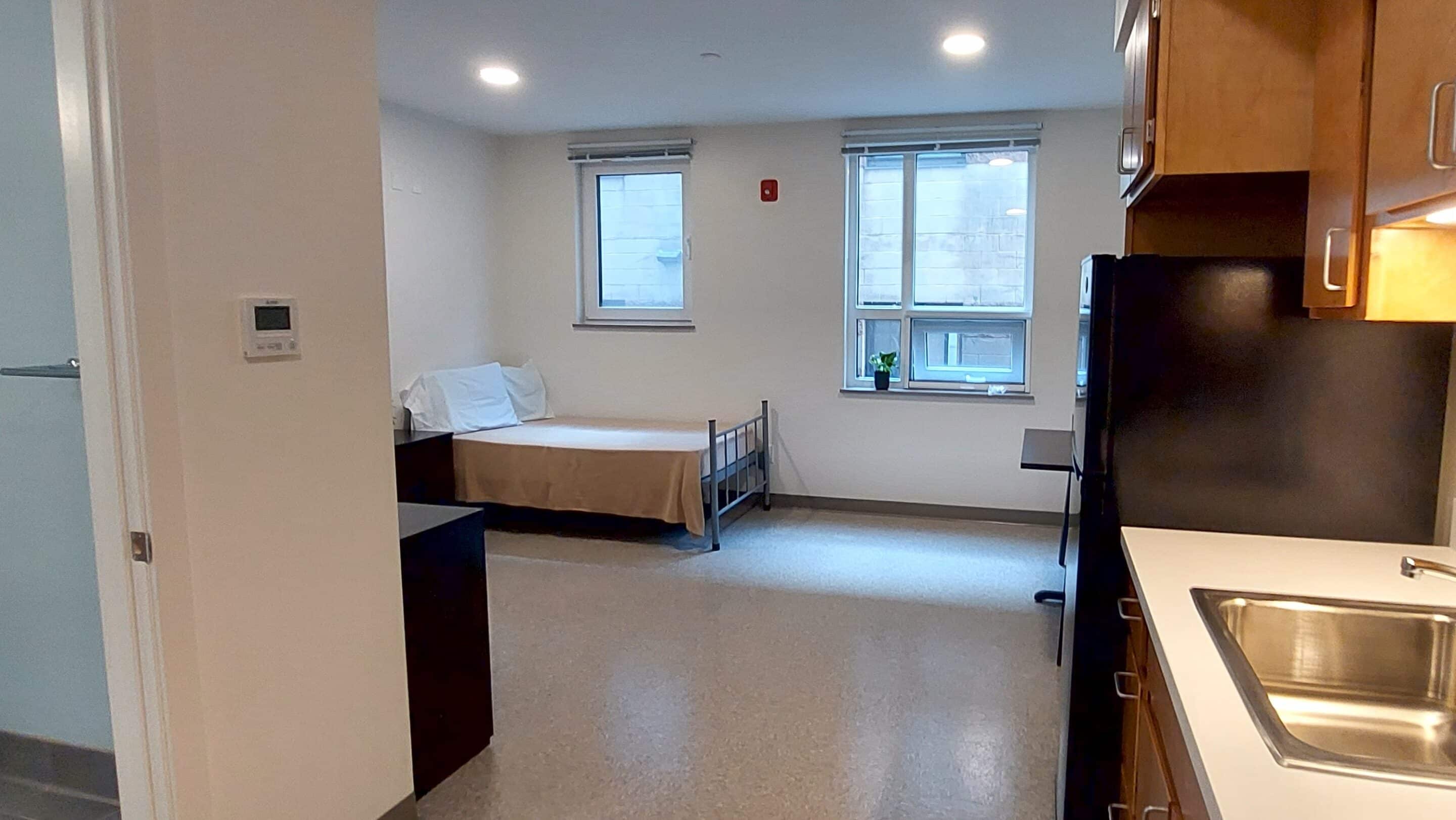
An apartment at the new permanent supportive housing building operated by Clinical & Support Options, Inc. on Worthington Street.
Reminder Publishing photo by Sarah Heinonen
SPRINGFIELD — Thirty-six people who have not had a stable place to call home will soon move into an apartment of their own in a new building owned and operated by Clinical & Support Options, Inc.
The property at 775 Worthington St., directly next door to CSO’s Friends of the Homeless shelter program, is permanent supportive housing. The building’s units are reserved for chronically unhoused people, defined by the federal Department of Housing and Urban Development as an individual with a disability who has been homeless for at least 12 months or on at least four separate occasions in the last three years, or a family who meets all of the criteria of this definition, including a family whose composition has fluctuated while the head of household has been homeless. The individuals meeting these criteria were identified by Springfield-Hampden Continuum of Care, a multi-agency partnership that works to fund homelessness service providers.
The units are covered by the federal Housing Choice Voucher Program, commonly known as Section 8, which pays housing costs beyond 30% of a person’s income. The vouchers were provided by the Springfield Housing Authority. Despite operating 110 other permanent supportive housing units on Worthington Street, there is a waiting list for the new building.
The purchase price for the property, the former site of The Fifth Alarm Lounge, an adult entertainment venue, was $336,345 and the construction costs totaled about $20 million. Funding for the projects came from multiple sources, including federal low-income tax credits, the state Executive Office of Housing and Livable Communities, the city of Springfield, Community Economic Development Corporation, Massachusetts Housing & Shelter Alliance, Stratford Capital Group and TD Bank.
U.S. Rep. Richard Neal said he was “immensely proud” of the lower income tax credit, which he helped create and save from cuts. He said the credits fill gaps in funding projects. He also pointed out that the city contributed funding from the American Rescue Plan Act, which Neal penned with then-Speaker of the House Nancy Pelosi.
Addressing the CSO team, Mayor Domenic Sarno said, “You see people at the worst possible times of their lives, and you bring them hope.” He said everyone knows people who have struggled. “But because of your efforts you’re able to help them get back on their feet.” Sarno also praised the assistance on the project by members of his administration, including Chief Development Officer Tim Sheehan, Housing Director Gerry McCafferty and Commissioner of the Department of Health and Human Services Helen Caulton-Harris.
The project, designed by Jones Whitsett Architects and constructed by Western Builders, took about 16 months to complete. Each of the 36 units contains a bed, dresser, small kitchen table and chairs, a kitchen with appliances and a full bathroom. Some of the units are accessible with lower countertops and appliances.
CSO President and CEO Karin Jeffers said CSO recently opened a similarly sized permanent supportive housing building in Greenfield. “For 72 individuals across both developments, this represents something that many of us take for granted, a front door of our own, a key in your pocket … and a new beginning with the peace of knowing they have a place to come home to every single night,” Jeffers said. She said stable housing and wrap-around supports have been shown to contribute to better physical and behavioral health, fewer hospitalizations, closer connections with family and increased employment.
Referring to the tenants, Jeffers said, “They’re here permanently, as long as they want to stay.” The tenants are not required to meet any other criteria. CSO provides wrap around services, including a case manager, resources for substance use disorder and other mental health issues or physical disabilities. While the tenants do not have to make use of them, Jeffers said, “We find that more people do.”
Neal said, “There are fewer issues that are more complicated than housing… We’ve tried many experiments in America for the better part of the last 75 years. Some of it worked, some of it didn’t.” He described CSO’s permanent supportive housing as a “trampoline effect. The people that find themselves down can hit the trampoline and they find themselves on the way back up.” He added, “Thanks from America.”
