
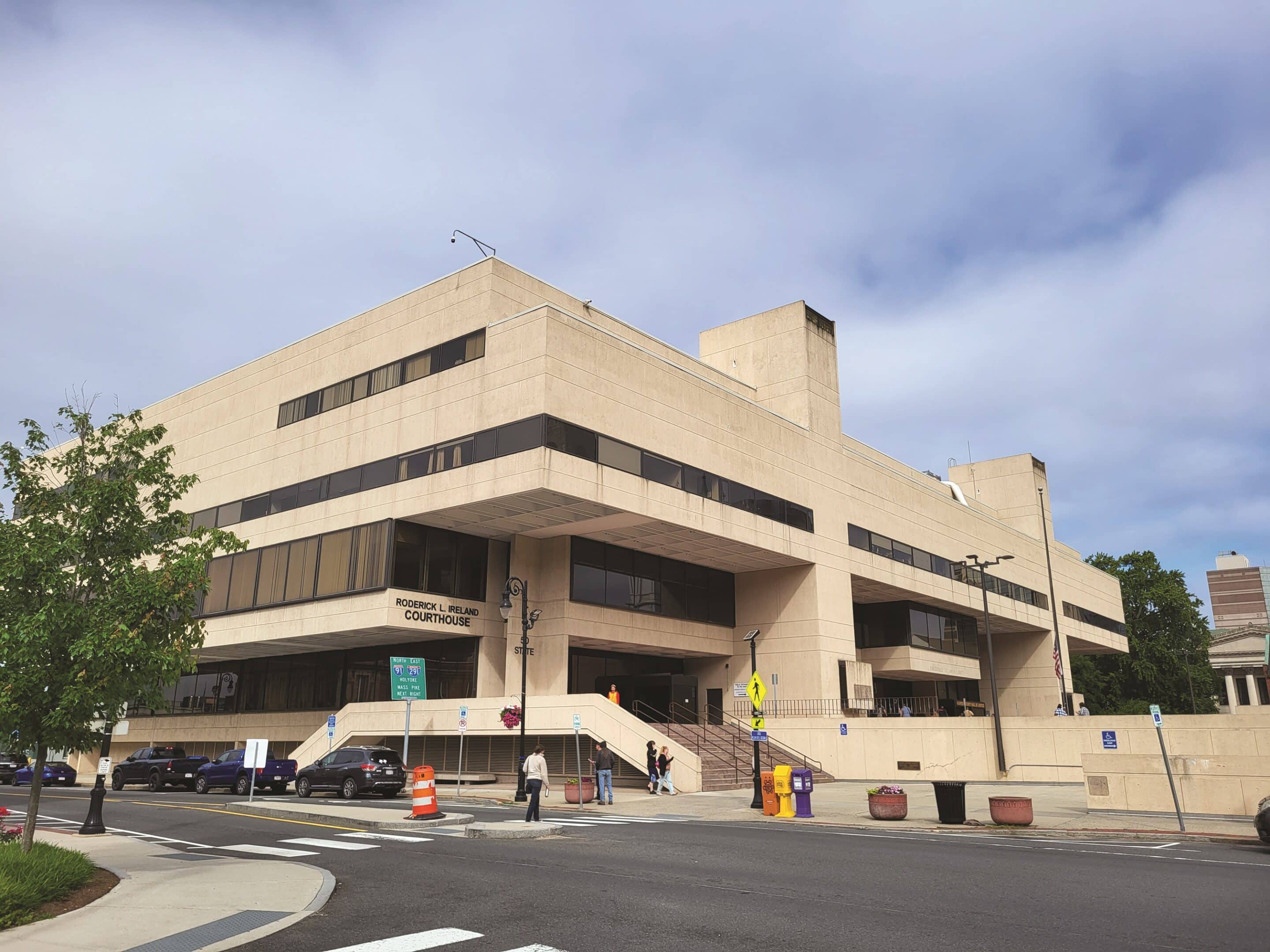
The Roderick L. Ireland Courthouse.
Reminder Publishing file photo
SPRINGFIELD — In a ruling by Superior Court Judge David Hodge on Aug. 24, developers Jeb Balise and Dinesh Patel were denied a temporary restraining order and preliminary injunction in the Liberty Junction courthouse case.
On July 2, the state’s Division of Capital Asset Management and Maintenance announced the selection of the Liberty Junction Team to replace the aging Roderick L. Ireland Courthouse with a new regional justice center at 125 Liberty St.
The $600 million project calls for a six-story, L-shaped building located in close proximity to Union Station and Interstate 291. To accomplish this, the currently vacant Liberty Medical Arts Building will be demolished, and the new building will be erected across that demolished building, a 2.2-acre piece of property on Frank B. Murray Street.
On July 9, Balise and Patel, owners of the competing projects USPB JV, LLC and Springfield Tower Square, LLC, filed a joint lawsuit against the Massachusetts Division of Capital Asset Management and Maintenance and the owners of the Developer FDS MA Liberty Junction LLC project, citing a potential conflict of interest.
At the preliminary injunction hearing on Aug. 11, John Butts, attorney for the plaintiffs, argued that the primary issue with the selection is that one of the company’s four partners, John Barros, had a conflict of interest because he is the interim executive director of the Massachusetts Convention Center Authority, a governmental agency.
In the denial, Hodge explained that when determining whether to issue a preliminary injunction, Balise and Patel would not suffer irreparable harm if they were denied.
“If they were to prevail at trial in this case, they could recover a monetary judgment for the amount of their lost profits,” he wrote.
However, he said that while Liberty Junction would suffer similar harm to Balise and Patel, potential harm to DCAMM would go beyond monetary damages.
“[DCAMM Director of Leasing Deborah] Russell states in her affidavit that if DCAMM is barred from entering a lease agreement, it will harm DCAMM and the Trial Court because DCAMM has devoted significant time and resources to this procurement, including hiring third-party architects to work with the selection committee and with Liberty Junction, and that those will have been wasted if DCAMM cannot complete its negotiations and execute a lease agreement with Liberty Junction,” he wrote.
In her affidavit, Russell said without the injunction DCAMM could proceed with negotiations with Liberty Junction and select another developer if there are any “insurmountable obstacles to lease execution.” However, it would not be able to if there were a delay in negotiations.
Hodge added, “This is a crucial time in the procurement process, and the target occupancy for the new courthouse is as soon as possible.”
Reviewing the potential damages, Hodge said they would not be in the plaintiffs’ favor.
“The balance between these risks plainly does not cut in favor of the plaintiffs. As a result, issuance of the preliminary injunction would be improper,” he wrote.
Hodge added that delaying the courthouse development would harm the public interest.
“The longstanding, serious problems with the current courthouse in Springfield are well known. Enjoining the defendants from proceeding with these negotiations would harm the public interest by delaying an already protracted process required for the Commonwealth to build, as expeditiously as possible, a sorely needed new courthouse in Springfield,” he wrote.
Hodge wrote that evidence left no doubt that the plaintiffs have not met the burden for seeking injunctive relief.
“The conclusion that granting the injunctive relief would not promote the public interest, but would adversely affect it, when viewed with the other considerations weighing against injunctive relief, leave no doubt that the plaintiffs have not met their burden in seeking injunctive relief,” Hodge wrote.
In a statement after the denial, representatives from Liberty Junction said they were “deeply appreciative of the Court’s decision” and added that the lawsuit was baseless.
They said that support from Attorney General Andrea Campbell and the Superior Court was enough evidence that the project should continue.
“The Massachusetts Attorney General showed that the Liberty Junction proposal will save taxpayers $420 million. The proposal also includes a building that the Trial Court and DCAMM consider to be exceptional for serving the court’s needs. The Superior Court agreeing should reassure taxpayers, and everyone committed to a fair process that the right decision has been made,” the statement read.
The developers also said in the statement that the project is long overdue.
“Many lives of the good people who work in the current building, now and in the past, and their families have been negatively affected by a sick building that should have been remedied years ago,” the statement read. “We are committed to providing the Court and the people of Hampden County with the courthouse they need and deserve.”
Despite the denial, Balise and Patel reaffirmed in a statement after the ruling that they would appeal the decision. According to the statement, Balise and Patel began issuing subpoenas seeking documents and testimony about the selection process.
“The people of Springfield deserve a full airing of the facts and circumstances surrounding this procurement, and they deserve a process that is fair, complete, and complies with the law. We remain fully committed to that goal. Our confidence is complete, and our commitment to this community is unwavering, which is why we will continue to pursue every available legal avenue, completely and without hesitation,” Balise and Patel said.
In a statement released after the ruling, Mayor Domenic Sarno said he still had concerns about the Liberty Junction project.
“As the state contemplates spending $2 billion+ for a new Hampden County Courthouse, my number one concern is for the taxpayers of Springfield and the state of Massachusetts. An argument has been presented that the Liberty Junction is not the cheapest proposal. This issue deserves a thorough vetting,” he said.
Sarno also highlighted concerns from some officials who will have offices in the new courthouse.
“District Attorney Anthony Gulluni, Register of Probate Rosemary Saccomani, Registry of Deeds Cheryl Coakley Rivera and Clerk of Courts Attorney Laura Gentile, whose offices and staff will be housed in the proposed courthouse, work each day in this facility serving the some 1600 people who visit the courthouse daily. They are all publicly opposed to the Liberty Junction proposal,” he said.
Reflecting on prior conversations with DCAMM Commissioner Adam Baacke, who Sarno said wanted the courthouse to be a transformative project for the city and area, he said this project is not in the city’s best interest.
“As I have stated previously, Boston should not be dictating what is in the best interest of Springfield. This is another example of Boston power brokers working in their own best interest,” he said.
