
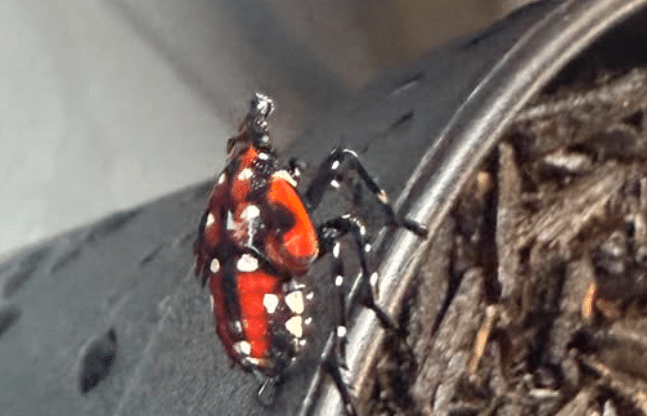
Spotted lanternflies have been spotted in 29 Western Massachuetts municipalities and 13 Hampden County municipalities.
Photo credit: Henry Lanouette
LONGMEADOW — Longmeadow Tree Warden Leah Wallner is providing tips on what to do when seeing a spotted lanternfly, which has been found across 50 Massachusetts municipalities, including Longmeadow, East Longmeadow, Wilbraham, Hampden and Springfield.
The spotted lanternfly is an invasive species that harms the fruit and forest industries by feeding on a variety of plants and leaving behind a sap called honeydew. Honeydew attracts other insects and promotes the growth of plant-damaging sooty mold.
Sooty mold stresses trees and leaves them vulnerable to other diseases and pests while disrupting photosynthesis, stunting tree growth and health.
The insect made its way into the United States from Asia around 2014 in a shipment of gravel, becoming an invasive species by 2022. It has been spotted in 19 states and Washington D.C.
The lanternfly’s preferred food source is the tree-of-heaven. It can also go after grapevines, black walnut trees, apple trees and other fruit crops and woody plants.
“One thing that makes these bugs so successful is that they are not picky about what they eat,” Wallner said. “They are sap-sucking insects that feed on over 100 of our local plants. Deterring them is difficult, although removing their favorite food sources – grape, tree-of-heaven and black walnut trees – from properties could be a good start.”
They do not bite or sting humans, pets or other animals since their mouths are straw-like to drink sap. They also do not infest homes and are not able to kill large, healthy trees.
Wallner said the species has minimal natural predators, reproduces quickly and is able to outcompete native species – making them invasive as opposed to non-native. She said Longmeadow first saw the insect in 2024.
“Since then, their populations have skyrocketed,” Wallner said. “They’re wonderful hitchhikers, traveling on cars, shipments, etc., and also reproduce very quickly, which would explain why we’re seeing more and more as years go on.”
She said there are a few options for managing the spotted lanternfly, but eradication efforts will be no small feat.
“Some options for mechanical removal can include sticky traps or vacuuming up clusters and allowing them to pass away in the vacuum bag,” Wallner said. “Some pesticides can also be effective, however, limiting those to only impact spotted lanternflies is difficult, and application should only be completed by a Massachusetts Licensed Pesticide Applicator.”
Wallner added that squishing the bug can help for individual sightings, but is not very effective with larger populations. Those who have come into contact with the insect report effective uses of warm, soapy water or hand sanitizer.
“Thankfully, getting up close and personal with them doesn’t come with many risks as they don’t sting or bite humans, and have not been known to swarm or target humans,” Wallner said. “Instructions for constructing homemade traps can be found on the Massachusetts Department of Agricultural Resources’ website. Ultimately, studies for management are ongoing and we may learn new methods for control over time.”
For more information about the spotted lanternfly, visit mass.gov/spotted-lanternfly.
Massachusetts residents are also asked to report any sightings with a photo at massnrc.org/pests/slfreport.aspx.