
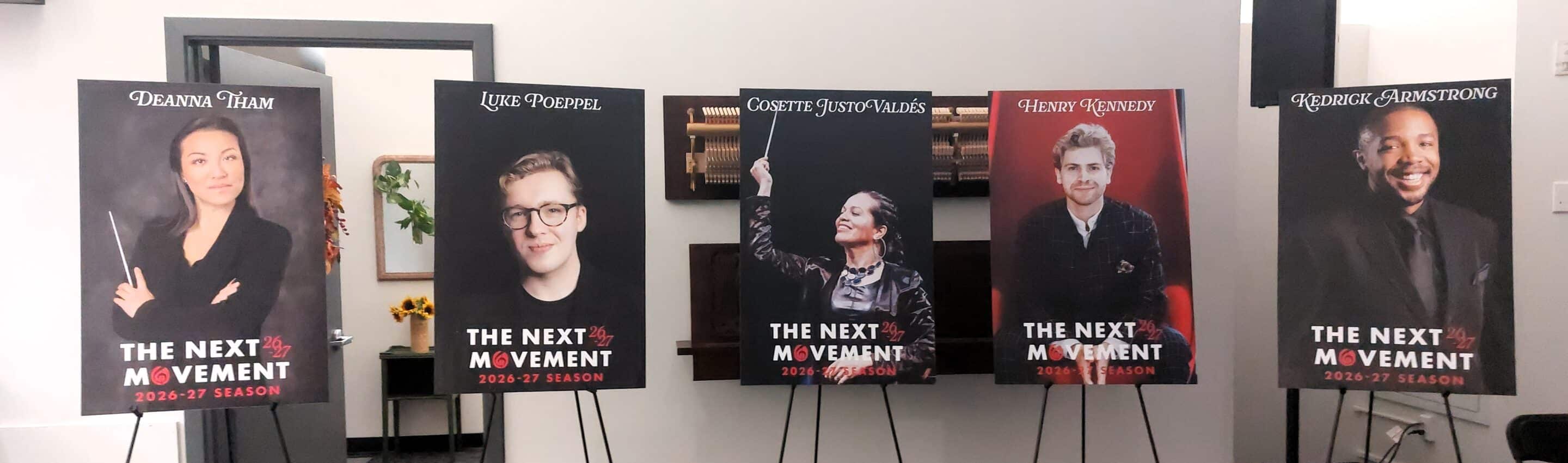
Headshots of the five finalists for the Springfield Symphony Orchestra’s music director.
Reminder Publishing photo by Sarah Heinonen
SPRINGFIELD — Five musical professionals have been selected as the finalists for the music director position with the Springfield Symphony Orchestra. Now, they will each have an opportunity to introduce themselves to the orchestra’s musicians and the community in week-long residencies throughout the 2026-27 season.
The SSO, the largest professional orchestra in the state outside of Boston and the only one in Western Massachusetts, has been without a music director for five years. SSO President and CEO Heather Caisse-Roberts said the symphony has needed to fill the position but was missing a strategy to move forward. Now, she said, “We’re in a different place. I think there’s a renewed energy and enthusiasm for what this could be.” She added, “I’ll be honest; I heard the musicians loud and clear. They’re ready. This is what we need to do to keep this here.”
Reflecting on the time that the SSO has played with a series of guest conductors, Thomas Bergeron, the SSO’s principal trumpeter, said it was akin to the New England Patriots playing every game with a different head coach. He said that when orchestra musicians get to know a conductor, their sound and expression grow from week to week.
Bergeron said, “Professional orchestra musicians are fundamentally professional collaborators.” While all the finalists are accomplished conductors, he said, “As we work with each of them in person this upcoming season we’ll be looking really for skilled collaborators above everything else.”
The search began in January 2025 with a committee meeting with musicians and stakeholders and developing a job description. In November of that year, the SSO launched an application. In total, 165 orchestral professionals responded. After several rounds, the applicants were winnowed to 15 candidates and eventually narrowed down the finalists.
The finalists include Kedrick Armstrong, the music director of the Oakland Symphony. In his time in Oakland, the symphony there has worked to elevate the voices of Black composers with the program “Blacknificent 7.” Armstrong has worked on the music staff of several opera houses and symphonies around the country and was the music mentor and supervisor for “EmpowerYouth! Igniting Creativity Through the Arts,” a program from the Lyric Opera of Chicago and the Chicago Urban League.
Deanna Tham is the music director of the Redlands Symphony. Previously, she was an associate conductor with the Oregon Symphony, Omaha Symphony and Jacksonville Symphony. In 2024, she was a semi-finalist in the prestigious La Maestra Conducting Competition in Paris, France. Tham is passionate about cross-genre collaborations and is a staunch advocate of music education.
An American German conductor and pianist, Luke Poeppel is the ensemble conductor for the Ryan Opera Center at the Lyric Opera of Chicago. He previously led nearly 30 concerts as the assistant conductor for the Kansas City Symphony. Poeppel’s background also includes opera and his work leading the orchestra was featured in The New York Times’ Best Classical Performances of 2025.
Henry Kennedy is a British Canadian conductor and the resident conductor of Canada’s National Arts Centre Orchestra in Ottawa. He held a similar position with Poland’s Wrocław Opera. In 2025, Canada’s public broadcaster ranked Kennedy among “30 Under 30” notable Canadian classical musicians. He has conducted across Europe, from Belgium to France and Germany.
A Cuban-born conductor living in Canada, Cosette Justo Valdés recently finished her tenure as artistic director and music director of the Vancouver Island Symphony in Nanaimo, British Columbia. In her time there, she programmed works of women composers and composers from Native Canadian and American heritage. She is also an advocate of bringing artists from other creative worlds into symphonic concert halls.
Caisse-Roberts noted that the international locations of some of the finalists may be a consideration, if obtaining a visa becomes an issue. “We’re not requiring anyone to move here for the position. It’s something that we’re hoping, that as they get more settled in with the orchestra, that they will make Springfield either their first or second home,” she said. However, she explained, “Conductors these days are all traveling a lot, so many of them sort of have like a home base, but not really a home, if you will.”
As part of the residency, the finalists will be interviewed by a wide range of radio and TV stations, attend meet-and-greet events and spend time with the musicians, all the while preparing for their performance. Armstrong conducted a concert in April of the SSO’s 2025-26 season. The media blitz and publicity opportunities he participated in to promote that concert shaped the residencies that each other the other finalists will participate in.
“We really put him through the wringer because he was the first one,” said Caisse-Roberts. At the time, Armstrong, the search committee and orchestra knew he was a finalist, although it was not made public because some of the remaining finalists had yet to be chosen.
“These individuals all — in their programming details they sent to us, in their essays they wrote to us — really hit what we also believe a music director should be,” Caisse-Roberts said. “And that was the most important thing for us. We’re looking for something very specific.”
