
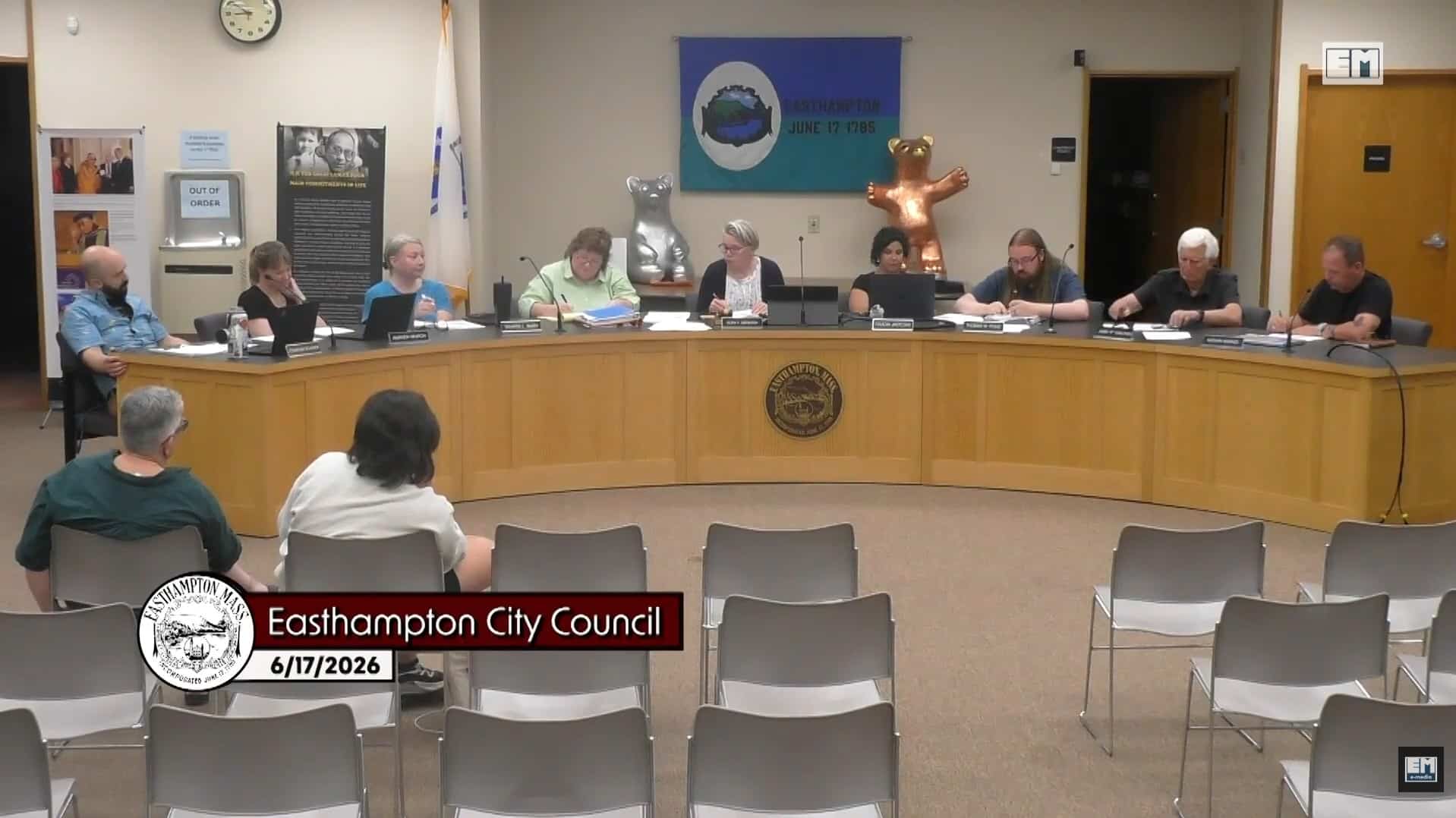
During its June 17 meeting, the Easthampton City Council adopted two state programs to help vulnerable populations, including seniors, amidst rising property taxes.
Photo credit: E-Media
EASTHAMPTON — A little over a week after Easthampton voters decided to adopt a $6.9 million override, the City Council passed two action items that aim to alleviate some of the burdens Easthampton residents face when property taxes eventually rise.
During its June 17 meeting, the council established a “Neighbor in Need” fund by adopting Massachusetts General Law Chapter 60 Section 3D. According to Dan Zdonek, the chair of the Board of Assessors, the state statute allows taxpayers in the city the option to donate a dollar or more on their tax bill to a property tax fund. Once that fund reaches a specific threshold, the city’s most vulnerable residents could apply for the chance to offset the cost of their tax bills by using the money from that fund.
Zdonek said that a committee consisting of him, the city’s treasurer, and three residents appointed by the mayor and approved by the council, will review applications and determine which residents qualify for this relief.
“The amount would be taken out of the cash that we have in hand in the account, and it would go as a payment on [residents’] actual tax bills,” Zdonek said of the fund, which was first presented by Mayor Salem Derby and approved by the council in a unanimous vote.
“Hopefully, this is an opportunity to help some individuals navigate the financial situation they may find themselves in,” City Council President Koni Denham said.
The other order that passed, which yielded a lengthier discussion amongst councilors, is a statewide program that allows certain senior homeowners the ability to defer all or part of their taxes up to half the total value of their home until the homeowner sells their home or passes away.
To be eligible for this program, seniors must reach certain requirements as of July 1. A key part of this vote is the council decided to raise the income eligibility limit for seniors to qualify from $30,000 to the current circuit breaker tax credit limit, which is $75,000 for a single individual who is not the head of a household, $94,000 for a head of household and $112,000 for married couples filing a joint return.
According to Zdonek, the income eligibility limit factors in gross receipts, not just taxable income. When the house of a senior under this program is sold or the senior passes, the payment of the deferred taxes and accrued interest would be due unless a surviving spouse continues to defer. The current interest rate in Easthampton is set at 4%, according to councilors.
Easthampton is the first municipality in the state to raise this program’s income limits that high, according to councilors, and these changes along with the program itself will be implemented on July 1 when fiscal year 2027 begins.
“The idea is that there’d be some potential value in this,” said Precinct 3 City Councilor Thomas Peake, chair of the Finance Committee, which spoke about this issue before the council meeting. “In the case of some individuals who have very little income but have a good deal of value in their house depending on their specific situation.”
Precinct 4 City Councilor Amanda Newton reminded the council that the approved override will increase property taxes by $1,200 to the average Easthampton home — which is valued at $418,000 — in FY27. She argued that by raising the income limit, a broader range of seniors can be eligible to defer their taxes.
“There are a lot of people out there who are probably having income around the $75,000, but expenses are so high right now and they’re probably getting by,” Newton said. “But to add another $1,200 onto their plate, I think is going to be really difficult for a lot of those people and especially seniors who have huge medication bills.”
Before the council meeting, the Finance Committee discussed raising the income limit to $60,000. Peake was initially nervous about raising it to the current circuit breaker limit because of the uncertainty of not knowing how widely it would be used and the liability that could be associated with such a significant increase. Ultimately, though, he was not opposed to raising the limit to the current circuit breaker numbers.
“I want to do what I can to help folks who are genuinely in a tough situation,” he said.
After realizing that the program’s eligibility requirements, such as interest rates and income limits, can be adjusted in future years based on the market, the rest of the council became comfortable voting for this.
Precinct 2 City Councilor Felicia Jadczak argued that raising the income limit for FY27 to the current circuit breaker levels widens the pool of people and gives Easthampton an opportunity to set a standard in the region.
“From an accessibility standpoint, why not let [people] make the choice that they need this,” Jadczak said. “I would hate to have someone who’s making $61,000 be locked out because we didn’t raise it to a higher level. $75,000 today is not the same $75,000 that it was five, 10, 20 years ago.”
Precinct 1 City Councilor James Kwiecinski echoed those statements. He stated that setting the income limits to the maximum amount now will put the city ahead of the curve when housing prices inevitably rise again.
“It sets a standard that can help a lot of people,” he said. “$20,000 [the default income level at the state level] was ridiculous. “60,000 I’m not sure will catch the attention of enough people. I think the [$]75[,000], ‘this is something I really have to think about.’”
City Councilor Kiam Jamrog-McQuaid argued that while this doesn’t solve the wider structural issues festering within the housing market across the state, he felt that this was a good direction to go in.
“Our housing market is really broken,” he said. “So, I think that [the program] allows people to defer some of those costs and allow them to stay in their homes.”
Seniors can start applying for these deferrals starting July 1. Zdonek said that although the process could take a while, any deferrals would be retroactive to that date.
The council approved the deferral program with the income amendments by a unanimous vote.