
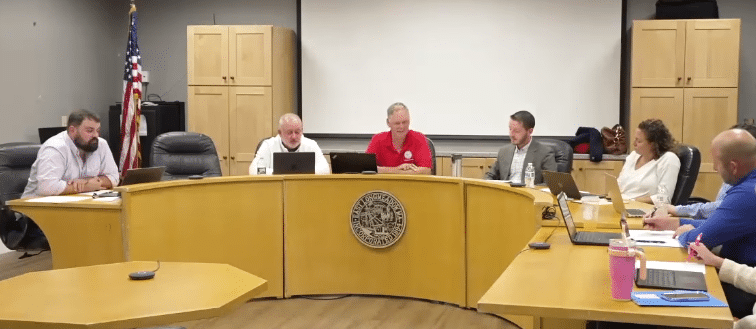
The East Longmeadow Town Council unanimously voted to send a letter to the Planning Board to decide zoning regulations on data centers.
Photo credit: ELCAT01028
EAST LONGMEADOW — The East Longmeadow Town Council gave its opinions on data centers and voted to send a letter to the Planning Board to dish out potential regulations and definitions.
Town Manager Tom Christensen consulted his letter with the council at its meeting on Oct. 13, which sought to make a zoning amendment to add data centers to the town’s list of prohibited uses.
A data center is a room, building or facility that houses IT infrastructure for building, running and delivering applications and services. Everything on the internet — from streaming a movie to running a business — is powered through a data center.
There are 3,172 operational centers, 1,199 planned and 400 under construction in the United States as of October 2026, according to dcmap.us. The tracker cites 56 operational centers in Massachusetts.
Data centers have been around since the beginning of the internet and were traditionally housed in smaller spaces, like utility closets and offices, and used little power or water for cooling.
Warehouse and stadium-sized data centers exploded with the launch of generative artificial intelligence.
“I think our bylaw’s written in such a way that, if it’s not listed as an approved use, it’s not allowed,” Christensen said. “It’s just to have a, sort of, added layer of protection. I will admit, I don’t know much about data centers, other than the negative press or the negative impact I’ve heard they have on infrastructure and communities. I just think if we were to get one without even knowing what the impact is going to be, I think it could be very difficult for us as a community.”
Council President Ralph Page said he thinks it’s reasonable to forward a letter to the Planning Department for discussions. He said the only initial concern he had was if there would be regulations on the size of a center.
“That way, an area with five servers doesn’t fall under it,” Page said. “[The Planning Board] should dive into it first.”
Councilor Connor O’Shea asked if there was a particular inspiration for Christensen’s letter and if there was legitimate concern.
Christensen said former Planning Director Rob Watchilla had discussed putting a moratorium in front of the Planning Board to give time for potentially writing a bylaw or figuring out regulations if the town allowed a data center.
“Mostly, in my opinion, this isn’t a use that we want in town,” Christensen said. “That’s solely the reason why I wanted to put it on the list.”
O’Shea said he respectfully disagreed, but it’s reasonable to say centers should be prohibited in residential areas.
“It’s no more damaging, in my opinion, in our industrial, or industrial garden park, than any of the other potentially destructive uses that are already in those zones,” O’Shea said. “I think, similar to Ralph’s concern, when it comes to the definition of it, there’s a lot of those businesses that have many server racks that need to be very careful of what you consider a data center and computing to be. They may fall into that definition already.”
He said the council might be getting ahead of itself by trying to regulate something that is very unlikely to come into East Longmeadow “at the scale that people are concerned about nationally or statewide.”
“We don’t even really even have the unbuilt land in town for the type of hyperscalers that are building these things out,” O’Shea said. “They’re certainly not going to move to our town with the incredibly high property values that they would have to pay to acquire that land or the expense of water and electricity when they could go elsewhere in the state that would be much cheaper for them.”
Page asked what harm would putting it under prohibited use do if the council isn’t concerned about it or if there wasn’t a chance of developers trying to build one.
Councilor Jonathan Torcia noted a statewide de facto moratorium that prohibits data centers unless a town or city approves it, citing it as added protection.
“I’m sure there’s some benefits to AI or kind of where we’re going for this, I’m totally against the idea of a single data center being in this community,” Torcia said. “I think we should have, frankly, the strongest, strictest restrictions towards it.”
He said he doesn’t see the upside in data center development and there could be 1,000 downsides nobody sees.
“I can think of [330 Chestnut St.], I can think of some other farmland or whatnot that could be swallowed up for one of these facilities,” Torcia said. “I think there’s noise issues, I think there’s environmental issues and I think this is probably one of the most important things that people are talking about right now.”
Councilor Jim Leydon said Christensen and O’Shea were both on the right track in their perspectives.
Leydon said it’s something the council should protect the town from in the short run and he’s in favor of the letter because the town doesn’t have any protections. He added it’s also more nuanced and there should be a conversation about it.
“You look at Lowell, that’s an atrocity what happened up there,” Leydon said. “There’s also potentially more attractive projects that we might want to see as a town that contributes to the tax base, that is not consuming tons of electricity, that are closed water loop systems.”
Councilor Matt Boucher said he agreed with Torcia and didn’t have any desire to see a data center in East Longmeadow.
“I’m one to maybe over-correct on things,” Boucher said. “I would support just prohibiting it completely, maybe that’s foolish, but at minimum I think it makes sense. Just send it to the Planning Board, let them look at it. When it comes back, I will probably support just not allowing it as a use, but I do think Connor’s comments actually make a lot of sense. You might have a server rack that counts as a data center, or what have you.”