
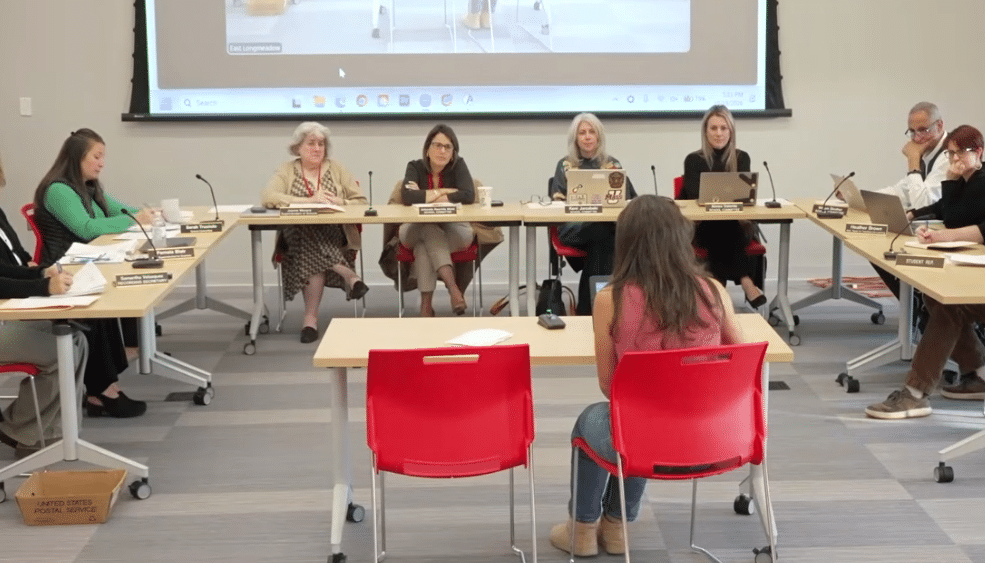
Student Representative Katie Powell discussed student concerns and presented a student petition with over 300 signatures.
Photo credit: ELCAT01028
EAST LONGMEADOW — The East Longmeadow School Committee is continuing discussion on the rollout and implementation of phone-free school days, following the lead of a number of Massachusetts school districts who have already gone through with a cellphone ban.
Attorney General Andrea Campbell awarded $49,203 to the district in September through the Phone Free Schools Support Grant, allowing the purchase of Yondr pouches.
Yondr pouches are fabric bags used to lock cellphones or any electronic device, using a magnetic mechanism to close. They are commonly used in schools, workplaces or live events to avoid photography or recording.
Pouches are intended to be implemented at Birchland Park Middle School and East Longmeadow High School by January 2027.
The two-year grant will fund the partnership with Yondr, replacement pouches, implementation, staff training, parent communication and trouble-shooting.
The Massachusetts House and Senate have both passed legislation to ban electronic devices in public schools during the entire school day, also known as “bell-to-bell” policies.
The Senate bill looks specifically at banning phones in schools, with exceptions for medical needs, IEPs, disabilities and emergencies. The House bill reaches into prohibiting social media from users under 14 years old. Parental consent would be required for users aged 14 and 15.
Neither legislation has become law, but other local school districts have put cellphone bans with Yondr pouches into place, such as in Springfield, Holyoke and Chicopee.
Brown explained why the district is moving forward with the bell-to-bell bans ahead of the state law at the committee’s Oct. 19 meeting.
She said many other schools already have a ban and “often there are things that come down from the state or DESE and they are not funded.”
Brown said, “it’s not just about pouches, but it’s about all the communication and education and really having good procedures in place.”
“[Yondr] will help us every step of the way,” Brown said. “The phones would be locked through classes, passing time and lunch. That includes smartwatches and earbuds. At the end of the day, they would unlock their pouches at unlocking stations that would be placed around the exits.”
She said the district is still working with Yondr to figure out a number of unlocking stations, but 15 students will be able to use a station at once.
Brown added Common Sense Media tracked teen phones for a week, and over half of students received 237 or more notifications a day. Every teen had used phones during the school day for a median of 43 minutes.
“Additionally, 72% of high school students called phones a major problem,” Brown said. “This is why we moved to the pouches in the classroom, but the state is moving to a stricter ban … Phones have been shown to cut into learning time, it affects youth mental health.”
She said principals have reported seeing more smiling faces in the cafeteria and in influx of interaction, such as through playing UNO during lunch.
Student Representative Katie Powell presented a student petition with 311 signatures addressing concerns with Yondr pouches.
“I’m not here to create any sort of chaos,” Powell said. “I know that we’re kind of far down this road and that they’ve already been set in motion, more or less. I’m just here to present some concerns from the student perspective about the implementation of the Yondr pouches and ask that maybe we at least reconsider them, but I understand you’re all doing this with our best interests in mind.”
Powell said the grant is a “general grant relating to anything that helps schools manage cellphone usage, including unique efforts, such as community engagement.”
“We could very easily direct this money to a more effective way to manage cellphones, which I would be happy to help with from the student perspective,” Powell said. “We’ve been told that we will own these Yondr pouches, take them home and will be held responsible to pay for them should they get damaged … Many families in our district are struggling to afford even basic necessities, like food and gas, and parents won’t want to pay for another school related cost that they haven’t even been made aware of yet.”
Based on a student survey sent to civics classes, 88.9% of students use their phones during the school day outside of class to message parents about rides or schedule changes, 61.1% message coaches, 77.8% to receive information from teachers and 94.4% want to have their phone on them in case of lockdowns or emergencies.
Powell said it’s not the time to take away a piece of connection that gives students and their families a little more peace of mind, and teacher-enforced phone pockets already work effectively.
She added only using phones in the office will clog up resources and “drastically increase communication time.”
Student Representative Finn Jordan said students are furious and upset about what they see as a “loss of freedom.”
“I don’t know what the solution to that is, whether there’s a way to solve it or if there’s a way to maybe give them some other concessions they feel is not just this ‘take, take, take’ from the School Committee,” Jordan said. “As much as we can talk about it and as much as I understand the reasons why this is being implemented, it is the general understanding among the students that they are very, very upset about this policy.”
School Committee member William Strother said he isn’t 100% in agreement with the policy, citing it as a “slippery slope.”
“We’re asking our students to not use technology, but we’re preparing them for the future,” Strother said. “I don’t remember any time I walked into work and they told me to put my phone in a pouch before I went to work that day … I think there is a balance. Taking it away 100% of the day, I’m not sure that’s the balance.”
He said the balance should be teaching the students to be more responsible with technology and not taking it away.
School Committee member Kerri Jarzabski said she can’t work without her phone so she hopes there is a balance in teaching students how to be more responsible.
Powell asked if there is any way to delay the January rollout to get more student feedback.
Brown said the date was picked because coming back from a break “feels like a reset,” but the rollout doesn’t have to happen then.