
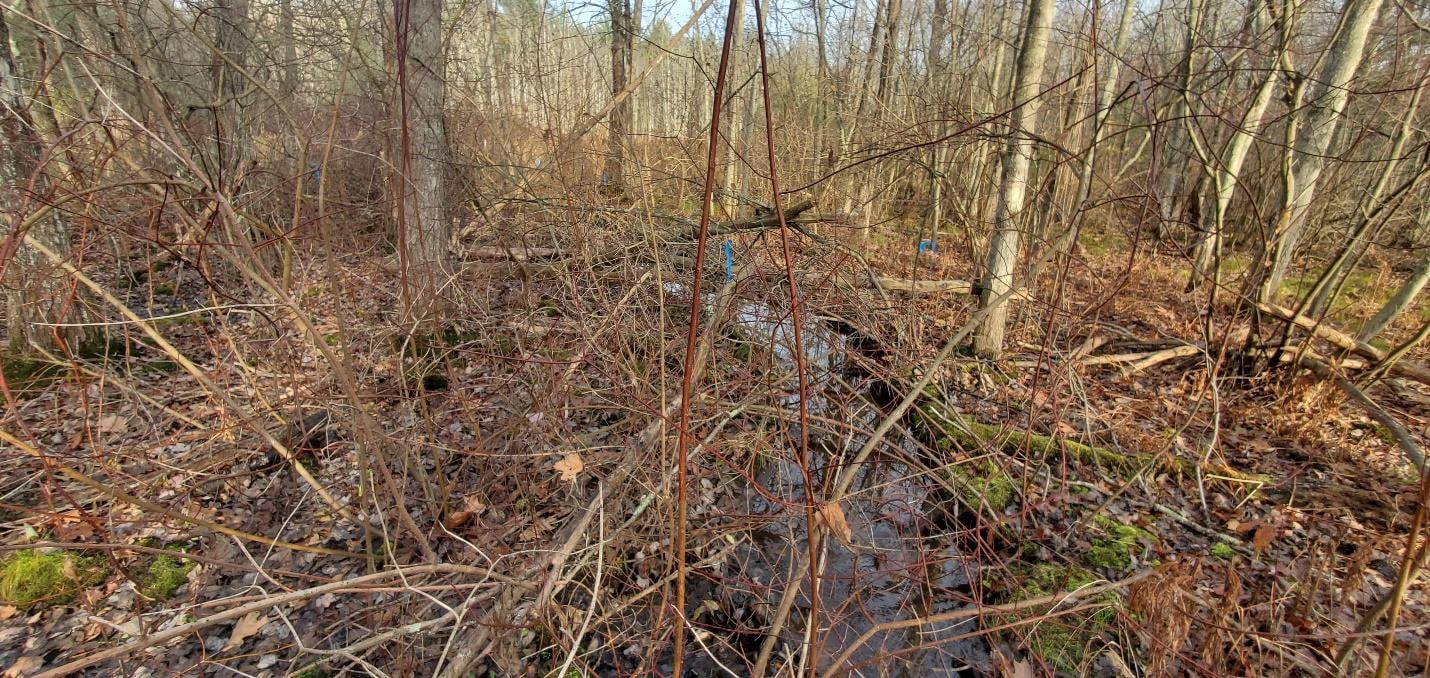
Nashawannuck Brook, west (upstream) of Old Wilson Road. “Wetland A” and “Wetland B” are along the banks (left and right, respectively). The city recently received a $2.8 million grant to aid in the brook’s restoration.
Reminder Publishing file photo
NORTHAMPTON — The city has received a $2.8 million Municipal Vulnerability Preparedness grant to complete the Rocky Hill Greenway and Nashawannuck Brook Restoration and Golf Course Rewilding Project.
The grant funding comes after the Healey-Driscoll administration announced on Aug. 13 more than $45 million in grants supporting 97 projects aimed at helping communities across the state better withstand flooding, extreme heat, coastal erosion and other climate impacts. The funding, awarded through the Executive Office of Energy and Environmental Affairs’ new Environmental & Climate One Stop program, will help strengthen infrastructure, restore and enhance natural resources and improve public safety while making it easier to access state funding for climate resilience projects.
“Massachusetts needs infrastructure that can withstand flooding, extreme heat and severe storms,” said Gov. Maura Healey. “This $45 million investment will help communities protect residents, strengthen roads, dams, coastlines and other critical infrastructure and lower costs. ECO One Stop is making it faster and easier for communities to access the funding they need to get these important projects moving.”
Specifically in Northampton, the action grant will aid the completion of the restoration work at the former Pine Grove Golf Course, which the city purchased in 2020 to rewild the course, restore Nashawannuck Brook and wetlands throughout the site and provide increased public access to outdoor recreational opportunities.
The latest funding will help remove the remaining infrastructure, such as an earthen dam that impounds a former irrigation pond, two culverts and in-stream impairments to the stream channel. The funding will also support the restoration of wetlands that were modified during the site’s years as a golf course and enhance the health and function of existing wetlands.
“The existing earthen dam that forms what was once an irrigation pond for the golf course will be removed to restore the free-flowing stream channel. The material that forms the berm is believed to have been the excavated material from the creation of the pond; the material will be put back into place within the existing pond footprint to restore the topography of the valley side slopes and tie into existing streambank grades upstream,” explained Planning and Sustainability Assistant Director Sarah LaValley.
The funding will also support the installation of an all-persons trail and boardwalks for equitable access to the site and its passive recreational opportunities. According to LaValley, the ADA-compliant accessible trail loop will run from the roadway and parking lot to the site of the existing dam and back up. It includes an accessible spur trail off the loop to the existing stone feature at the south end of the site, and a cut-across trail that will be partly boardwalk to give a shorter ADA-accessible loop option.
“The intent of these trails is to provide meaningful, equitable site access so that all users can experience the variety of habitats across the site. Nearly one mile of accessible trail loops will be created,” she added.
The final step of this work will involve volunteer planting of more than 7,000 trees and shrubs to reforest the site with climate-adaptive species aiding cooling and carbon sequestration.
“The planting list is being developed to be climate-forward, that is, to prefer species whose native range extends south into warmer climates such as the Mid-Atlantic and Carolinas. Preferencing species which are already successful in these warmer conditions will result in a forest on site that will be well-adapted to new climate conditions by the time it reaches maturity,” LaValley explained. “On the other hand, species that are less likely to do well in warmer conditions, or which are expected to be increasingly sensitive to invasive pests, will be avoided.”
LaValley said the work will have significant benefits for habitat improvement, flood storage and storm buffering.
“Restoration of the Rocky Hill Greenway and Nashawannuck Brook will have regional benefits for watershed and landscape connectivity. Restoring stream and wetland function with floodplain reconnection and increased flood storage will reduce the flashiness of streamflows exported downstream, including at Mass Audubon’s Arcadia Wildlife Sanctuary. Reduced hydrological flashiness will also reduce bank erosion and scour and sediment loading downstream,” she explained.
She added that Nashawannuck Brook’s designation as a headwater tributary to the Manhan River helps combat climate change.
“Replanting the riparian corridor with native vegetation will shade and cool stream water temperatures, which will have both a local and downstream effect. Removal of barriers to aquatic passage will improve longitudinal connectivity for aquatic and semi-aquatic species, including macroinvertebrates and fishes, to move within the stream network and access habitat for refugia from warmer temperatures and drought or low flow conditions,” LaValley explained.
Work on-site has been ongoing over multiple years through the Division of Ecological Restoration and MVP funding. The effort has been labeled a DER priority project. According to LaValley, the most recent restoration work included the removal of a failed culvert, the creation of parking and the removal of armoring from the stream. A bicycle and pedestrian bridge that exceeds all ecological stream-crossing standards was installed at the former culvert location on Old Wilson Road, and the bridge will connect to the accessible trail network within the site.
LaValley explained that the city also installed beaver dam analogues — human-made structures built with natural materials designed to mimic a natural beaver dam — at intervals within the lower reach of the restored stream below the existing dam. She said the analogues will aid beaver recruitment and facilitate streambed aggradation.
“The BDAs, along with proposed ‘beaver buffet’ plantings, will recruit new beaver populations to inhabit Nashawannuck Brook that further builds upon these BDAs, enhancing habitat diversity and a healthier riparian system in perpetuity,” she explained.
She added that the Division of Ecological Restoration grant will aid vernal pool work on adjacent parcels to the south and east.
“This will add to the mosaic of vernal pools present on the landscape. Vernal pools are particularly susceptible to climate change due to increased variability in precipitation patterns, including increased frequency and duration of droughts,” LaValley said. “An array of pool sizes and spatial arrangements in proximity boosts population-level resilience for wetland-dependent species. Each vernal pool area has an associated turtle nesting habitat area.”
LaValley added that the project’s next phase will go out to bid early this fall. She noted that dogs must be leashed at all Northampton conservation areas. Since this is an active restoration site, it’s especially important that dogs be leashed at all times and that all dog waste be removed, she said.
To learn more about this latest funding and the project, visit northamptonma.gov/2587/Pine-Grove-Restoration.