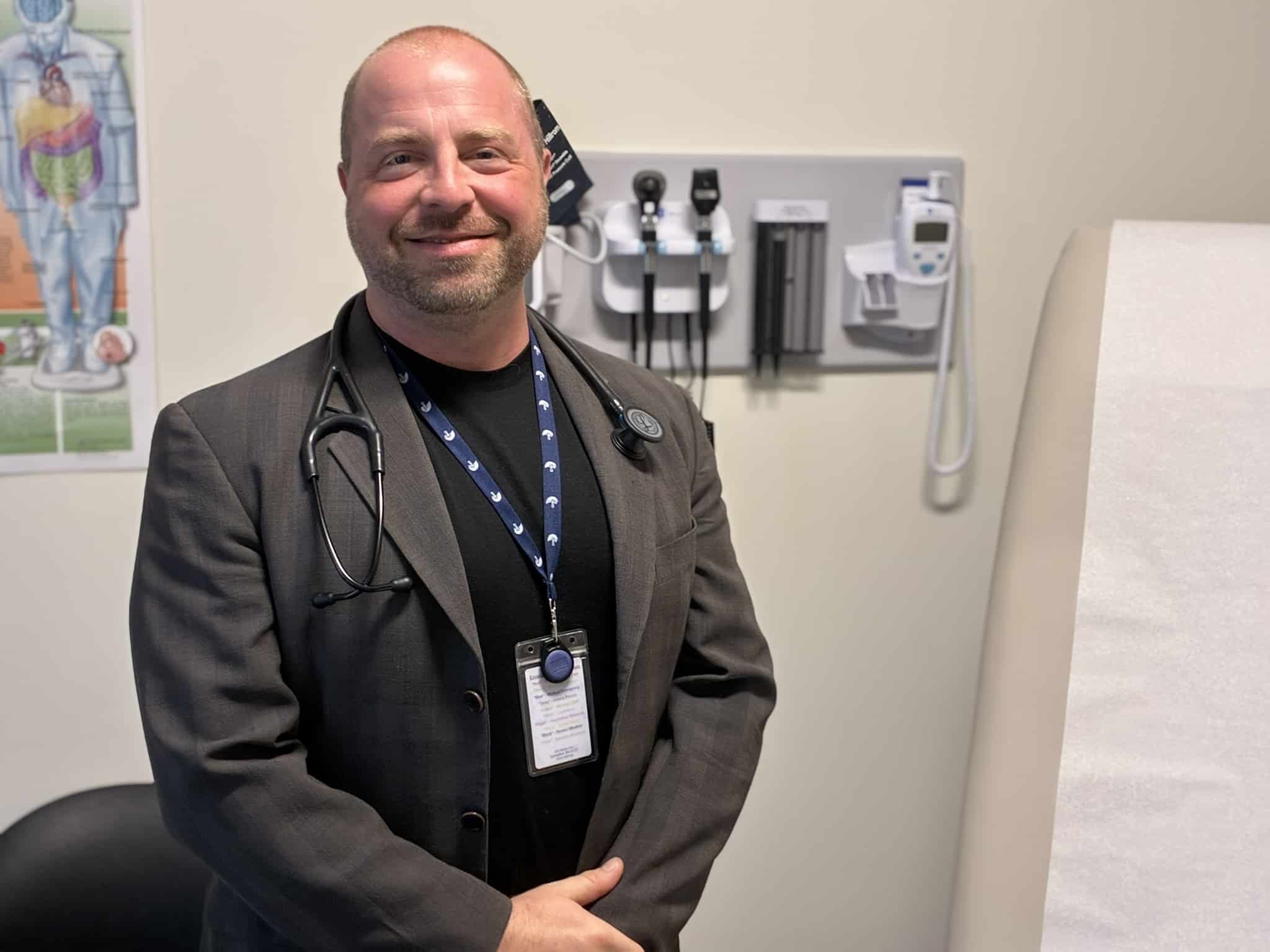
Center for Human Development Chief of Medicine Dr. Chad McDonald.
Reminder Publishing submitted photo
In an effort to reduce the deficit in primary care providers, the Center for Human Development has expanded services at three of its outpatient behavioral health clinics in Western Mass.
CHD Primary Care is the new service line at CHD’s outpatient behavioral health clinics in Easthampton, West Springfield and Orange. The program will integrate medical care, nursing case management and behavioral health services under one umbrella.
From preventative visits and routine checkups to managing chronic conditions, CHD said the expansion aims to make it easier for people to get the personalized, ongoing care they need close to home without waiting.
“Access to primary care in Massachusetts has been a challenge for a lot of people and families for a long time, in large part because the system in place for training and incentivizing providers has not given appropriate recognition to the importance of primary care,” CHD Vice President of Community Engagement Ben Craft told Reminder Publishing. “In the case of CHD, we were involved in many other facets of the lives of the people we support — behavioral health, housing and shelter, access to opportunity — and yet regular access to primary care was a recurring theme. We’re trying to fill that deficit of services across demographic boundaries. You don’t need to be an existing CHD client to get primary care services.”
- Services through CHD Primary Care will include:
- Minor illnesses such as coughs, cold, flu, ear and eye pain, sore throat, rash
- Minor injuries, including burns, sprains, bumps and bruises
- Chronic disease management, including asthma, diabetes, COPD and high blood pressure
- Diagnostic services: on-site rapid testing and orders for off-site lab and radiology available
- Medication refills
- Referrals to specialists, as well as bridge treatments
- Convenient access to behavioral healthcare at CHD
Dr. Chad McDonald, D.O., the CHD chief of medicine who has been seeing patients at the Park Street Primary Care Clinic in West Springfield, explained that housing primary care and behavioral health services in one setting supports a team-based approach to care delivery and treats the whole person, looking at both physical and mental needs, rather than separating both types of care into two different systems. McDonald said this allows medical and behavioral health providers to collaborate easily in the same location.
“If I’m seeing a patient for diabetes, and I see what may be a mental health issue, I can get them an appointment with a mental health clinician, who I can immediately consult with, so a smaller issue can get taken care of before it becomes a big issue,” McDonald added.
On the flip side, someone with a psychiatric or mental health condition might come to see a CHD behavioral health clinician or psychiatrist but have a medical issue that has never been addressed. That is the basis for CHD’s reverse-integration model, the organization said.
Traditionally, integrating primary care and behavioral health services invites behavioral health clinicians into primary care practice, but CHD is doing a reverse integration in that it has brought the primary care practice fully into three behavioral health clinics, they added.
“A standard primary care office doesn’t have all the tools that CHD has in its toolbox,” said McDonald, a family physician and an addiction medicine specialist. “This is important because our mental health and physical health are very intimately connected. If you’re ignoring one, then the other is likely going to struggle too, and several studies have shown that patients with psychiatric illness live 10 to 20 years less than patients who don’t struggle with those ailments.”
McDonald said his board certification in addiction medicine is particularly useful in increasing healthcare access to the population he serves.
“If you’re not taking care of your mental health, and you have a major medical problem, you’re going to ignore those physical health concerns — and when you add in substance use, that further complicates things,” McDonald said. “With many people, there are all three problems — medical, psychological, and social service needs — that need attention, and CHD is in a position to treat all three.”
CHD Chief of Psychiatry Dr. Ryan Alvares agrees with McDonald’s points, adding that when mental illness and addiction are co-occurring, they tend to take over. When that happens, a patient tends to make physical health less of a priority. Alvares added he is enthusiastic about providing whole-person care to patients.
“I feel great about telling them they don’t have to wait a year to see someone, and we’re all going to be able to work together. It’s a huge benefit,” Alvares said.
Advanced Practice Registered Nurse Sarah Moquin, who works at CHD’s Easthampton Outpatient Clinic, shared excitement to be part of the innovative reverse-integrated primary care approach, especially because the shortage of primary care physicians in the area is prompting people to visit urgent care and hospital emergency rooms for their medical needs too often.
Specifically, Moquin recalled a CHD patient in his late 40s who hadn’t been to a primary care provider in 20 years.
“He only came to us because he recently had a heart attack,” Moquin said. “It turned out he also had diabetes, high cholesterol and occluded coronary arteries. In my career, I’ve worked in urgent care, I’ve worked in the ER, and I see how folks overutilize these services when they should be seeing a primary care physician, but they don’t have one. So, anything we can do to overcome barriers to accessing primary care is essential in maintaining people’s best health.”
Craft added that from CHD’s perspective, medical and behavioral health needs directly affect each other.
“When your body is healthy, your mental state is better, and when you’re mentally healthy and at peace, you’re much more likely to do the kind of preventive work that is most effective at sustaining physical health,” Craft said. “Our approach gives just as much focus to the behavioral as the physical, which we think is appropriate. Accessing both services in one place is more efficient care that’s better for the patient, and we think it’s a model that will grow locally and nationally.”
For more information about CHD programs, services and more, call 1-844-CHD-HELP or visit chd.org.