
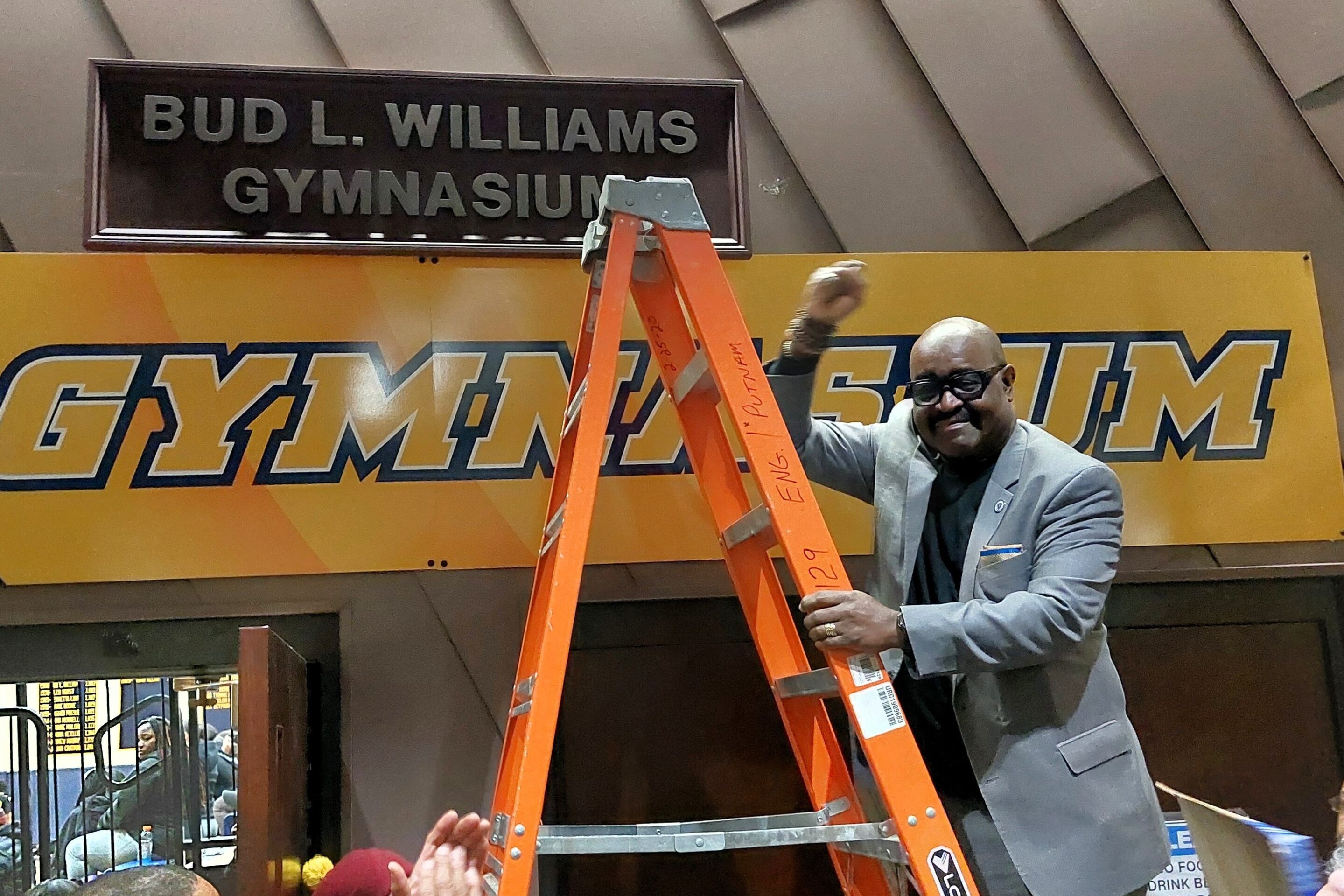
State Rep. Bud Williams lifts a triumphant fist after unveiling a plaque naming the gymnasium at Roger L. Putnam Vocational Technical Academy in his honor.
Reminder Publishing photo by Sarah Heinonen
SPRINGFIELD — Two lines of cheerleaders flanked the podium at Roger L. Putnam Vocational Technical Academy, rustling their blue and gold pom-poms as state Rep. Bud Williams stepped up to speak.
After the applause died down, Williams made his remarks, saying, “There’s a lot of history in the Trade family, the Putnam family.”
Williams is a part of that history, and to honor that, the school has named the gymnasium in his honor.
At the Jan. 30 naming ceremony, Williams said it was a “full circle” moment for him. He described growing up “very poor,” one of 10 children living in the North End in the 1960s and 1970s. Williams’s father died when the future legislator was 17. He attended what was then Trade High School, which was renamed after former Mayor Roger Putnam in 1972. During his time at the school, Williams made a name for himself on the basketball court, becoming the first person in the school’s history to score more than 1,000 career points. Williams’ colleague in the Massachusetts House of Representatives, Carlos Gonzalez, called Williams “the Michael Jordan and Dr. J of his time.”
Retired NBA player and Springfield native Travis Best attended the ceremony. Best said Williams and his father, Leo Best, were contemporaries, playing high school basketball during the same time. Referring to a displayed photo of Williams in his Trade High School basketball jersey, Best said, “I love that image. When I was growing up hearing about basketball in Springfield, it was Trade, Classical.”
Williams said his mother told him education would be his “passport” to advance in life. Williams received a scholarship to attend then-Westfield State College, going on to become a teacher and then as one of the first Black probation officers in city history.
Speaking of Williams’ work as a probation officer, Gonzalez said, “He kept a lot of people out of prison,” those who were “getting the short stick” because of their race. Similarly, Robert “Cee” Jackson, who described himself as a father figure in Williams’s life, said Williams made a difference. “Back then, the courtroom wasn’t fair to us, people of color,” he said, adding, “He stood up for us.” Jackson told Williams, “As a friend, as a father image, you’ve made me proud.”
A string of elected officials, community leaders and close friends took the microphone to praise Williams and the legacy he has made in Springfield. Mayor Domenic Sarno said, “When you look back in the 1960s, there may not have been so many opportunities” for Black and brown people. He praised Williams’s accomplishments, including those he made as a city councilor and now, as a state representative. He specifically called out the way Williams partnered with the city during the coronavirus pandemic to keep Springfield’s Black residents healthy, who nationally were facing significantly poorer outcomes than their non-Black counterparts.
After listening to the speakers sing his praises, Williams quipped, “I didn’t know they were talking about me.”
Williams told the crowd, which included students, “To get anywhere in life, you need to stand on somebody’s shoulders.” He shared a memory from his time playing basketball at Trade and said that to travel in the 1970s, teenage boys were expected to wear sports coats, but Williams did not own one. Then-principal Edmond Garvey and coach, Ted Plumb, bought him a suit with their own money so he could travel to away games. “The shoulders I have stood upon…” Williams reflected. Finishing his remarks, he quoted an “old negro spiritual,” saying, “May the work I do speak for me.”
Williams and his son, Kamari Williams, are the only father and son pair in the city to both have a gymnasium named for them. Kamari was the head coach of the High School of Science and Technology Cybercats, and the school’s gymnasium was named for him after his death in 2020.
