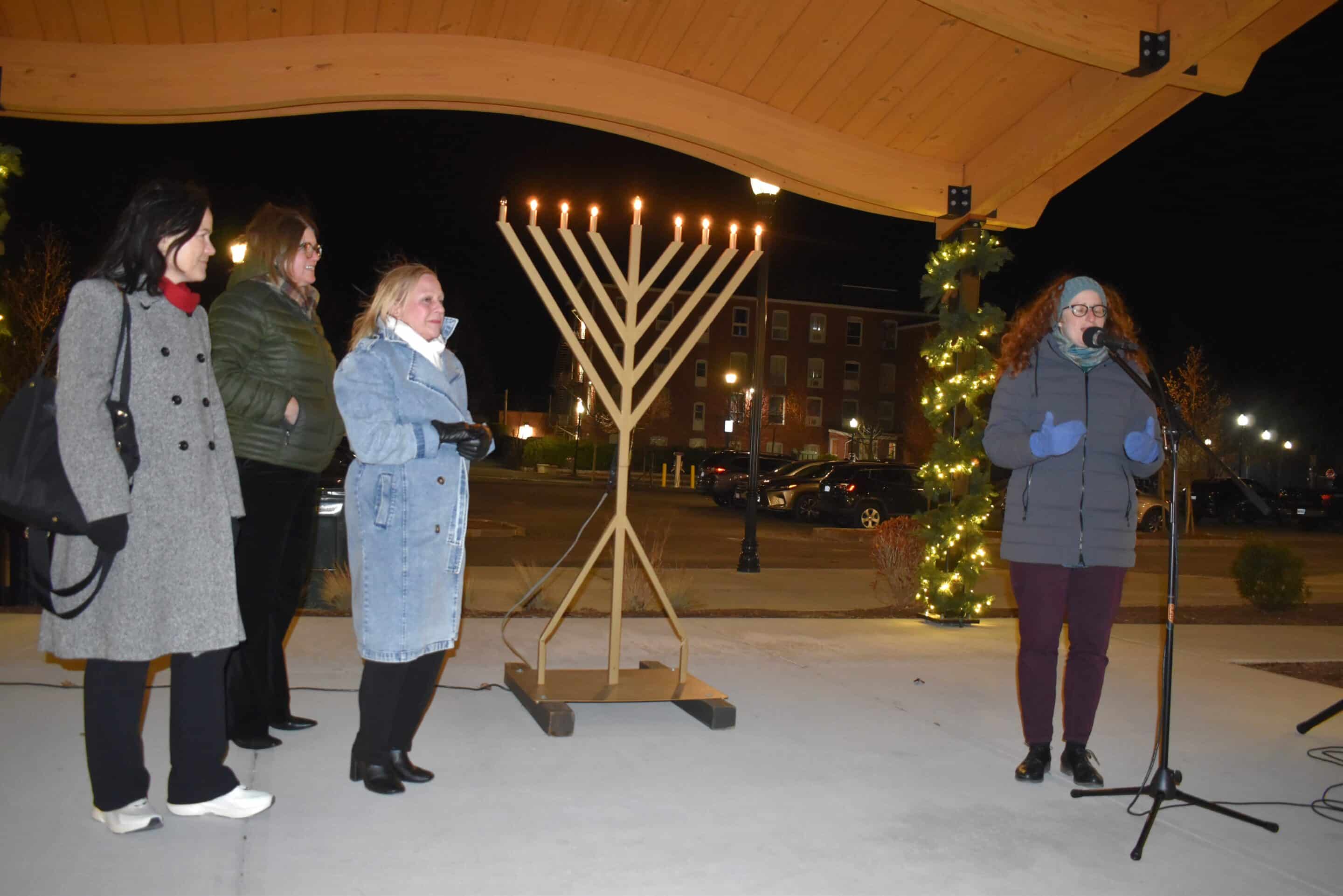
Robbi Shahar Colt of the Congregation Ahavas Achim of Westfield gives a blessing before the eighth candle of Hanukkah is lit. On left are Councilor Bridget Matthews-Kane, Amy Tosi, executive assistant to the mayor and Councilor Cindy Harris.
Reminder Publishing photo by Amy Porter
WESTFIELD — The lighting of the Menorah on the Elm Street Plaza on Dec. 21, was not only the celebration of the eighth day of Hanukkah, the festival of lights, but of the rededication of the Congregation Ahavas Achim 50 years ago in Westfield.
Rabbi Shahar Colt led the attendees in a song that celebrated light and peace. “One little light can keep us going,” she said, saying the rededication was of Jews to Jewish life in the city.
Colt said the name of the holiday means dedication. She asked those gathered what each of them are rededicating themselves to as members of Ahavas Achim. “We rededicate ourselves to all the ways we support each other in the community of Westfield,” she said. “Especially in this time of violence, bias, and intergroup strife, how can we be more in community and connect to each other.”
Colt then asked Amy Tosi, representing Mayor Mike McCabe and City Hall, to light the eighth candle on the menorah. Also present on the stage were Councilors Bridget Matthews-Kane and Cindy Harris. Everyone was then invited to a Latkes and Lights party at the First United Methodist Church.
After the potato latkes were served, with sour cream, apple sauce and oranges, longtime congregant Risa Larson introduced Westfield historian Robert Brown, professor emeritus at Westfield State University, who spoke about the history of the Jewish community and of the Congregation Ahavas Achim in Westfield.
Brown said he and his wife, Judy Brown, are the last surviving members of the original group of 14 families that reestablished the congregation 50 years ago, although the community’s origins date back to the mid-19th century.
“The Jewish community of Westfield was always very small,” Brown said, adding that it was not a significant part of the political, social or economic life of Westfield, which he called in the early years “a very Yankee, very white community.”
He said in the 1850s, the Jews in Westfield were largely male, with not many women or children. Known among them were the four Jackson brothers, who ran a dry goods store and were peddlers, taking trips to the hilltowns to sell their wares. On one of the trips, one of the brothers was murdered, which marked the first appearance in the newspaper of the community, Brown said.
A few years later, three Solomon brothers, John, Henry and Phineas, immigrated from England, where they were in the cigar industry, to Westfield. When war broke out, John and Henry joined the 10th regiment in Massachusetts, representing the Union army, and Phineas joined a New York regiment.
After the war, John joined his brother, then known as Joseph Thompson, in Australia. Henry suffered a head wound in the war and Phineas became active in the cigar industry. Phineas became one of the founders of Woronoco Savings Bank, now known as Berkshire Bank.
Both Henry and Phineas eventually emigrated to Australia, where they are buried in a cemetery in Sydney under the name of Thompson that now serves as the site of American Memorial Day ceremonies in Sydney.
Brown said the second major period of the Jewish community in Westfield was from the late 19th century up until World War I, when 9,000 new immigrants, mostly Lithuanians, Poles, Russians and Slovaks, a small minority of them Jewish, doubled Westfield’s population.
He said the Jewish community resided in what he referred to as the Westfield Jewish ghetto on Morris and Maple streets off of Franklin Street for the first 30 to 40 years.
Brown said they were poor, mostly peddlers and shoemakers. They had minimal religious services under lay rabbis until 1917, when they were able to create a Synagogue named Ahavas Achim on Sumner Street. The building is behind Santiago’s restaurant, and now, a Puerto Rican church.
Their first rabbi, Jacob Kaplowitz, served from 1932 to 1941. After he left in 1941, the congregation was served by three rabbis, all refugees from the war and all trained rabbis who did not stay. Brown said by 1944, the congregation was aging and on shaky ground, and from 1955 to 1965, they no longer held services except on high holy days. Finally, in 1967, the temple building was sold, and the Torah scrolls were transferred to Springfield.
In 1975, Westfield State psychology professor Harvey Rosen and history professors Marty Kaufman and Bob Brown met during a benefit and started talking about the lack of a Jewish congregation in Westfield, Brown said. All three families had young boys getting older and were concerned about their religious education.
He said while two of the three of them were in mixed marriages — Judy Brown is Jewish, and Bob Brown and Rosen’s wife were not Jewish — they decided to try to start one. They reached out to other Jews on the faculty, and Kaufman went through the phonebook, sending letters out to people asking if they would be interested in establishing a Jewish community.
The first meeting was held on April 14 at Brown’s house, where 25 people gathered to meet with a retired rabbi from Springfield, Irwin Schneider, who encouraged them to go for it. Schneider told them the history of the Jewish community in America is about lay leaders, and they shouldn’t worry about mixed marriages.
At the next meeting on May 9, 1975, 14 families — 40 people — showed up. At the meeting, led by Kaufman, they adopted the former name of Congregation Ahavas Achim. Brown said they also received strong encouragement from the five remaining members of the congregation, who were happy to see it start up again.
In the fall of 1975, they held their first high services led by a rabbinical student in Springfield.
Twenty-two families paid dues that fall, and they received a Torah scroll that had been donated to a Boston temple that had many of them.
Judy Brown started a Sunday school in their home that she ran for many years. Bob Brown said, unfortunately, Marty Kaufman died two years later, but the community was secure. In 1981, they held their first bar mitzvah for Brown’s son, Bob Brown.
Initially, the new congregation met at the Masonic Temple and occasionally in the First Methodist Church. They have been meeting in the Interfaith Center at Westfield State University since the late 1980s.
Brown said since shortly after its founding, Congregation Ahavas Achim has been providing monthly meals for the Westfield Soup Kitchen on the first Thursday of each month and also preparing a roast beef dinner every year on Christmas.
“We became active once again and survived 50 years,” Brown said. “All organizations, after a number of years, get tired. It’s clear that the community remains small and transient, always was, but it survived. Congratulations — as active members of a community that has a long history in Westfield.”
A 50th anniversary cake congratulating the “small and mighty” Congregation Ahavas Achim was then served to the crowd, who also enjoyed the dreidels and chocolate coins on the tables.
New Westfield resident Joseph Schneiderman, said he moved to the city a year and a half ago. A lawyer and displaced New Yorker, he said he knew he was home when he taught the mayor and Matthews-Kane to play dreidel at last year’s Hanukkah celebration. “I’m home at long last,” he said.