
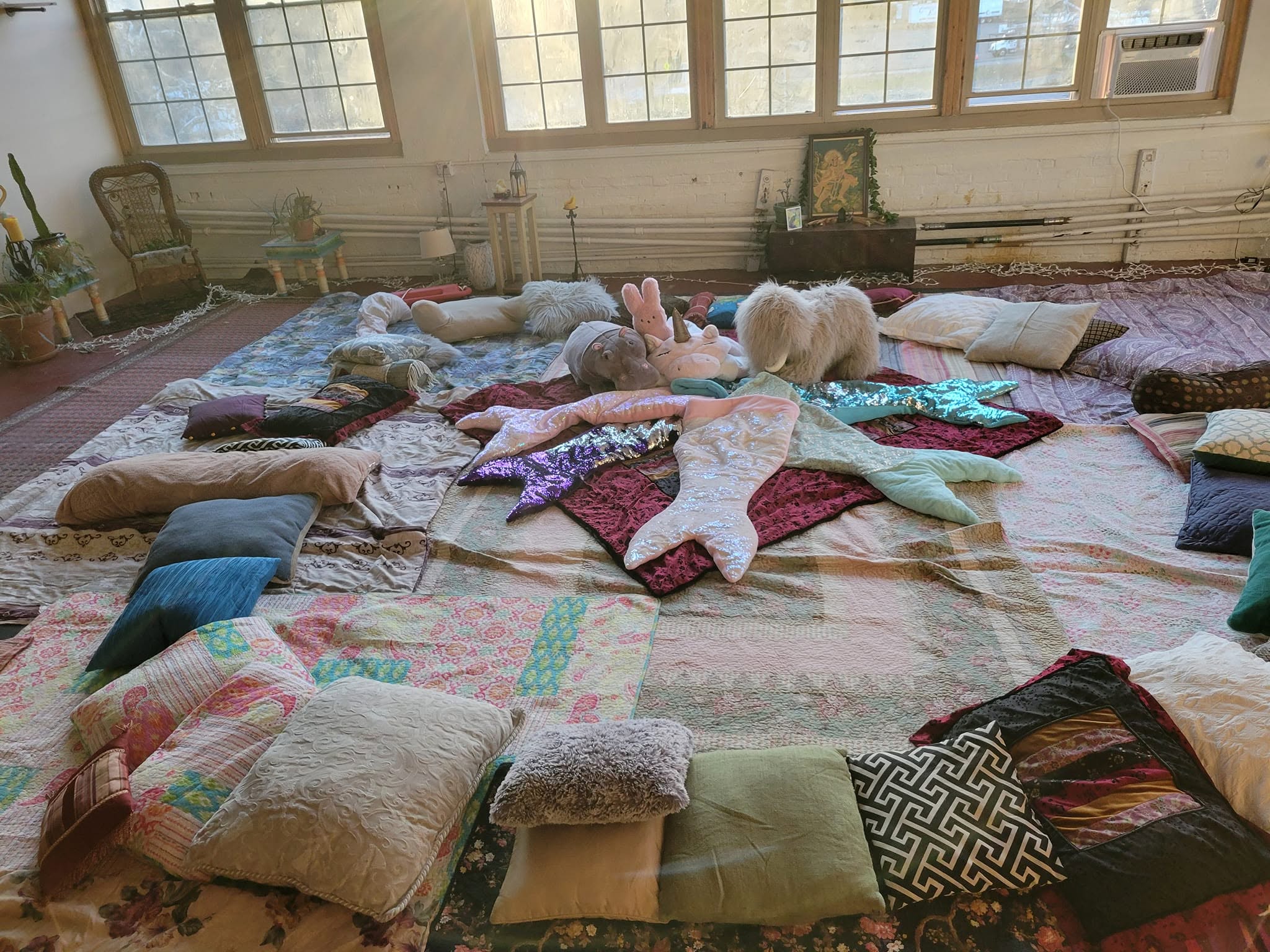
A circle of pillows set up before a Cuddle Party to create an inviting atmosphere.
Reminder Publishing submitted photo
NORTHAMPTON — In a gathering space on the third floor of Brushworks Art & Industrial, a factory-turned-artist studio complex in Florence, pillows of all shapes and sizes were piled high in the center of the room.
Comforters and blankets covered the cold concrete floor in a room warmly lit by floor lamps and string lights.
It was Nov. 1 and several of the people who milled around were dressed in character onesie pajamas or costumes, talking with others or hovering near the snack table.
Then, Doug Pouliot, dressed in an “Incredibles” onesie, called for everyone to choose a pillow and sit in a circle. I grabbed a large stuffed hippopotamus pillow and found a spot on the floor. Pouliot then led the group in a two-hour workshop about consent, empowerment and the need for physical connection. Then we cuddled.
After all, this was a Cuddle Party.
Cuddle Party Inc. is a nonprofit organization created in 2004 in New York City by relationship coaches Marcia Baczynski and Reid Mihalko.
The purpose was to give people a safe space to engage in non-sexual group intimacy and create human connections. Cuddle Parties are a hybrid of consent and self-care workshop and relaxed social event. People at the parties explore how to ask for the touch they want, become comfortable saying no — or yes — and treat each person with respect and care.
People of all genders, ages and backgrounds participated in the Florence Cuddle Party. Each of them had their own reason for being there, but many expressed a need to “recharge” their batteries after dealing with stress in their everyday lives and circumstances that did not afford them enough physical touch or human connection.
A 2023 advisory by the office of the U.S. Surgeon General declared a loneliness epidemic in the United States. That document defined loneliness as the “distressing experience that results from perceived isolation or inadequate meaningful connections.”
Karyn Rossacci, chief nursing officer at Mira Vista Behavioral Health Center in Holyoke, said the “perceived” part of that definition is important. Everyone desires a different amount of physical contact. What may feel like an adequate amount of touch to one person may feel unbearably isolating to another.
The rate of loneliness has increased in recent years. A 2025 advisory from the American Psychiatric Association showed that 1-in-3 Americans report feeling lonely at least once a week.
Loneliness and a lack of interpersonal connection have been longstanding issues in modern society, Rossacci said, but added, “It wasn’t really talked about, I think, until COVID.” The public health reaction to the coronavirus pandemic involved social distancing and isolating when ill. While necessary to control the spread of the virus prior to widespread immunization, it exacerbated feelings of detachment, depression and anxiety among some people, she said.
“As humans, we’re social creatures,” Rossacci said. A lack of connection impacts people’s well-being, “Not just mental health, but physical health,” she said. A global report from the World Health Organization Commission on Social Connection stated that loneliness is linked to an estimated 100 deaths every hour — more than 871,000 deaths each year.
Among the underlying issues that have created the loneliness epidemic, Rosacci said people are working harder and working longer hours. Data from a 2025 survey by the Pew Research Center showed that the people most likely to feel lonely are younger than 50 years of age, especially those with lower incomes or without a college degree, and adults living alone or with a partner they are not married to.
“I think technology plays a piece, as well,” Rossacci said. She said it is well documented that people present an idealized version of their lives on social media, one that is sometimes divorced from reality. Social media can therefore reinforce ideas that others are happier and have a better quality of life. People also rely on technology to connect with people, rather than meeting with people in-person. The APA advisory reported that 62% of adults agree that technology allows them to stay in touch with people and maintain relationships with people they otherwise would not. To get the most out of interaction, though, Rossacci advised, “Don’t use your phone as much.” But if people cannot meet in person, she said, “Even a phone call is better than a text message. You have to make time for those connections. To create new connections, she recommended people join groups centered on shared interests. “Something I do is karate classes with friends,” she said.
For those who are struggling with their mental health, Rossacci urged reaching out to a professional. “There are a lot of people coming in feeling lonely, feeling depressed,” she said, adding that Mira Vista has a robust group therapy program.
In the past there has been a stigma around expressing the need for touch and connection, particularly for men, Rossacci said. That stigma was something Pouliot was cognizant of while leading the Cuddle Party. As he said, “Not everyone is comfortable with people knowing you’re a weekend cuddle monster.”
Pouliot has been hosting Cuddle Parties since 2021. He organizes a monthly event in Florence and has recently begun facilitating one in Vermont. While there are no firm figures on how many regularly operating Cuddle Parties there are, Pouliot estimated there are about 200 Cuddle Party Facilitators worldwide, including those in Ireland, Canada, Panama, South Africa and Australia. He is facilitator No. 175.
Cuddle Party facilitators undergo a four-day in-person training or several online sessions. Each facilitator uses the same script when guiding people through the core rules of Cuddle Party, which all participants must agree to. The first agreement is that clothing stays on at all times. The parties are platonic events and participants agree to adhere to that.
The parties are centered on consent. Participants are not required to touch anyone, and people must ask permission before touching, being as specific as possible. Requests run the gamut from “Can I give you a hand massage?” to “Would you be willing to spoon me?” All requests require a verbal yes or no, and people are encouraged to change their minds at any time. The workshop also covers how to accept a “no” with respect and grace.
It can be awkward to touch strangers, but after two hours of conversation, laughter and reinforcing the freedom to ask for touch, the 20 or so people at the party settled into groups of two, three or more. People talked softly and laughed while leaning back-to-back or gently giving back massages. The understanding that everyone there would respect each other’s boundaries made it easier to relax while touching people who had been strangers two hours earlier.
Personally, I joined a spoon train of five people, asking for permission before cuddling up behind the last person in the line — the big spoon. Not long afterward, the entire group rolled over like logs on a conveyor belt, and I found myself the little spoon. Later, after extricating myself from the train and talking with people around the room about what brought them to the Cuddle Party, I laid down on the floor and held the hand of one person to my left and another to my right. As we chatted comfortably about life, I almost forgot I was clasping their hands and had a sense of calm contentment. It felt like I was among friends.
At the end of the evening, the whole group gathered back into a circle and reflected on the experience of the evening. Some of those who had never attended a Cuddle Party before said they were pleasantly surprised by their level of comfort they felt with others. Veteran partiers talked about returning the following month for more camaraderie and cuddles.
