
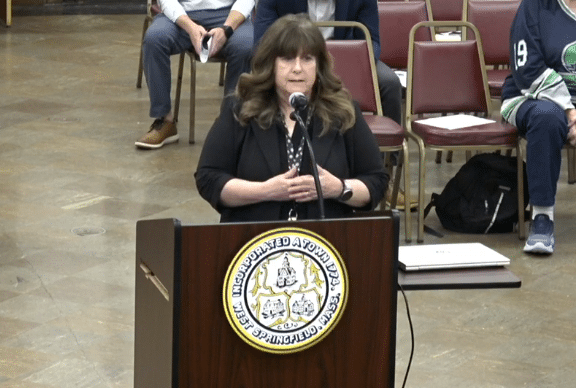
Chief Financial Officer Sharon Wilcox outlined the fee increase at the Town Council meeting on Nov. 2.
Photo credit: Town of West Springfield
WEST SPRINGFIELD — West Springfield residents will see a change in their sewer bill for the first time since 2021 after the Town Council unanimously approved a 10% rate increase to get ahead of projected budget deficits and emergency price hikes.
The sewer fee has been $4.62 per 100 cubic feet — also referred to as centum cubic feet — for five years. One CCF is equal to 748 gallons of water.
The 10% fee increase would change the rate to $5.08 per CCF and kicks in on Jan. 1, 2027.
It does not change the $2.20 per month meter service charge or residential sewer cap threshold of over 15 CCF.
Individuals who qualify for a residential real estate exemption, as determined by the Board of Assessors, will be eligible for a 10% discount on residential sewer.
The DPW will automatically apply the discount on July 1 in the fiscal year following approval.
Mayor William Reichelt and Chief Financial Officer Sharon Wilcox presented the fee increase during a public hearing at the Town Council meeting on Nov. 2.
Reichelt said continuing to invest in the town’s sewer infrastructure is extremely important.
“It’s been a while since we had an adjustment to the sewer rate,” Reichelt said. “While we don’t like to ever have to go up on these things, Springfield does raise the rates every year to treat our sewage, and we probably don’t remember it but about 10 years ago, before we did the big sewer infrastructure project across town, we had a lot of backups in peoples’ houses across the community. We don’t want to go back to something like that.”
He said the town wants to make sure when “we flush our toilets, everything goes towards Bondi’s Island, not back into the house.”
“This is a small increase,” Reichelt said. “A small step in making sure that happens and we continue to invest in our sewer system.”
Wilcox’s presentation dove into the rate’s history, a five-year look ahead at what operating costs and capital projections look like and how the increase may impact the “average residential user.”
West Springfield only saw six rate adjustments from 2000-2017, starting at $1.29 in 2004 and rising to $2.23 by 2017.
Wilcox said the rates floated around a little bit and were unstable between 2018 and 2021.
The rate decreased in 2021 from $5.65 to $4.62. There have been zero adjustments since, even as the consumer price index has risen about 28% since 2021.
She said if rates did not change, the town would by seeing operating cost deficits from 2028 and onward.
The deficit with no rate increase is projected at $389,658 for 2028, increasing to $644,514 in 2029 and $976,481 in 2030.
Revenue with a 10% increase is projected at $255,000 for 2027 and $560,000 each year from 2028 to 2032.
Wilcox explained how the change will look on resident water bills through a sliding scale of figures.
Starting at 3 CCF, residents would see a monthly increase of $1.38 and a yearly increase of $16.56. The 15 CCF threshold would bring a monthly increase of $6.90 and a yearly increase of $82.80.
The average volume usage among West Springfield residents is a consumption of 6.6 CFF per month, which has an increase of $3.10 per month and yearly increase of $37.20.
West Springfield’s increase would only put the town’s rate higher than East Longmeadow out of Springfield, Agawam, Holyoke, Easthampton and Northampton. East Longmeadow’s rate is $5.06 per CFF and Easthampton charges $8.30.
Wilcox said the increase would put West Springfield “more in line with where our neighboring communities are.”
She said no action now would force sudden, large emergency rate hikes in the future and rates should be evaluated annually to provide needed funding for operations and planned capital needs.
Councilor Frederick Connor said he had looked at financial figures on his own to see what increase may really be needed. He said he came out to 10% as well.
“I was hoping that I could maybe find something a little lower,” Federick said. “By my analysis, [10%] is a realistic number.”