
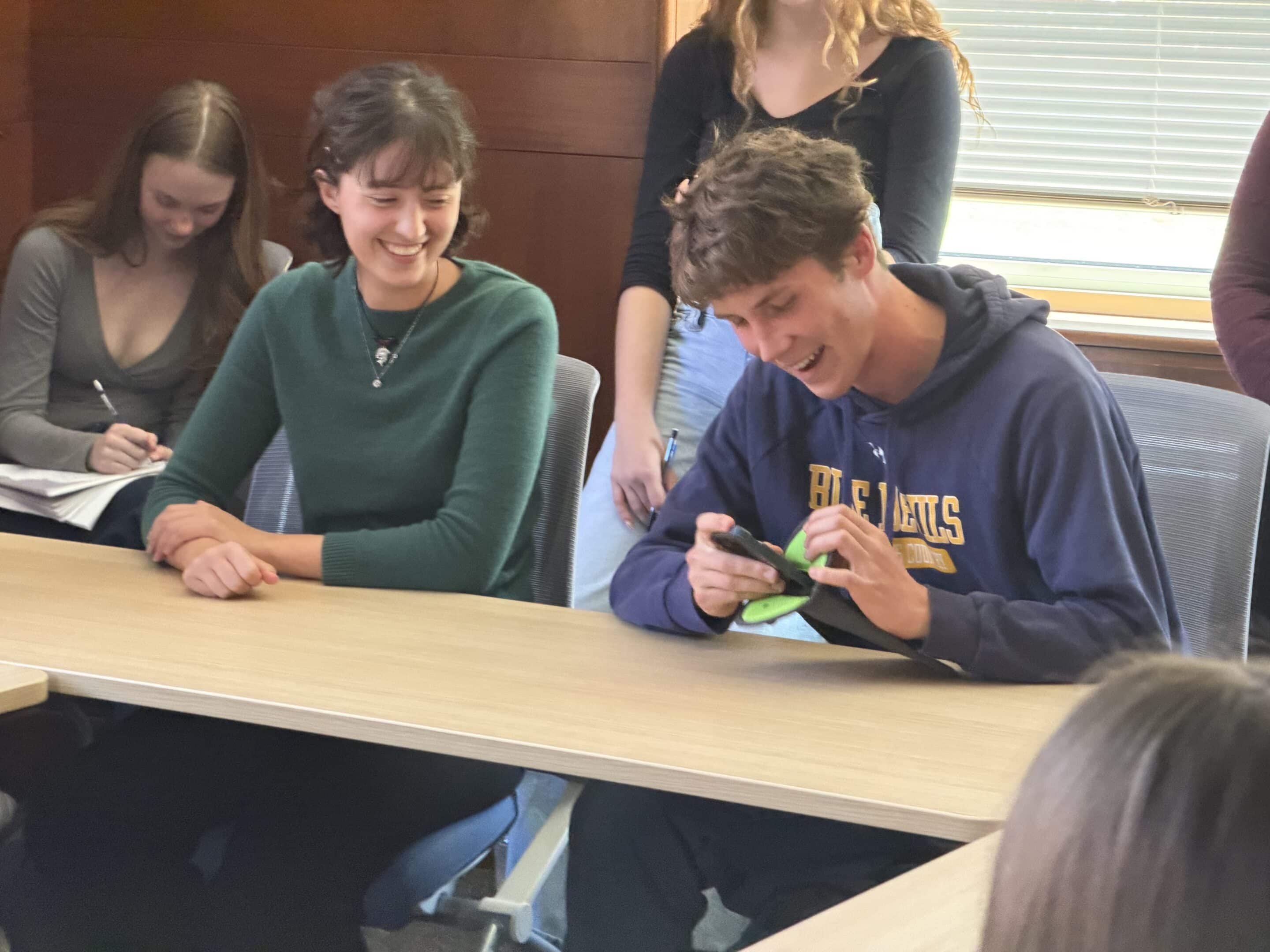
Northampton High School senior Henry Daggett (right) showcases to state and local leaders how students store their phones in Yondr pouches during the school day.
Reminder Publishing photo by Trent Levakis
NORTHAMPTON — To bolster the Northampton Public Schools’ phone-free learning environment, the district is receiving a $50,000 grant as part of more than $625,000 awarded to 17 school districts across the state by the attorney general’s office.
To celebrate the announcement, Attorney General Andrea Joy Campbell visited Northampton High School on Oct. 27 for a press conference about the awards and to participate in a student roundtable discussion to learn directly from students about how the new policy has affected the day-to-day school and learning experience.
“Young people are facing a mental health crisis driven in large part by the constant use of their cellphones and social media. During the school day, kids deserve to be able to set those distractions aside and focus on learning and building relationships with their peers,” said Campbell in the announcement. “We’ve heard from schools across the state how phone-free policies have improved students’ focus and connection. These grant awards will allow more students to experience those benefits and thrive in a phone-free environment.”
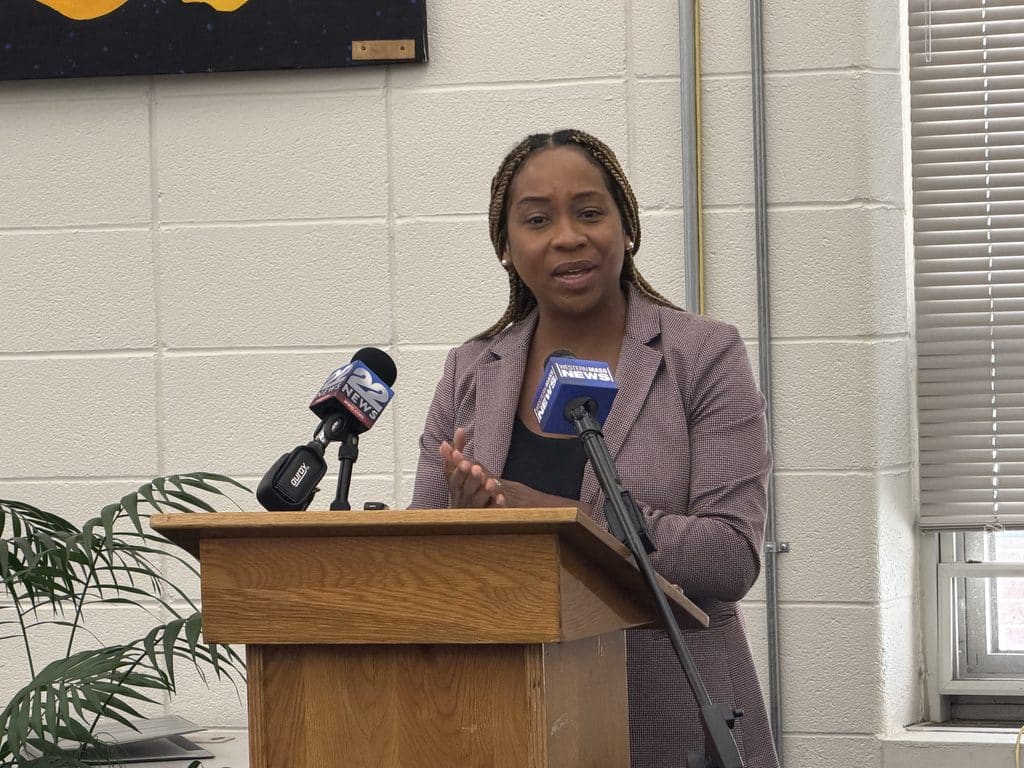
Attorney General Andrea Joy Campbell visited Northampton High School on Oct. 27 for a press conference to announce state grant awards to support phone-free learning environments, including $50,000 to Northampton.
Reminder Publishing photo by Trent Levakis
Northampton’s phone-free bell-to-bell policy gives students Yondr pouches to put their phones into before the school day begins. The pouches stay locked during the school day and can be unlocked at the end of the day or under specific circumstances. Students shared with Campbell and other state and local leaders during the roundtable discussion that they have seen positive impacts on learning because of the school’s policy eliminating phone use during the school day.
Campbell announced the launch of her office’s Phone Free School Support Grant in May to help public schools, charter schools and educational collaboratives establish distraction-free learning environments. Applications were evaluated based on proposed bell-to-bell phone-free policy submissions to be implemented with grant support, alignment with recommendations in the Attorney General’s Office’s Phone Free Schools Toolkit and other criteria.
These funds will support expenses like phone storage, staff training, program evaluation, and accessibility for the phone-free school efforts. Campbell said the state’s efforts hope to empower more schools and districts to implement bell-to-bell phone-free policies and give more students the opportunity to learn and thrive in a distraction-free environment.
The Northampton School Committee voted to implement a district-wide cellphone-free policy in June. Northampton Superintendent Annia Azarloza said during the conference that the phone-free policy is an investment in the community’s young people.
“School isn’t just about learning algebra or analyzing literature; it’s about learning how to navigate life. It builds relationships and how to work through disagreements. So, when Northampton made the decision to go phone-free, we decided it was time for our youth to stop watching life through screens and start living in it,” Azarloza said. “You can imagine how thrilled our teenagers here were when they were told their phones would be locked away for the day. But something remarkable has happened. Our halls have been bustling with conversation; our youth are choosing to play Uno at lunch; they’re rediscovering something we used to take for granted.”
Azarloza added that while she loves technology and believes in innovation, sometimes innovation comes from having the courage to recognize when something isn’t serving the youth and doing something different.
“In Northampton Public Schools we talk about education with soul, and you can’t have education with soul if we’re losing the human connection that makes our schools come to life,” Azarloza said. “So yes, we’re putting our phones away and making room for more conversation, more connection, more learning and more life.”
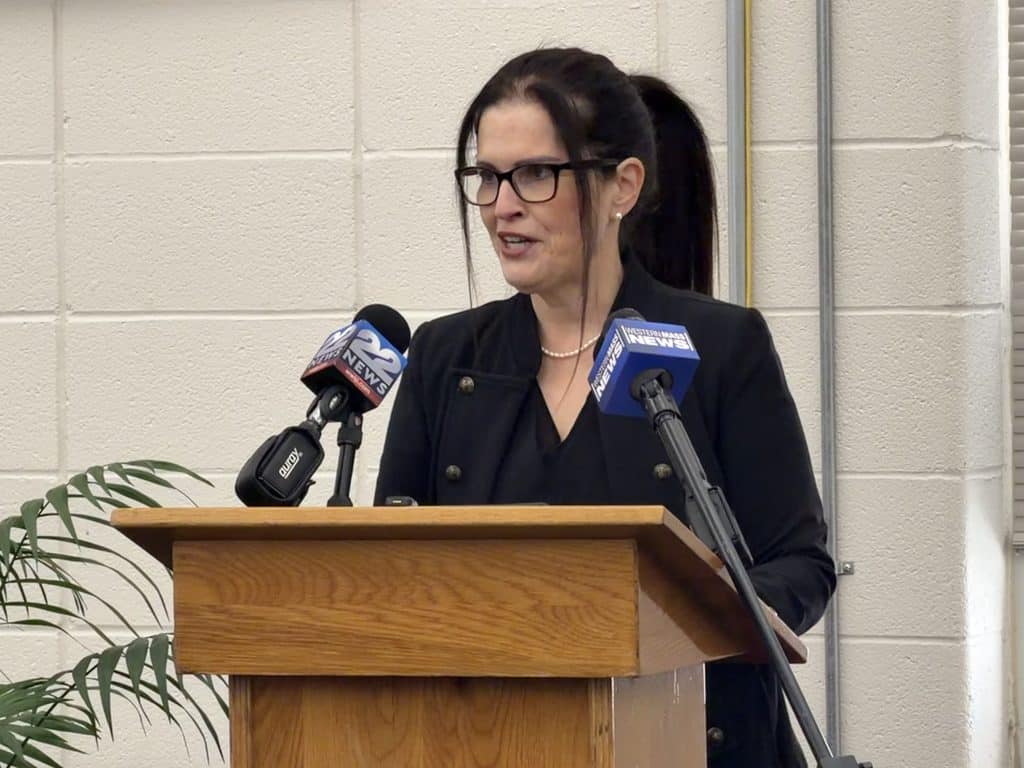
Northampton Public Schools Superintendent Annie Azarloza thanked the state for the $50,000 grant to support the district’s bell-to-bell phone ban policy. She said it was an investment in the city’s youth.
Reminder Publishing photo by Trent Levakis
Campbell noted that school leaders and teachers in the state have reported that cell phones and social media are driving classroom distractions, shortened attention spans, increased anxiety, negative peer interactions, and more frequent cyberbullying, harassment and hate incidents. At the same time, schools that have begun implementing distraction-free policies, including the use of phone storage systems, are seeing increased student focus, improved peer relationships and reductions in cyberbullying, Campbell said.
One of the main concerns from parents and communities about the policy has been that phone bans would eliminate parents’ ability to reach their children in an emergency. Campbell said those concerns are valid, but the state shares districts’ confidence that law enforcement and school faculty can protect students.
“If there’s a safety drill, well, ‘how will I reach my young person, how will I reach my student?’ And we push back on that in a very loving way and to say it’s our job as adults, and of course, law enforcement and others, to protect our kids, and we will do that while ensuring they can learn in a distraction-free environment,” Campbell said.
Students gave firsthand accounts of what the transition has been like, and some of the positives so far have come from the policy change. During the roundtable, students described the transition as nerve-racking, but ultimately better.
“I would say that as a student, the Yondr pouches were the correct choice to make for the implementation of the statewide phone ban,” said student Edie Adams-Sternal. “I’ve noticed that productivity and connection between students have increased.”
Other students shared similar sentiments, saying the phone-free school environment has helped them and their peers socialize more and remove distractions from learning.
“We had three years of high school where we could have our phones. At first, I think a lot of people were really doubtful [about the policy],” said senior student Catherine Peters. “It doesn’t feel different to me; it’s just now I’m in class, and I’m talking to the people next to me. At times it’s mildly inconvenient, but I really haven’t felt it affect me in a real, serious way.”
Fellow senior Henry Daggett added that he has definitely noticed a big social change.
“If you were to walk into the cafeteria last year at lunch, it would just be a bunch of people on their phones, myself included, scrolling or playing a game, and everybody kind of looking down,” Daggett said. “Now when you walk in this year, everyone’s kind of looking up at each other. I would say academically it probably has helped students stay more focused in class.”

You must be logged in to post a comment.