
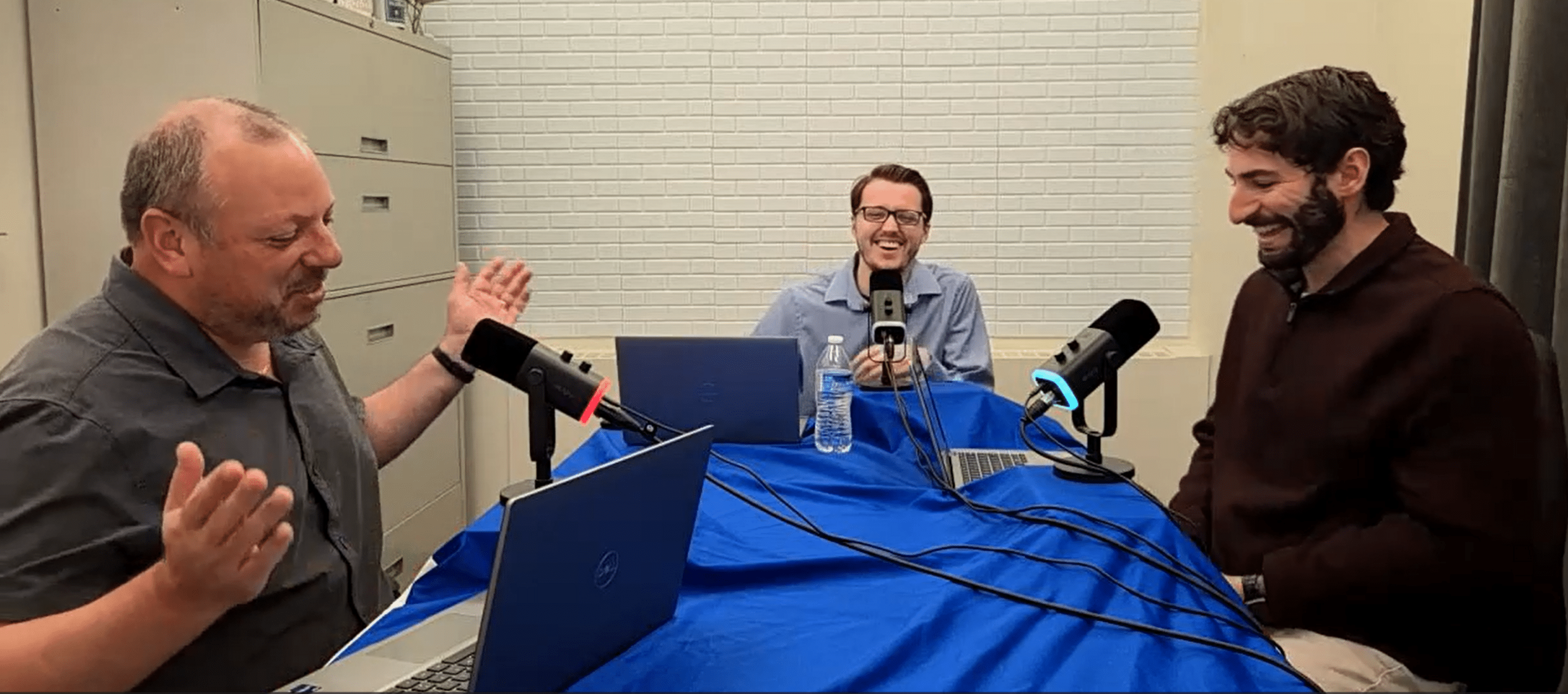
Hosts Chris Maza, Ryan Feyre and Tyler Garnet discuss the nine ballot questions Massachusetts voters will face on Nov. 3.
Reminder Publishing photo by Chris Maza
EAST LONGMEADOW — With Massachusetts voters facing nine questions on the ballot this year, “So That Reminds Me” Hosts Chris Maza, Tyler Garnet and Ryan Feyre sat down to break down this year’s questions.
Question 1 on the ballot asks voters to approve a measure to make certain records from the governor’s office and Legislature public records. Exceptions would include documents related to legislators’ policy-position development, as well as communications between a legislator’s office and their constituents about access to government services.
Feyre highlighted many of the guests on the podcast who have supported passing the measure, including State Auditor Diana DiZoglio, who has been outspoken about passing the measure and auditing the Legislature.
Maza said passing Question 1 could help journalists better serve communities by providing more information about the Legislature and the job it does.
“One thing when you look at Massachusetts compared to the rest of the country, they’re one of the few states that don’t have this kind of comprehensive access. Anytime that you can kind of give people more of an idea as to how their government is working, I don’t necessarily see that as a bad thing,” he said.
Citing state Sen. Jake Oliveira’s appearance on the last episode, who he said was concerned about the guidelines for requesting public records, Maza said those are already in place.
“It’s not like there aren’t guideposts for this. I think the spirit of in general is greater transparency. I don’t deny that there is probably some political motivation on the state auditor’s part as well,” he said.
When speaking about a potential audit following the passage of this measure, Maza said that it could go beyond financial matters, which is what the Legislature is currently audited on.
Question 2 would allow employees from the Committee for Public Counsel Services to participate in collective bargaining and require CPCS to request funding from the governor within 30 days of entering a collective bargaining contract.
Feyre said that the measure would directly target an oversight that prevented public counsel from collectively bargaining while other court employees are allowed to.
“In 1973 state and municipal employees and the state had the right to collectively bargain and then 10 years later, court employees got that right. That same year in 1983 the Committee for Public Counsel Services was created, but it wasn’t part of the group that could collectively bargain. It seems like this is addressing that oversight,” he said.
Approving Question 3 would eliminate party-based primaries and create a single primary election in which all candidates would be listed on the ballot, regardless of political party affiliation. In this system, the two candidates that receive the most votes would advance to the general election.
Maza said this measure would alleviate some of the concerns, especially for unenrolled voters.
“When I go to the polls on a primary day, I have to choose which ballot, which can be frustrating because there could be races that I’m interested in on races on both sides, but then I’ve gotta make a choice about which race is more important to me,” he said.
He added that this is a close issue for Western Massachusetts because the area tends to be more split between Democrats and Republicans. He also said this change would require governor and lieutenant governor candidates to run on a ticket, which they do not currently do.
Question 4 would allow same-day voter registration, so anyone who is not registered to vote could register or update their address on Election Day.
Question 5 asks voters to change how the state calculates its tax revenue limit so it equals the prior year’s net state revenue plus the average growth of wages and salaries in Massachusetts over the prior three years. The measure would also add income tax revenue collected under Section 2 BBBBBB of Chapter 29 of Massachusetts law to the state tax revenue.
Feyre said passing this measure would essentially give refunds when the state has excess tax revenue.
“What this essentially at face value does is it would change a 40-year state law to make it so there would be more refunds to taxpayers when there is an excess of revenue at the state level,” he said.
Maza said this could raise questions about what happens to places that already don’t receive enough state funding. Feyre said opponents fear that passing this measure could cap state revenues and limit funding for programs like transportation and government.
Question 6 would create the Nature for All Fund to fund nature conservation efforts. By establishing the fund, before July 1, 2028, 50% of the tax revenue on sporting goods, recreational vehicles and golf courses would be placed in the fund. After that date, 100% of the tax revenue from those sources would be placed in the fund.
Maza said these specific tax revenues do not currently have a designated fund, but designating them for conservation funds could cut revenue to other programs.
Question 7 would require cities and towns to allow single-family homes on residentially zoned lots that meet a minimum of 5,000 square feet, at least 50 feet of frontage on a street or public way, and access to public water and sewer services.
Question 8 would repeal laws that allow the sale of recreational marijuana and the cultivation of cannabis in homes.
A “yes” vote on Question 9 would uphold House Bill 4885 that enacted changes to the state’s firearm regulations, including developing an electronic registration system to track ownership; prohibiting assault-style firearms; requiring safety certificates to obtain firearm permits; mandating serial numbers for firearms; allowing school administrators and licensed healthcare providers to request that a court issue an extreme risk protection order; and permitting courts to order firearm surrender when issuing harassment prevention orders. A “no” vote would repeal these changes.
Feyre explained that a yes vote would keep the current bill in place and said the wording is confusing.
Maza said that it has been put out there as a vote to repeal.
“There are some who feel that this was done intentionally to maintain the law. This is a skepticism that those on the side of repealing this law, it’s a concern that they’ve had is the wording of this and making sure people understand exactly what the ‘yes’ and exactly what the ‘no’ mean,” he said.
To listen to the full conversation, head to thereminder.com/ourpodcast or search for “So That Reminds Me” on your favorite podcasting platform.
