
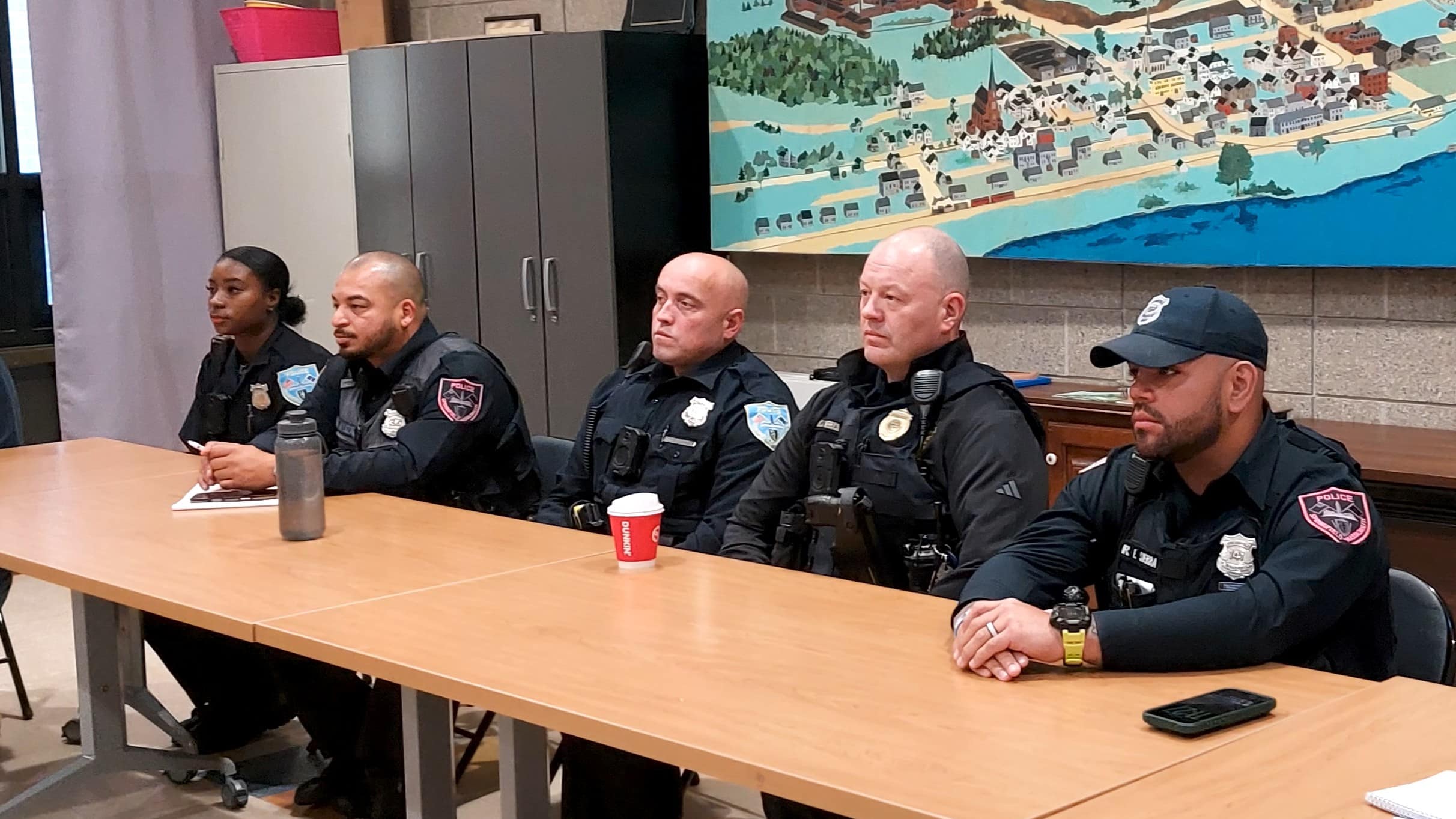
Officers Tequila Taylor-Evans, Alex Lozada, David Suchcicki, Eddie Sierra and Sgt. Jacob Werbicki listen to Indian Orchard residents during the neighborhood’s first C3 meeting.
Reminder Publishing photo by Sarah Heinonen
SPRINGFIELD — About a dozen residents filled seats in the Indian Orchard Community Center. Several officers from the Springfield Police Department, members of Hampden County District Attorney’s Office and community organizations sat behind a U-shaped set of tables in the room. The residents had concerns; the police were there to listen.
This was the neighborhood’s first C3 policing meeting. C3 stands for Counter Criminal Continuum, a Springfield Police Department initiative with the stated purpose of creating safer environments, reducing gang activity and establishing youth and parental programs. The crucial first step toward these goals is to foster community relationships and partnerships with community leaders, local organizations and the State Police.
Sgt. Jacob Werbicki, who directs the C3 Unit, said C3 policing encourages people who live in the community to get involved in its improvement. “If we have relationships, people feel more comfortable talking to us,” he said. “When I came in 2021, specifically in the metro area, we always got lots of information. The people who came to us, they see the results.”
Officer Alex Lozada shared that two reports of shots fired had been recorded in the neighborhood during the month of October, and one arrest was made. Several stolen cars were recovered. He urged people to keep their vehicles locked and to call the police if they notice an unfamiliar vehicle loitering.
While community members report crimes, including car break-ins, home break-ins and illegal dumping, Werbicki said quality of life issues are often top of mind for residents who come to C3 meetings in other parts of the city. The same was true in Indian Orchard.
“Indian Orchard seems to be isolated from the rest of the city,” said Zaida Govan, president of the Indian Orchard Citizens Council and the city councilor for Ward 8.
Barbara Footman was one of a few people who said speeding was a significant issue in the neighborhood. She said cars race down her street “like a bat out of hell,” and suggested the police install a camera to catch speeders. While the officers offered to put a radar sign on the street, they explained that speed cameras are illegal in Massachusetts. Legislation is making its way through the State House to legalize the technology.
Another resident said a large group of college students have had several loud parties from midnight to 4 a.m. and called the police with noise complaints. Suchcicki explained that a noise complaint may have taken a lower priority if there were more urgent calls at the time. He said the police can contact the college if the issue is occurring on campus housing.
Others complained about people who throw trash out their car windows and the noise from vehicle mufflers. When the officer asked a resident if she had called the police, she said the person would be long gone before officers could respond.
Officer Tequila Taylor-Evans responded that logging an incident is the first step in handling such situations. She said officers can then patrol the area, and ideally, catch people in the act. People can report quality of life issues to her as one of the city’s ordinance officers. Officer Eddie Sierra added that the relationships built between the people who live in Indian Orchard and the police was the foundation to “take your community back.”
Hampden County District Attorney Anthony Gulluni’s office sent its Community Safety and Outreach Unit team to the meeting. The team members, led by Tony Simmons, explained that they bring several programs into area communities, ranging from healthy relationships to problem gambling and how to avoid scams.
Springfield Community Connections Coalitions advocates for residents, addresses community priorities and connects people with resources. Justin Spainhoward said, “The goal is to break down silos.”
A representative from Baystate Advocacy Center also attended the meeting. The center offers several types of services, including case management, a homicide bereavement program and trauma training classes.
After the meeting, Footman said she was pleased with the experience. “I think it went very good. It will be nice for the people to get out there, rather than just complain about things,” she said. “If you don’t say anything, how are things going to rectify?”
The next C3 meeting in Indian Orchard will be Nov. 4 and are scheduled every other Wednesday at 11 a.m. at the Indian Orchard Community Center, 117 Main St.
