
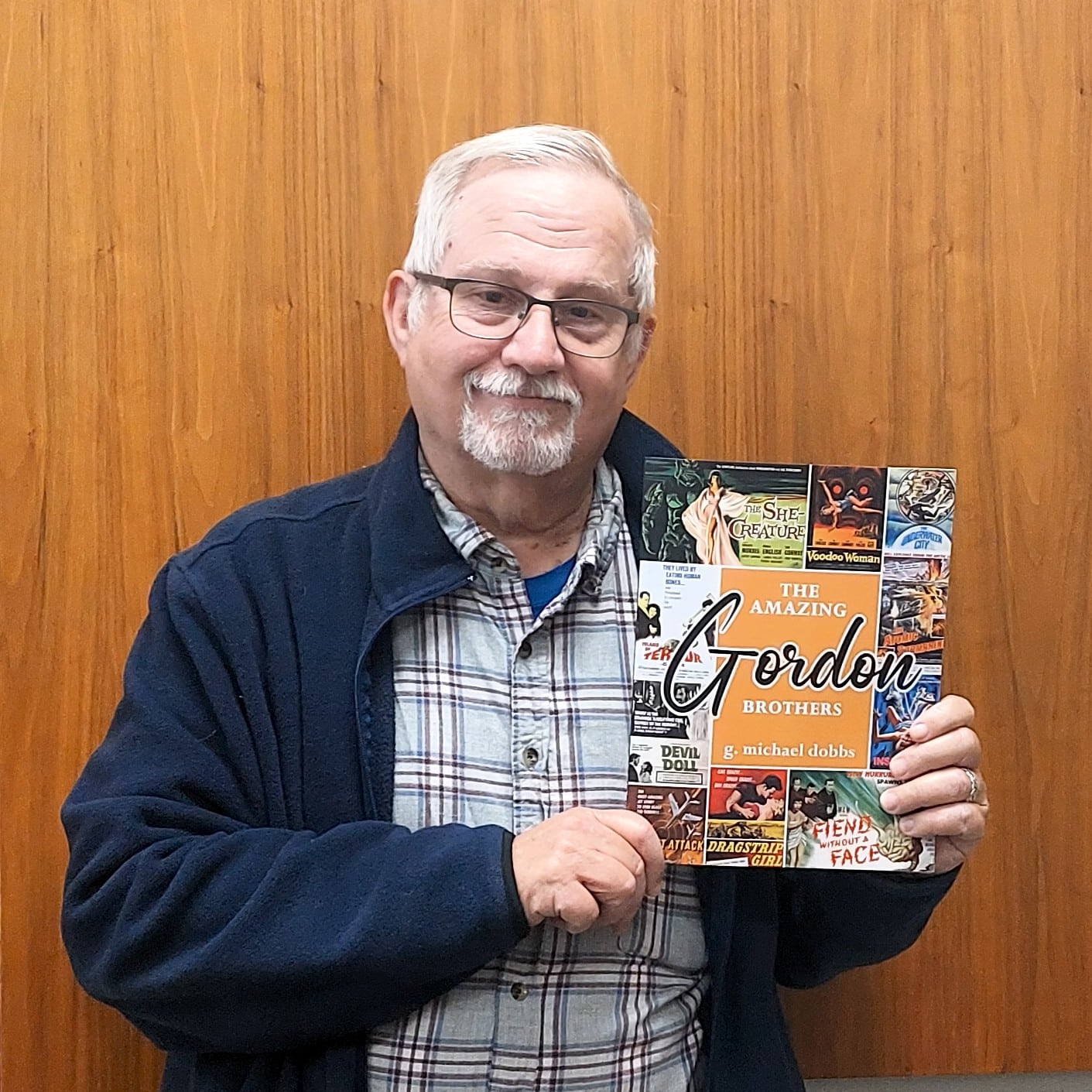
Author G. Michael Dobbs holds a copy of his latest book, “The Amazing Gordon Brothers.”
Reminder Publishing photo by Sarah Heinonen
SPRINGFIELD — For his entire life, G. Michael Dobbs has had a love affair with movies. As such, the author has something in common with Alex and Richard Gordon, the subjects of his ninth book, “The Amazing Gordon Brothers.”
“This is a very unique story,” Dobbs said. “These are two kids. They remember the first movie they saw when they were growing up. They started journals as soon as they were old enough to write, where both of them kept track of every film.”
He shared a tidbit from the book in which Alex wrote a letter to Variety, a show business magazine, in 1959, to dispute a story it had published about someone claiming to be Britain’s champion moviegoer. In the letter, Alex, then 36, said that as of Dec. 31, 1958, he had seen 20,072 features, with an average of 724 pictures per year.
“These guys loved movies … And there’s not very many fanboys who make that trip from rabid fans to then being producers, and producers who then worked with people who they loved as kids.” Dobbs added, “I don’t think there’s any two other brothers in the history of cinema who did what they did.”
“The Amazing Gordon Brothers” is Dobbs’s latest deep dive into personalities who made their careers in the film and animation industries. He has also written books on Tom Tyler, an actor who made his name in low-budget westerns during the 1920s and starred in 1941’s “Adventures of Captain Marvel”, and Max and Dave Fleischer, who created classic animated characters, including Betty Boop and Pop-Eye the Sailor Man.
“I love this stuff. It’s what I was raised on,” Dobbs said, recalling going to the theater to watch serialized cartoons. “Local TV stations would buy packages of movies, the same movies that my mom may have seen. Occasionally, my mom would comment on the movies that were on the TV… I always felt that that element of television when I was growing up provided a bridge between my generation and my parents’ generation.”
Dobbs said, “When the movie bug hit me in junior high school, I wanted to see every Universal horror movie, I wanted to see every Marx Brothers film, every W.C. Fields film. To me, it was like opening up a whole new area of entertainment that existed.”
Dobbs tried his hand at stop-motion animation movies. “Did I ever want to go to Hollywood? Oh yeah, I just lacked the courage … Naturally, we all think of that in the back of your mind, but if you’re in this long enough and you talk to enough people, you understand what the odds are.”
Dobbs wanted to do more than watch movies, though. “When I found out that you didn’t need to be ‘a professional,’ an adult to put out a fanzine … I had my own fanzine and the very first movie star I interviewed was Buster Crabbe, who’d been in the ‘Flash Gordon’ serials, among many other things, in the 30s and 40s. Very nice man. I was green as grass, and he was very nice to me.”
He continued, “I wanted to talk to people who were in the business and I’ve been very fortunate that I have talked to many people.” Among Dobbs’s books is a collection of interviews titled, “15 Minutes With… 40 Years of Interviews.” He said, “For the Fleischer book I was very lucky that I was able to do those interviews with the people when I did them. If I had waited any particular time, a number of those people would have passed on.”
Dobbs said his most challenging book was the one he wrote about Tom Tyler. “Tom Tyler basically never really did an interview with anybody and he died in 1954. I had to reconstruct his career through a lot of research.”
“The Amazing Gordon Brothers” was the book Dobbs found to be easiest to write because both brothers remained involved in the film industry until their deaths and were prolific writers, including letters to the editor to various film publications and, in the case of Richard, a column for horror magazine Fangoria. This provided Dobbs with a large volume of information and quotes to work with.
Perhaps more important, at least to the author, was Dobbs’s friendship with the Gordon brothers, particularly with Richard. “Having their voices, I mean, that was more fun because I hear their voices in my head, you know … like ‘oh, well that is something Richard would say. I can imagine that Alex would have said that.’”
Dobbs said the brothers had an interesting dynamic. “Richard stayed in New York City and made all his films in Great Britain, where they’re from. Alex went to Los Angeles. But throughout their careers Alex and Richard helped each other, so it wasn’t sibling rivalry.”
Alex died in 2003, while Richard passed in 2011. Dobbs said, “I wanted to do this book when they were both alive, and Alex immediately said ‘yes.’ Richard immediately said ‘no.’” When Dobbs asked why not, the filmmaker said, “I don’t want people to think I’ve retired. Both of these guys … they stayed on their jobs literally until they physically died. That was just them. They loved what they did so much that the concept of retiring, much less, leaving because of ill health was not something that either of them could embrace.”
That dedication to continuing to work is something else Dobbs learned from Richard, his mentor. The author and journalist retired as the executive editor of Reminder Publishing in 2022. Since then, he has continued to write books, hosts “Government Matters” on local television station Focus Springfield and created “Cine-Geezers,” a podcast about movies, which he hosts with his friend, illustrator Steve Bissette. He also authors a column on Medium.com titled “What I Would Have Written for the Newspaper This Week.”
Asked why he felt it was important to continue to write a column, Dobbs said he finds the atmosphere around local media to be disheartening. “There isn’t a single media outlet that hasn’t been adversely affected by budget cuts, by changes in philosophy and there is a lack of local voices.” Opinion pieces should be backed by fact, he said. He said he considers himself lucky to be able to continue participating in journalism through Focus Springfield and online platforms.
“I just feel I can contribute something,” Dobbs said, “There’s just stuff that I still want to do. I have to admit, having cancer sort of puts that in sharp perspective.” Dobbs recently went into remission after undergoing treatment for prostate cancer and has become a strong advocate for cancer screenings.
Dobbs reflected on the way that the film industry has changed in the years since the Gordon brothers made their names. In the 1950s, he said, it was difficult to make a movie without being connected to the large studios of the day, such as Metro-Goldwyn-Mayer and Paramount.
“Right now, making a movie is easier than ever and more cost-effective than ever because of digital technology,” Dobbs said, noting that many cell phones can be used to make decent quality recordings.
“If there’s anything that hangs up independent producers, it’s the distribution part,” Dobbs said. Richard retained that rights to his movies after their initial theatrical release and would sell them again and again, on VHS, DVD and even to streaming platforms in the years before his death. Now, Dobbs said, “It is tougher now for the distribution of a low-budget film than it was in Richard and Alex’s day … Major studios have turned their back on rental. They’ve put all their money into steaming packages. The people who run the major movie studios have no interest in movies. It’s products.”
Despite the films and animations of yesteryear being the focus of many of his books, Dobbs said he keeps up to date with movies. “In our podcast, ‘Cine-Geezers,’ we did a whole practically 90 minutes on ‘Backrooms,’” a horror movie released by studio A24 in May. Dobbs said, “There are people who are working today who, yeah, I’d absolutely love to sit down with them. Would I want to interview Tom Cruise? No, that’s boring. What’s he going to say? Would I want to interview the director of Backrooms, for instance, and talk about how he was able to do what he did? Yes.”
“The Amazing Gordon Brothers” can be purchased on Amazon, bookshop.org and other online retailers. Other books by Dobbs include “Escape! How Animation Broke into the Mainstream in the 1990s” and “What They Didn’t Teach You in Journalism School: The Memoir of an Ink-Stained Wretch.”
