
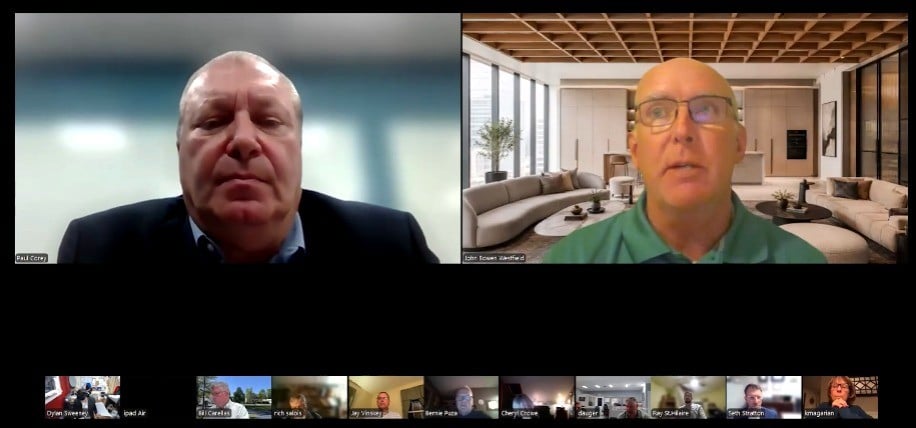
Paul Corey of Servistar Realties LLC hears a question from Planning Board member John Bowen at the Oct. 13 virtual meeting.
Photo credit: Westfield Community TV
WESTFIELD — The Planning Board unanimously denied a three-year extension of Servistar Realties LLC’s special permit for the Westfield Data Center, citing a lack of good cause.
The decision came after Paul Corey presented Servistar’s request for the extension. The special permit expires Oct. 19.
The board voted against including public participation, which was not required during a special meeting. Only Servistar representatives and Planning Board members spoke, except for one resident who was mistakenly allowed to speak and was quickly muted.
Corey detailed Servistar’s activities since the three-year special permit was first issued on Oct. 19, 2021, and its subsequent placement under a blanket two-year extension for data centers granted by Gov. Maura Healey on Nov. 20, 2024.
He described the data center at full build-out as having 10 data center buildings and 2.74 million square feet of data center space on 15 parcels totaling 162 acres.
Corey called the location ideal, surrounded by distribution centers and in close proximity to the local airport. “We think that this is actually the best use of the site for this type of commercial development in an industrial zone.” He said the buildings would be state-of-the-art commercial office buildings with computers inside and no windows.
According to Corey, the project faced several obstacles, all of which had to be resolved in order for companies to be willing to invest in the $2.5 to $3 billion data center.
Corey said the main hold-up was the four years that it took for the state legislature to pass a 20-year state sales and use tax exemption for data centers, which ultimately passed in November 2024.
The tax exemption covers data center equipment, computer software, electricity used in the operation of the data center, and construction costs incurred for the construction, renovation or refurbishment of a qualified data center.
Corey said companies interested in the data center project that, he implied without naming names, were among the largest in the business in the country, would not commit to the investment without the sales and use tax exemption.
“We had negotiations with about 20 plus very large companies that wanted to look at coming to Westfield because there is absolutely a need for a hyperscale data center in New England to support the current local businesses, but also the various industries in and around Boston, the biotech industry, the universities, the hospitals, etc. But all of the companies that we had discussions with would not put up the capital to build out the project until we had sales tax legislation adopted,” Corey said. “That would be about $40 million in development costs.”
Once the sales tax exemption passed, the project began to move forward, but uncertainty increased due to the tariffs imposed by the Trump administration in 2025 and the upheaval in energy markets earlier this year caused by the war with Iran.
Corey said Healey then paused new data center applications on June 25 this year, and Westfield enacted a local moratorium on new data centers, after which Servistar had to review its status.
Several times, Corey mentioned local opposition not just in Westfield but nationally, which he said was unfounded, especially concerns about water use and energy consumption. He said that while older data centers had open cooling systems that used a lot of water to cool equipment, the industry had moved towards closed-loop systems, which use nearly zero water for cooling.
He said that, regarding electricity costs and grid concerns, Servistar negotiated an agreement with WG&E to pay 100% of the costs and would not be connected to WG&E’s system but would be connected directly to the transmission grid.
Another holdup was what Corey referred to as the Jupiter battery energy storage system project in Westfield, which he said jumped ahead of the Servistar project in the energy queue after its initial application was withdrawn during negotiations with WG&E.
“So that has a big effect on the timing and the cost of the interconnection process. When they [Jupiter Power] withdrew in April of ‘25, that actually helped us quite a bit, but we had to rerun all the economics of energy costs from the tariffs and from freeing up the available capacity in the queue,” Corey said.
Corey said he was sure there would be issues to address.
“Just to summarize, 400-plus full-time jobs at full build-out, 1,200 indirect jobs and 1,800 construction jobs. Over 350 million in direct property tax payments to the city over the 40-year term,” Corey said, adding, “We believe we’ve proven our case for good cause by documenting the extensive development work that we’ve done and continue to do. And we believe that a three-year extension is appropriate and should be approved.”
Corey also said there was now a large company very interested in the project, but the investment required a three-year extension from the Planning Board.
Following his presentation, Planning Board members questioned Corey on several fronts.
Member Jane Magarian questioned obtaining the special permit before the financial pieces were in place. “In my opinion, a lot of those should’ve been done before you even got the permit … We’re not reiterating the good the project would do. We’re reiterating whether the three-year extension is warranted by good cause,“ she said, adding that the financial piece should have been more in line.
“You have to have local approvals before you could proceed with any project,” Corey said. He said the zoning permit and the Planning Board permit are the first permits any project must obtain.
Magarian said Servistar could have laid some of the groundwork on the preliminary items, and the project would have been halfway there.
Corey said they now have the financial commitment to move forward, contingent upon the extension. He said they would be filing the request for environmental approvals with the Conservation Commission and MEPA early next year and, at the same time, the interconnection application. “So we are ready to proceed,” he said.
Planning Board member Dylan Sweeney asked what environmental work Servistar has done at the site since receiving the special permit in 2021.
Corey said they had several environmental consultants working on their behalf for the project who met with the Conservation Commission, during which time they did preliminary work, including delineating the wetlands on the property.
“We had all of the design work for the buildings, all the onsite facilities, the substation, roads and so forth all designed to comply with the Conservation Commission and MEPA requirements, including all of the setbacks,” he said, acknowledging that they had not filed with the commission yet.
Planning Board Chair William Carellas said in the initial application for the special permit in 2021, Servistar stated that the initial phase of the project would be the acquisition of all land parcels and completion of all pre-development work required to bring the first approved 50-acre site to shovel-ready stage for phase one, the construction of the first 54-megawatt data center in two three-story buildings and one accessory building.
“I believe our permit at the time gave you everything you needed to do to start phase one,” Carellas said, which, according to the application, was to commence in January 2022, but by the end of 2022, nothing was in the ground.
“Last time I knew, you guys haven’t bought land yet. And clearly, we gave you what you needed in 2022 to go out and buy the land,” Carellas said.
Planning Board member John Bowen asked them when they did the wetland delineation whether they had surveyed property that they didn’t yet own.
Corey said the property was under contract, and Servistar mapped it out and delineated all the parcels.
“We’ve been in constant communication with the landowners, and if we get the extension, we will acquire the land,” he said.
Bowen said the whole hearing was about good cause. He said no one was debating whether the data center was a giant undertaking.
“My concern has always been that some of this stuff could be happening at the same time. For example, there’s nothing that you talked about that would have prevented you from getting the conservation permit in and starting that process. That process doesn’t cost a tremendous amount of money, whether you’ve got the Mass sales tax or not… So in my mind, that’s a good faith effort that got skipped. The fact that your special permit never got registered with the Registry of Deeds, to my mind, that’s not a good faith effort,” Bowen said.
Seth Stratton, managing partner at the Fitzgerald Law Firm and Servistar’s legal counsel, who was on the call, stepped in to clarify the process.
“I think I’ve heard a few times ‘good faith.’ The standard is good cause. They’re two different things. And the question is whether good cause for the delay exists; that’s the statutory inquiry under the ordinance. In theory, you could have lack of good faith and still good cause,” said Stratton, adding, “I don’t think that’s the case here. But I think it’s important that the board is focused on the proper question, which is whether there is good cause for the delay, not whether there’s good faith shown by a particular applicant toward this board.”
Planning Board Vice Chair Cheryl Crowe asked Corey why he didn’t come forward when he was running into problems, roadblocks and delays. “It seems like the organization of this project was not thoroughly reviewed prior to coming before the Planning Board; it just seems like everything was done after it came before the Planning Board,” she said.
“As far as I’m concerned, good cause would be to come before us when you already knew you were in trouble before your three years to come forward … So I feel like we were just kind of left out,” Crowe added.
“We certainly didn’t intend to leave out the Planning Board and we certainly always act in good faith,” Corey said, adding that they had intended to come before the board to request an extension in January or February of 2026. The extension was requested on Sept. 4.
“So that’s where I’m feeling a little uncomfortable that it was never brought back to the Planning Board,” Crowe said.
At the end of the meeting, the Planning Board was not persuaded that Servistar had shown good cause for a three-year extension and voted unanimously to deny it.