
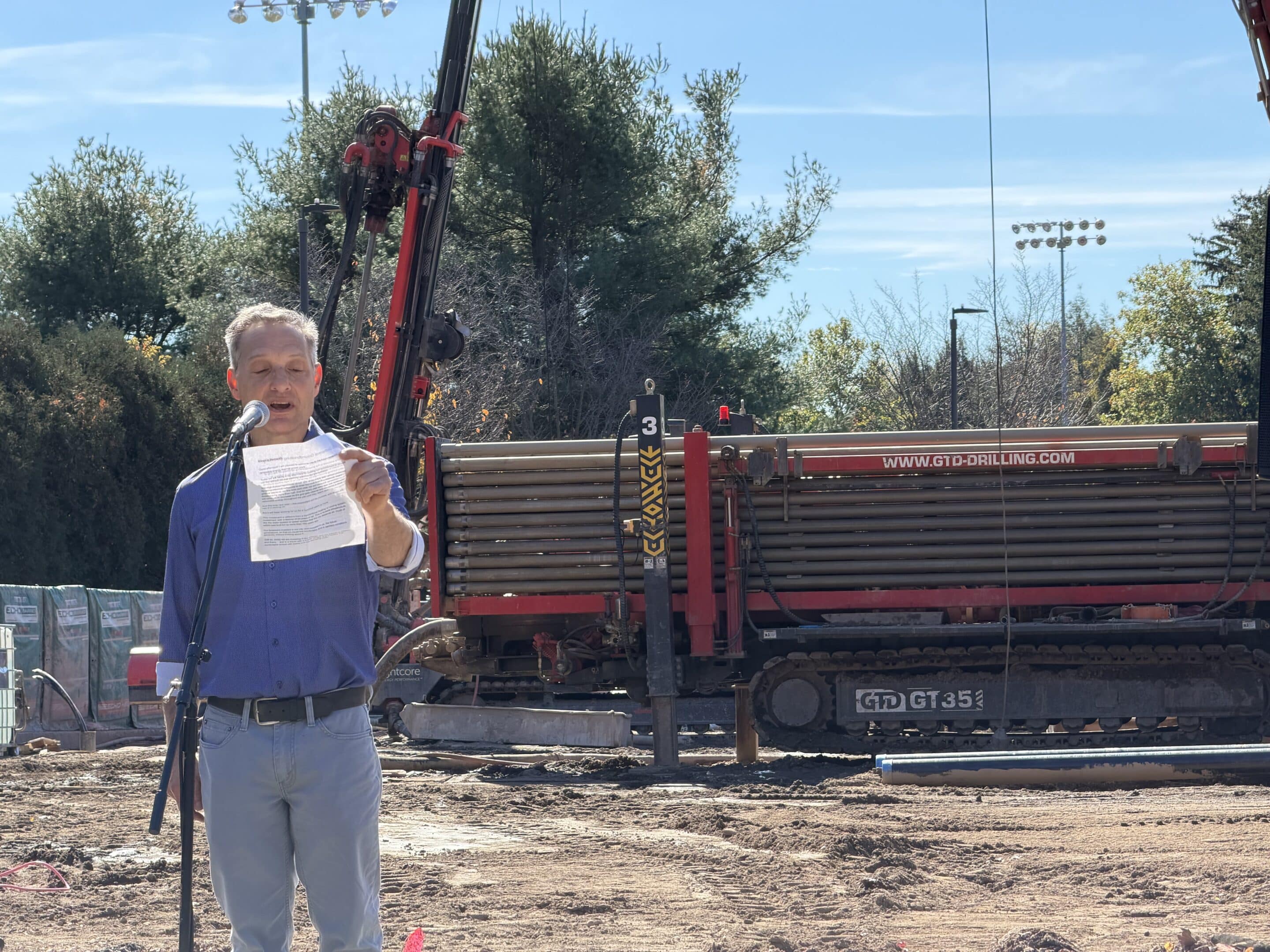
Department of Climate Action and Project Administration Director Ben Weil called the project the most significant investment so far in fulfilling the city’s commitment to climate action.
Reminder Publishing photos by Trent Levakis
NORTHAMPTON — A groundbreaking marked another step toward installing a new geothermal system that will replace outdated heating and cooling equipment and cut carbon emissions by half at Northampton High School
City officials, representatives from the Mass Clean Energy Center, construction manager Brightcore Energy Services Inc., local organizations, and students and staff from Northampton High School gathered on Oct. 15 outside the site of the $11.6 million energy project, which is happening 850 feet beneath the school’s parking lot. The project will replace the school’s outdated heating and cooling equipment with a geothermal, ground-source heat pump to regulate indoor conditions.
“This is the city of Northampton’s most significant investment so far in fulfilling its commitment to climate action and to guaranteeing a comfortable and healthy learning environment for generations of high school students,” said Department of Climate Action and Project Administration Director Ben Weil. “A ground source heat pump is simply the most efficient way to provide heating and cooling. This is as close to a future-proof investment as you get in HVAC.”
When finished, water will be pumped through the installed pipes, drawing from the consistent underground temperature and replacing traditional heating and cooling systems in an energy-efficient manner.
“The laws of thermodynamics do not change, so no matter what technological development occurs, exchanging heat with the relatively mild earth 850 feet down will continue to minimize energy use and maximize performance,” Weil explained at the groundbreaking.
The geothermal project has been in the making for some time and picked up momentum last December when the City Council voted to authorize the use of Climate Stabilization funds and municipal long-and short-term bonds to finance the design, installation and construction of the project.
This May, CAPA was awarded $4 million through the Mass. CEC Green School Works program to support the school’s ground-source heat pump. The money was part of $19 million awarded statewide through the program.
Mayor Gina-Louise Sciarra shared great excitement for the project and said that this new system is expected to last at least 100 years or more. She added that the project offers the best return on investment, as it was funded through a combination of stabilization funds, grant funding, tax incentives, utility incentives and borrowing.
“By using electricity efficiently to draw our heat from the relatively stable ground below us, by this time next year, we will have cut our carbon emissions by more than half at high school. And so, for every year after that, our emissions will continue to decrease as the grid gets cleaner and we invest in more renewable energy options throughout the city until we reach zero,” explained Sciarra. “While we fulfill our obligation to our future, we are being responsible to today’s residents as well. This new, highly efficient system will provide contractually guaranteed operating savings every year. The contractual maximum project cost guarantee means that unlike many other public projects, the costs cannot balloon.”
Weil has previously explained both to Reminder Publishing and at public meetings that the school’s current chillers are well past their expected useful life and will need to be replaced within five years at the latest. In addition, the high school’s boilers are also nearing the end of their expected useful life, which is why the geothermal project has become an enticing, proactive approach to benefit the building built in 1940, its students and staff, and reduce the building’s carbon emissions.
The high school represents about 10% of the city’s total carbon emissions, so the ground source heat pump brings the school and community closer to its goal of operating the city without greenhouse gas emissions. More specifically, the heating and cooling associated with ground source heat pumps are projected to reduce energy costs by 17%, maintenance costs by up to 50%, and the building’s total energy use by 68%, based on earlier estimates.
Program Manager for the Green School Works Program through MassCEC Jamie Scott said the program’s goal is to inspire and support commonwealth schools in becoming more efficient, comfortable and emission free. He explained that the program achieves this goal through direct funding for innovative, replicable, cost-efficient demonstration projects, and added that over the last three years the program has committed over $72 million to Massachusetts schools.
“Often these upgrades, as we’ve heard, save schools money by transitioning from costly fossil fuel boilers to hyper-efficient modern alternatives. The infrastructure produces operating costs and channels more money to meeting the educational needs of the students,” Scott explained. “But crucially, we also hear a lot about what these projects mean for student and community pride. The students may not use these exact words, but it’s easy to feel valued when the community invests in a learning environment and schools are some of the most valued places in our communities, in our cities and towns, and it sends a message to the whole community when we’re prioritizing the best.”
Construction is expected to be completed sometime in 2027.
“We’re doing it because it is our turn to responsibly set up our current and our future generations and that is something truly remarkable to celebrate and I thank all of you in the part you played in bringing us to this wonderful project,” Sciarra said.