
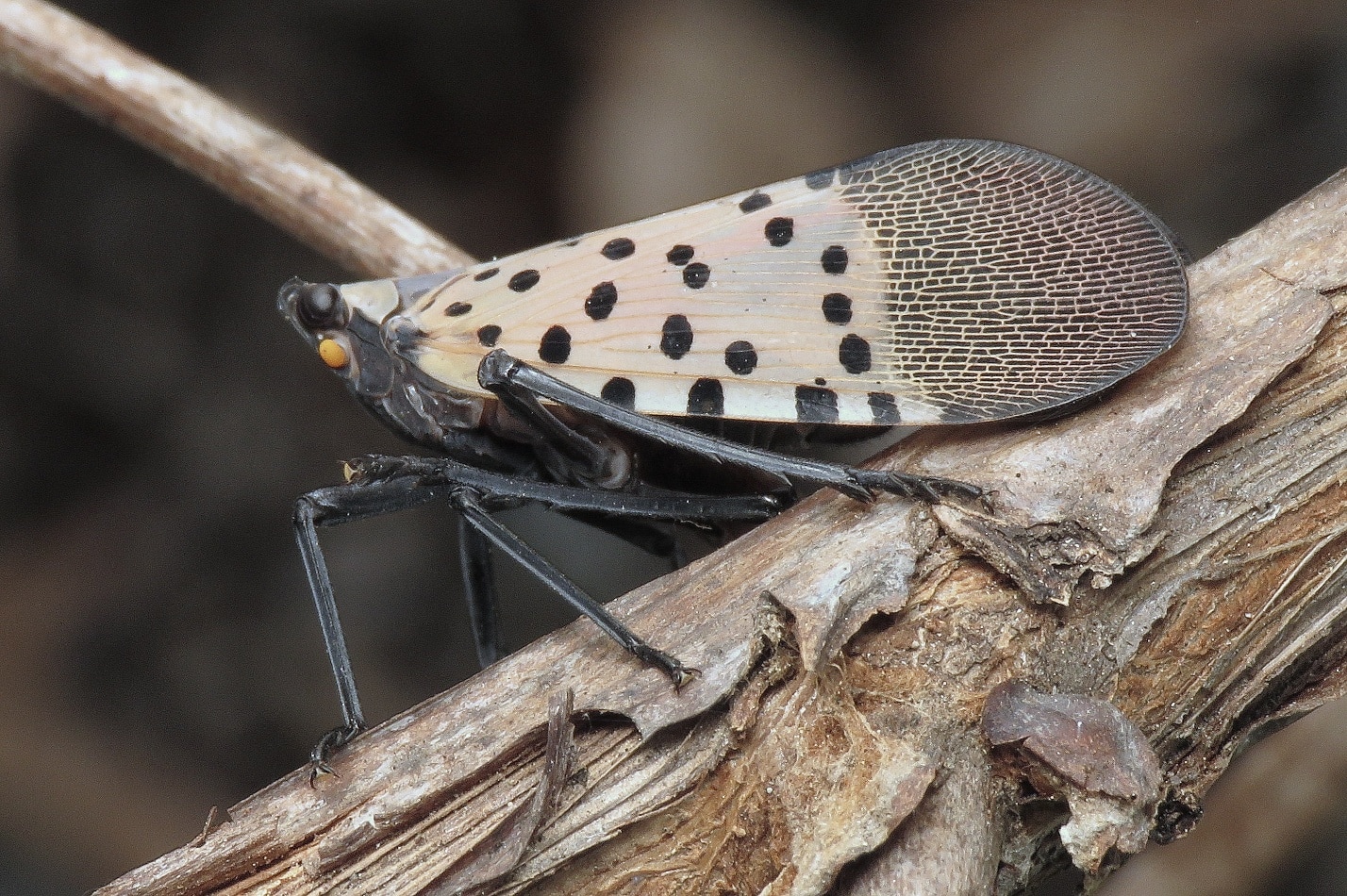
A photo of a spotted lanternfly.
Courtesy of the Massachusetts Department of Agricultural Resources
SPRINGFIELD — There is no doubt that most people in the Greater Springfield area have seen a spotted lanternfly.
Almost as large as a person’s thumb, their brown wings and red bodies marked with black spots give them their name.
City Forester Alex Sherman said that the insects are an “invasive pest.” Originating in China and Vietnam, the flies first arrived in the United States in 2014. Sherman said the insect eggs are believed to have come in on a shipping container bound for Pennsylvania. Since then, the population has been growing, and their range has been spreading. In 2022, flies arrived in Springfield.
At the Oct. 14 Health and Human Services subcommittee meeting, At Large City Councilor Brian Santaniello, who chairs the committee, described the lantern flies as “infamous.” Sherman agreed, noting that he had received many calls from residents about the infestation.
Sherman explained that the insects are sap suckers and are therefore attracted to certain types of vegetation, including tree of heaven — itself an invasive species — black walnut, elm and grapevines.
Santaniello asked Sherman whether the insects cause damage to trees and if there is a risk of dead limbs falling under the weight of ice this winter. The forester responded that the flies have not appeared to be “a real tree killer.” He did not expect substantial damage to the area’s large shade trees. Fruit trees, however, might be negatively impacted, with lower yields. Massachusetts is home to Concord grape crops and Santaniello asked if they were endangered. “That is a huge concern,” Sherman said, also noting apple crops may be impacted.
Ward 8 City Councilor Zaida Govan asked about the efficacy of killing the flies when encountered. Sherman told her that stomping the flies may help people feel like they are doing their part, but with hundreds of thousands of flies, it is an uphill battle. Instead, he said killing egg masses will be more impactful.
Spotted lanternflies lay masses of between 30 and 50 eggs in the fall. The inch-long masses are covered in a gray-brown waxy coating and often resemble a smear of mud. According to the Spotted Lanternfly Project, while the eggs are usually deposited on trees, they can be found on porch furniture, vehicles, rocks, outdoor sheds or equipment and other sheltered spaces. The eggs can be destroyed by crushing them with a plastic putty knife or credit card, or by scraping the egg mass into a bag and allowing them to soak in rubbing alcohol.
Santaniello pivoted to ask about other invasive pests in Springfield. Japanese beetles attack rose bushes, and the councilor wanted to know how much impact they had on the Forest Park rose garden. Sherman said the real predator is deer, which nibble on most ornamental plantings. The Parks Department is working to redesign the garden to protect the roses.
Sherman also said the city is struggling with the emerald ash borer and beech leaf disease, which damage and can kill ash and beech trees, respectively.
One way the city is fighting back is by planting new trees of varying species throughout the city. He said planting a wide range of trees minimizes the impact of a future infestation spreading through Springfield. Sherman said 1,000 trees were planted this spring, and the city is on track to plant another 700 by the end of the fall.
