
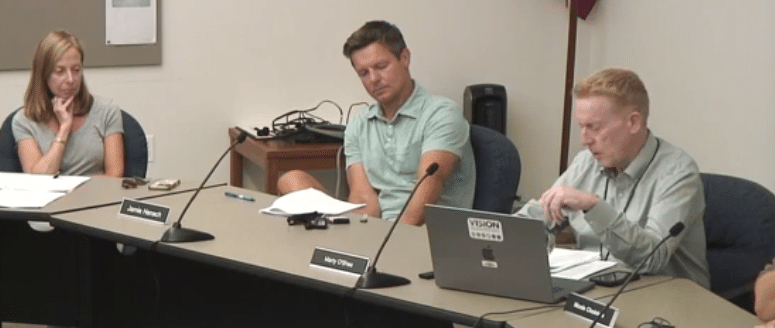
Superintendent Martin O’Shea ran the School Committee through the policy changes at its meeting on Aug. 25.
Photo credit: LongmeadowTV
LONGMEADOW — Longmeadow students are officially back in school and the district is proposing policy changes surrounding student discipline and medication.
Superintendent Marty O’Shea introduced the changes at the School Committee meeting on Aug. 25
The modified policies include policy JKAA, time-out, seclusion and physical restraint of students; JLCDC, self-administration and self-carry of medications; and JLCD, administering medicines to students.
Proposed policy changes require a public comment period for 30 days until the School Committee can vote.
The policy subcommittee helped vet the language, which came almost exclusively from the Massachusetts Association of School Committees.
O’Shea said policy JKAA stems from recent litigation across the state and country where “school districts behaving badly” took advantage of situations described as time-outs for students but were actually seclusions or suspensions.
He added that it tightens reporting requirements if a restraint is required.
A time-out is a behavioral support strategy where a student temporarily separates from the learning activity or the classroom, either by choice or by direction from staff, for the purpose of calming. Staff members supervise the student during time-out in an unlocked setting that the student is allowed to leave once calmed.
“The new policy specifically defines what a genuine time-out is, they give the kid a chance to get a regulatory break,” O’Shea said. “It prohibits seclusion and physical restraint, except under some very specific circumstances. Physical restraint can’t be, sort of, a go-to strategy as part of a student’s behavioral plan or IEP.”
Seclusion is the involuntary confinement of a student alone in a room or area in which the student is not allowed to leave. Physical restraint is direct contact that prevents or restricts a student’s freedom of movement.
Seclusion and physical restraint are prohibited unless the student poses an imminent threat of assault or serious physical harm to self or others. Physical restraint is considered a “last resort” in the policy if the student is unresponsive to the other directives and other interventions are deemed inappropriate for the circumstance.
Policy JLCD comes from regulations made by the Department of Public Health and tightens requirements for administering medication.
“It specifies what would happen if a nurse needed to delegate responsibility for the administration of medication to another staff member,” O’Shea said. “The previous language was pretty lax frankly, so this really requires some specific DPH-blessed training for people to engage in if their personnel are administering medication.”
Policy JLCDC adds requirements and protocol on if students are able to self-administer their own medications, along with requirements on storage, receiving doctor’s orders and authorization from care-givers and parents.
“It’s all good stuff,” O’Shea said. “It really provides some additional clarity to staff, to administration, to our nurses.”
O’Shea said the language will be broken down to make sure the staff and administration is fully educated, assuming School Committee approval after the public comment period.
The full policy changes are available at longmeadow.k12.ma.us/school-committee/policy. An impact form is available as well to provide feedback.