
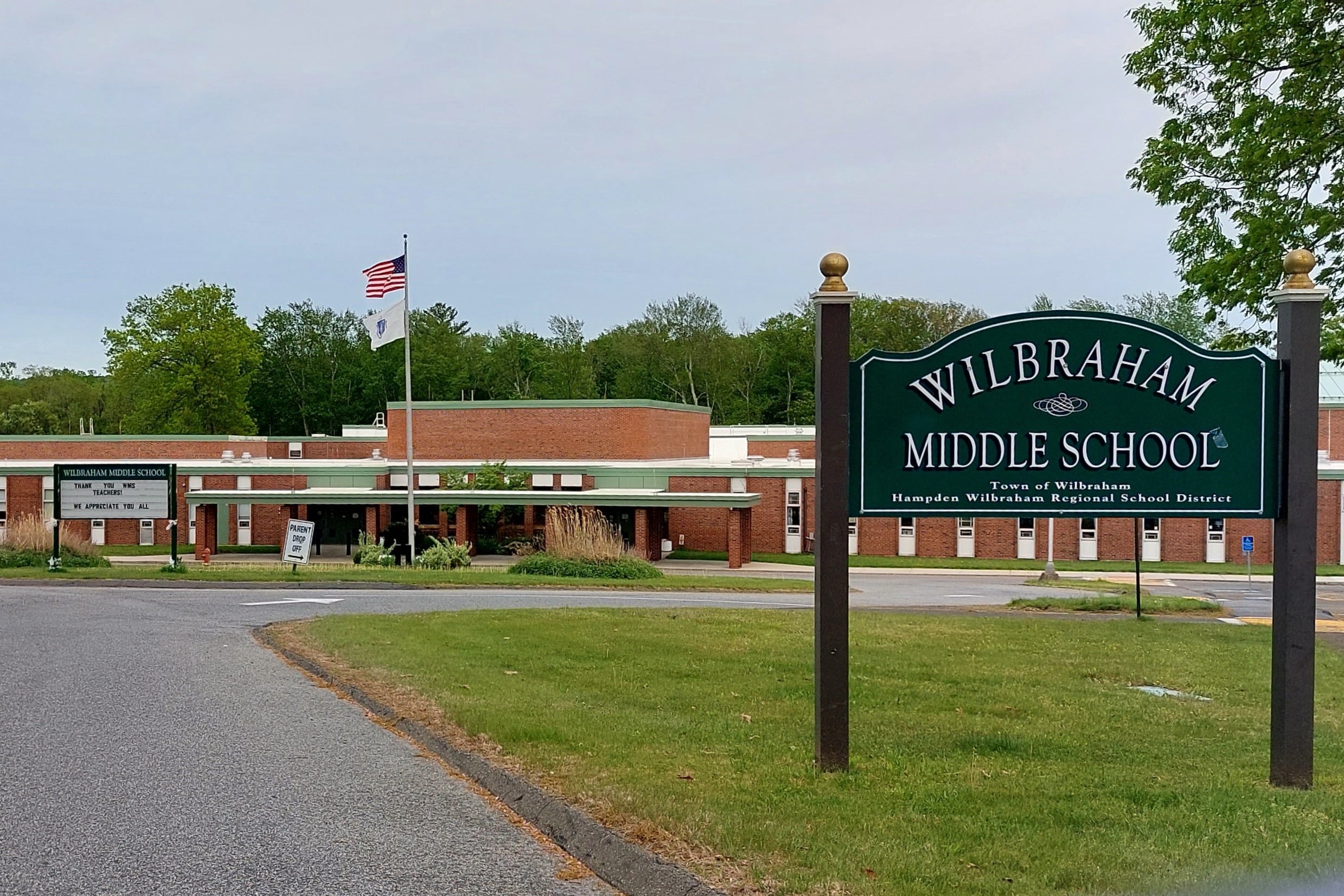
The Hampden-Wilbraham Regional School District is currently awaiting a decision from the Massachusetts School Building Authority on acceptance into the core program.
Reminder Publishing file photo
WILBRAHAM — The Wilbraham Select Board and Hampden Selectboard have begun to lay out a plan intended to improve the conditions of Wilbraham Middle School until the Massachusetts School Building Authority gives a decision on the school’s acceptance into the core program.
The two boards hashed out projects for the middle school’s interim plan, methods of payment and scheduling at a joint meeting on July 23.
Wilbraham Select Board Chair Marc Ducey said he wanted to hear Hampden’s perspective on what could happen with the school, and Hampden Selectboard Chair John Flynn said the major concern is providing a good educational experience for the middle school students over the next five to seven years.
“If you’re in the core program, you’re not building a brand new penthouse,” Flynn said. “You’re maintaining a good, safe environment for education.”
Hampden-Wilbraham Regional School District’s Assistant Superintendent for Finance, Operations and Human Resources Doug Slaughter laid out three things necessary to “extensively manage the building while we try to participate in the core program” and to keep it in working order.
“There’s the question of building security doors and that sort of thing,” Slaughter said. “There’s some funding that Wilbraham has already funded, so we’ll do that. There’s a little bit more in this plan to make sure that the doors we have on the building secure it and control the environment a bit better.”
Slaughter said funding from a few years ago will go toward mediation and management of the school’s asbestos tiling this summer and that there will be a small amount of money remaining to maintain the flooring for the next few years. Indoor air quality is the third focus for the school.
“We’ve got some mechanisms that we put in place over the last couple of years to try to keep the air quality in good order, particularly in humidity and mold in the building,” Slaughter said. “The idea with some of what we were looking at was taking those kinds of things we’ve been doing that have been keeping the air quality in a somewhat satisfactory manner, and bolstering them up just a little bit to make it work a little bit more efficiently.”
Slaughter said the cost for these improvements is fairly modest — around $86,000 — because of what the district has on hand, and that some aspects could be repurposed in the district later down the line. He said he hopes it’s a workable number for the two communities to stretch the building until a deeper renovation or replacement is in place.
Hampden Selectboard member Don Davenport said the building is owned by Wilbraham, and anything over $35,000 in capital expenses is Wilbraham’s responsibility. Ducey said one option would be to amend the school budget to use the money as an operating expense, which would require a vote by the School Committee and at the fall Town Meeting.
Hampden Selectboard member Erik Vanderleeden said he thought the number is reasonable to take the remediation step, but was concerned about making voters at Town Meeting uncomfortable by roping everything into one big purchase.
Superintendent John Provost said his initial hope for state aid would be around $150 per pupil, which is what the district budgeted for. The actual state aid ended up being $160 per pupil, and Provost said there’s potential for some of the extra money to be applied to the project, but that the entirety of the project can’t fit within the district’s revenue.
Wilbraham Select Board member Susan Bunnell said the same concerns existed in the school when her son attended 30 years ago, and that this felt like “short money to get us through whatever it takes to get us to being able to present a much bigger conversation and bigger decision.”
Vanderleeden added on to Bunnell’s point, and said he has children going into eighth grade and that he “hears things” about the school.
“We have to put aside our differences and go forward for the betterment of the children, if we cannot come to an agreement,” Vanderleeden said. “This seems like a fair agreement to me. I just want to present it to the people of Hampden in a manner that they can thoroughly understand what we’re trying to accomplish at the end of the day.”
Davenport said Hampden’s share — $17,000 — is not a lot of money, but the feedback from some people would be “you sold us down the drain, that’s not our building and you’re fixing up their building and we don’t want to pay for it.”
Davenport added that it’s a “small group of people, but it depends who turns out at the Town Meeting and how angry they are about something else that’s going on.”
Bunnell said work while the school is empty is best, and asked how willing everyone is to go out on open expectations that the model will be accepted at the fall Town Meeting. Provost said the plan is to complete the work that has already been funded and work on other projects as funding becomes available.
“We have some things that we could do, definitely during the school year,” Provost said. “Door projects we could probably do during a winter break. Things like the main splits would have to wait until next summer.”
Provost said main split installation is a long process because it involves drilling into the building, but Flynn said they had it done at the new Town Hall within a week and that it could easily be done during a break. He said “if this is a priority, I don’t see why we don’t make it a priority.”
“This is a priority, and we’re gonna get it done next year,” Flynn said. “How do you pronounce the two things together?”
Wilbraham Select Board member Michael Squindo said to Flynn’s point “to be fair though, it’s a six-to-10-year priority.”
“I just want to make sure that we’re really saying we’re having a difference of timing over less than $10,000 on a less than $100,000 10-year plan,” Squindo said. “We’ve already told the schools that the money they asked for this year wasn’t awarded at the needed request that was provided. Then we’re gonna ask them to nickel and dime from the budget this year for a 10-year plan.”
Slaughter said that plan execution can happen over the next 12 months with a lot of it being “much, much sooner than later.” Provost said it’s a place to get direction from the School Committee.
“What we’re hearing from the two boards here, is that you’d like us to essentially deficit spend in anticipation that there will be more funding in a few months,” Provost said. “I think we have to find out whether the School Committee has an appetite for that.”