
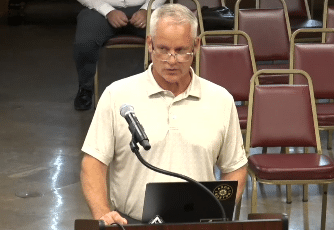
Officer Michael Chapdelaine tells the West Springfield Town Council about the lasting effects he faces from his 2000 line-of-duty injury.
Photo credit: West Side Media
WEST SPRINGFIELD — The West Springfield Town Council unanimously backed a special legislation act drafted by state Rep. Michael Finn to help West Springfield police officer Michael Chapdelaine receive 100% of his pension while on disability retirement.
During a narcotics investigation on Nov. 8, 2000, Chapdelaine — then a member of the FBI’s Gang Task Force — was accidentally shot by a Springfield officer and run over by a suspect’s car. He has been on disability retirement since 2002.
Gov. Maura Healey signed “an act relative to disability pensions and critical incident stress management for violent crimes” in July 2024, enacted into law on Oct. 29, 2024.
The act ensures emergency service employees on disability retirement from a violent injury receive 100% of their monthly compensation. It lowers to 80% upon the applicant reaching mandatory retirement age for their position.
The act does not apply to those approved for disability or injured before the October 2024 enactment. The standard disability before the 2024 enactment, such as in Chapdelaine’s case, paid 72% of regular compensation.
The Town Council heard from Chapdelaine and approved the act at its meeting on July 20. It isn’t final until approval by the House of Representatives, the Senate and signed by Healey.
“This is something that happened and continues to affect me,” Chapdelaine said. “I’ve been hospitalized upwards of eight times since the shooting. I count my lucky stars, I’m blessed, I’m fortunate to be here. It’s not fun when I have to go through those episodes, those hospitalizations with the intestinal stuff and the blockages. They can’t operate to improve it because scar tissue begets scar tissue. I’m just kind of going through things and seeing the effects of something that happened 26 years ago can have on an individual.”
He said his disability didn’t end when he left the hospital and it has continued to affect every aspect of his life over two decades later, enduring chronic medical complications, a disrupted metabolic system and being diagnosed with Type 2 diabetes and coronary artery disease with no familial history.
He added that his case demonstrates that violent injuries can become lifelong medical conditions and the act corrects an inequity in the state legislation.
“The date of the injury doesn’t change its nature,” Chapdelaine said. “The violence was the same, the injuries were the same, the lifelong consequences were the same. The only difference is the calendar … Today, if an officer is injured under the same circumstances, they would receive the protections the legislator determined were appropriate. Without this petition, two officers with the same catastrophic, line-of-duty injury are treated differently solely because one was injured before the law existed.”
He told the Town Council that supporting the petition honors the commitment made to public safety officials, and that officials hope the community stands behind them if the worst were to happen while serving the public.
“I am not asking to rewrite state law,” Chapdelaine said. “I am asking you to give the legislature the opportunity to consider whether this law should apply to someone whose injuries exemplify exactly why the law was enacted.”
Chief of Police Jay Gearing put support behind Chapdelaine, stating they are childhood friends and were hired together in 1996.
“I’ve been there a long time, and I can speak to the injuries that he spoke of,” Gearing said. “I will never forget the day that Michael got shot. He got shot in the city of Springfield and I called the department here because, like we do when officers are hurt, we rally. I called the station to make myself available, and that’s when I found out it was Michael. It wasn’t easy, as you can imagine. … it’s been a long road, and I just wanted to thank you for your support and speak to support what he said.”
Councilor James Welch said this is a very fair option and the town would be proud to say it took care of one of its own.
“Chapdelaine grew up in West Springfield, went to West Springfield High School, played sports and was involved in the community,” Welch said. “This is a gesture I think that we as a council and a community can take that shows that we’re serious about protecting the people that serve our community and certainly serve a situation that can be very violent at times.”
Councilor Brian Griffin said Chapdelaine was doing dangerous work that “we asked him to do on behalf of the community.”
“The act of violence did not merely end in one shift, it permanently ended a law enforcement career to which Mike had devoted himself,” Griffin said. “Mike Chapdelaine was more than a police officer wearing a West Springfield badge, he served as a detective, he worked as a special federal officer in the FBI Gang Task Force investigating narcotics, firearms, gang activity. He operated undercover and worked alongside federal, state and local law enforcement agencies. Before that, Mike served our country as an intelligence analyst in the United States Army. This was a man who repeatedly placed himself between dangerous people and innocent people, first for the country and then for his community.”
He said police officers are often thanked at ceremonies and told their service is appreciated, but that “the real measure is not what we say in the immediate aftermath of that sacrifice.”
“The real measure is what we do after the headlines are gone,” Griffin said. “Nearly 26 years have passed since Mike was shot, and nearly 24 years have passed since he was forced into disability retirement, yet the consequences of November 2000 did not retire with him. Mike and his family have carried this every day since and that’s why this vote matters … Mike did exactly what West Springfield asked him to do. He accepted the risk, he answered the call, he confronted danger and he paid a permanent price.”
Griffin added that West Springfield has to honor its side of the commitment and that the town’s responsibility to the officer doesn’t end when the injury prevents them from putting on the badge. He said the act isn’t preferential or a charity, it’s a “fulfillment of a promise.”
“Tonight, we cannot undo what happened to Mike,” Griffin said. “We cannot restore his career that was taken from him. We can’t return the years that his family have lived with the consequences, but we can make certain that the sacrifice is met with something lasting, more than words. We can keep that promise.”