
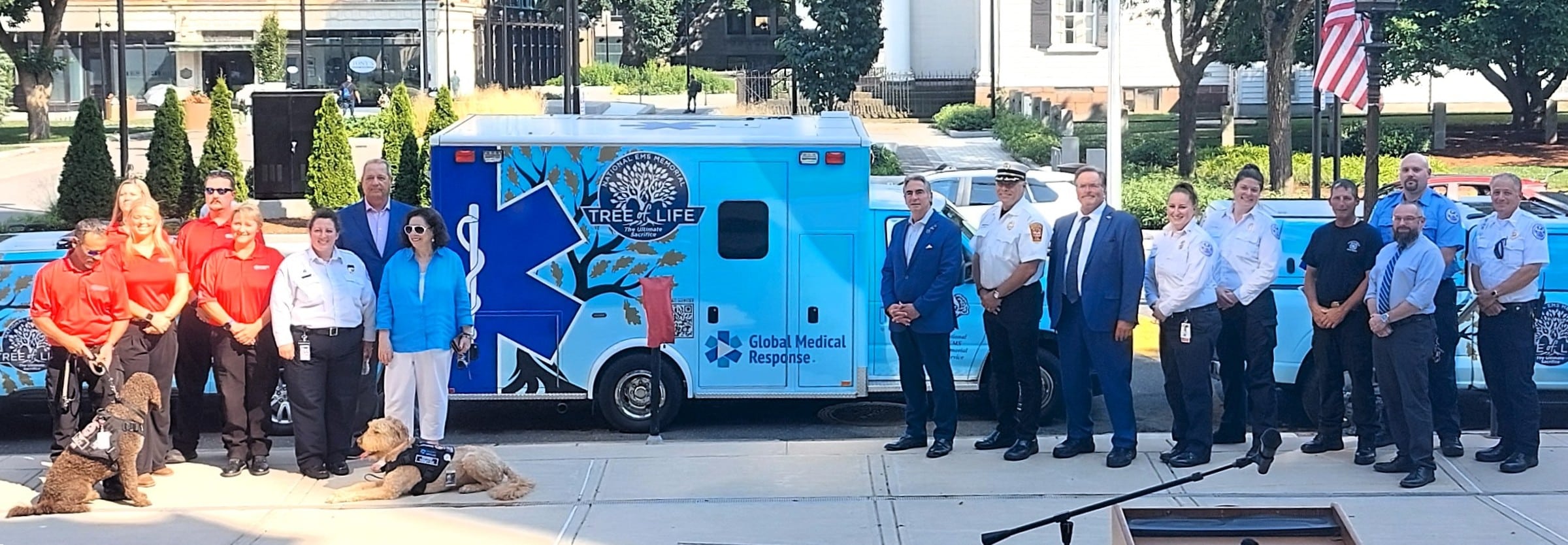
Springfield city leaders, the EMS Moving Honors crew and EMS professionals from American Medical Response flank the truck that contains the 2026 EMS Memorial Tree of Life.
Reminder Publishing photo by Sarah Heinonen
SPRINGFIELD — Sirens could be heard echoing off the buildings in downtown Springfield on June 29, announcing the arrival of six ambulances and emergency medical services vehicles.
Crews from American Medical Response Springfield escorted the vehicles from the National EMS Memorial Moving Honors convoy to the steps of City Hall, where they honored their fallen colleagues.
Emergency Medical Service professionals die in the course of their duties every year. Unlike their first responder colleagues in the police and fire fields, however, there is no permanent national memorial for them. The memorial service has been hosted annually for three decades, and each year a display dubbed the “Tree of Life” is built and the names of the previous year’s fallen colleagues are added. Since 2020, a convoy of EMS vehicles has journeyed across the country, carrying the Tree of Life from city to city and state to state, allowing people to pay tribute.
“We’re so proud to have this convoy come through here, and to all the EMS professionals and their families who stand side-by-side with them, thank you for what you do day-in and day-out,” Springfield Mayor Domenic Sarno said at the ceremony.
“As a 34-year paramedic, I know all too well the work and sacrifice that EMS professionals put in day-in and day-out to serve their communities. Some of the most meaningful interactions I’ve ever had with people were in the back of an ambulance,” Fire Commissioner BJ Calvi added. “This memorial serves as a great reminder to the dedication and sacrifice that EMS professionals make every day in this country and are often the unsung heroes of public safety.”
Haverkamp, the Moving Honors Crew Chief, has been escorting the Tree of Life for seven years. She said she comes from a first responder family. “We go in on someone’s worst day and unfortunately, these people didn’t get to come home,” she said, referring to those who died. “It is an honor to carry the spirit of the fallen. We’re fortunate to get to honor them.” For Haverkamp, the moments that leave the most impact are when people she meets share memories of their loved one who died on the job.
The establishment of a permanent memorial in Washington, DC will require a great deal of funding and the appropriate legislation, Haverkamp said. She was cautiously optimistic that a memorial would become a reality within the next five years.
Calvi later said that he believed no permanent memorial had been erected because EMS professionals did not have the same organizational structure that fire and police have, such as the National Fraternal Order of Police, the National Association of Chiefs of Police, the National Fire Protection Association and the National Volunteer Fire Council, which helped garner support for national memorials.
Some entities that are advocating for the permanent memorial include the National EMS Memorial Service and Global Medical Response, AMR’s parent company, both of which sponsor the Moving Honors.
The Moving Honors procession follows a six-week, 10,000-mile journey from Redding, California, to Arlington, Virginia. Along the way, the convoy stops in 32 cities and towns in 24 states. When the procession reaches its destination, the fallen will be honored at the National EMS Memorial Service during the Weekend of Honor.
Each year, a Tree of Life occupies a place of honor in the procession. The leaves bear the names of the fallen EMS providers. While many died this year in vehicle accidents or medical emergencies, five of the 37 EMS professionals died of illnesses stemming from their response to those in need at the World Trade Center on Sept. 11, 2001. Haverkamp said there are a couple who die due to World Trade Center illnesses every year.
“I think back on the natural and manmade disasters that we’ve faced here in the city of Springfield, whether it was the devastating EF3 tornado; whether it was that gas explosion downtown; the worldwide COVID-19 pandemic that we went through; EMS professionals, AMR delivering a baby; being on police and fire calls — seeing people at the worst time of their lives,” Sarno said. “AMR’s been a great corporate citizen and it’s been a great asset here to the city of Springfield.”
