
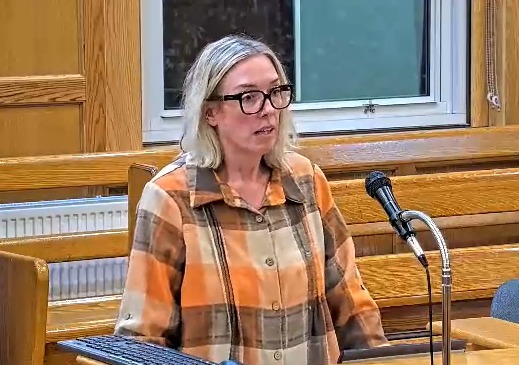
WPS Director of Finance Shannon Barry.
Photo credit: Westfield Community TV
WESTFIELD — Westfield Public Schools Director of Finance Shannon Barry said that, only two months into the fiscal year, the district already has a $1.2 million deficit, a number that is likely to grow.
In a presentation to the School Committee at its Oct. 19 meeting, Barry said a few factors affecting the school budget were not known when the budget was planned in the spring. For one, the district received a Commonwealth Preschool Partnership Initiative grant to pay for free preschool classes in the district. Initially, the grant was for $1 million, but it was reduced by $360,000 over the summer after teachers were hired and preschool students enrolled.
Another expense came when Highland Elementary no longer qualified as a low-income school under Title I, so the salary of one reading specialist was no longer covered under the grant and had to be moved to the general fund.
Southampton Road Elementary had to add a kindergarten classroom due to rising enrollment, which meant adding a teacher and a paraprofessional. Westfield Intermediate School also had to add a teacher for the developmental learning program because of class size.
The district is looking for another teacher for the Milestone Program at Paper Mill Elementary. Barry said this was another unplanned position because students moved into Paper Mill over the summer, requiring the hiring of another teacher to reduce class sizes.
Barry said the district has had to add 14 paraprofessional positions that weren’t in the budget because of incoming preschoolers and students who moved into the district and required one-to-one paraprofessionals.
“We do unfortunately have a lot of unfilled positions, and a lot of unfilled paraprofessional positions, specifically,” Barry said.
Barry said special education has significant deficits in both contract services and out-of-district expenses. The district budgeted for 78 out-of-district students and currently has 87, with another seven students in 45-day placements who may go year-round.
Barry said that she intends to apply for extraordinary circuit breaker funds to cover the unanticipated expenses, but if the district receives the relief funds, they won’t come until May.
“To qualify, we have to be 25% more than what our instructional tuition costs were in FY2026. It will be some money if we qualify for it, but it’s definitely not going to cover the deficit,” she said, adding that the relief could be in the $500,000 range, which may only cover added transportation costs.
Other budget impacts included a change in how the Special Education 240 grant funds may be applied, reducing one source Barry said she has been able to use in the past.
She said the cost of contract law services for ongoing cases had also doubled.
Barry said the budget deficit could be anywhere from $1.2 million to $1.7 million. She said the worst-case scenario would be for the district to tap into next year’s circuit breaker funds, which would have huge impacts on the budget in fiscal year 2028.
School Committee member Bo Sullivan, who chairs the Finance Committee, said he could see what was going on from the numbers. He asked how worried she was.
“I’m pretty concerned,” Barry said.
Sullivan said people need to know the district was getting hit on both ends by increases in special education and the $300,000 loss of CPPI funds, which the district learned about two months into the year.
Barry said out-of-district tuition keeps increasing. “We’re talking about students that are coming in, and it’s $300,000 for a residential placement, or $160,000. There’s not many placements that are under $100,000 anymore. I think there’s one,” she said.
Mayor Michael McCabe, who serves as chair of the School Committee, said he’s been in open discussions with the Massachusetts Municipal Association about the increase in out-of-district tuition, particularly for students in a 365-day placement.
“So when we’re looking at Chapter 70 … we really should be taking into consideration that if the state decides that it’s going to place people for 365 days, they really should come up with the methodology to pay for that,” McCabe said, adding that it puts an extraordinary financial burden on municipalities.
“So I hope nobody thinks that we’re not trying to figure out what we’re doing, but we’re really truthfully trying to do this on the fly. This isn’t your issue, this is a state issue,” McCabe said.
Superintendent Stefan Czaporowski said the state sets the inflation rate for these out-of-district schools and that for next year it’s 2.97%.
“But then these out-of-district schools have the right to say they’re reorganizing,” Czaporowski said, allowing them to charge more.
McCabe said that was part of the conversation at MMA because if they are reorganizing, there is no cap on the percentage increase. “It was one of the things that was specifically addressed, because I don’t know how we’re going to staunch this type of bleeding,” he said
McCabe then asked Barry to bring the budget update to every School Committee meeting, instead of once a month.
School Committee member Jeffrey Gunther, who serves on the Finance Committee, said it might also be helpful for that committee to meet outside the budget cycle and specifically look at how special education is growing as part of the budget.
“I would love to dig a little deeper into how that’s growing as a part of the budget, where we’re seeing those numbers move and year-over-year comparisons, just so we can get our arms around the size of the problem and see what it might look like in the future,” Gunther said.
McCabe noted that Councilor Ralph Figy, who represents the School Committee at the City Council, was in the room. “I’m sure by early December there’s going to be an ask made of the City Council to try and help out the School Department, which is reasonable,” McCabe said.
Later in the meeting, McCabe said he would travel to Amesbury the next day to meet with mayors from across the state and discuss how to refocus the state’s budgetary process.
“The state budget is, just in case you don’t know, running at a budget surplus of about $9.6 billion on a total overall budget of about $62 billion,” McCabe said.
The Department of Local Services mandates that cities and towns maintain between 5% and 8% in free cash.
“If they were to apply that same methodology to the state, their budget would be somewhere in the ballpark of a $4 billion surplus rather than a $9.6 billion surplus. So if you are inclined to speak with your legislators, because they’re truly the people that move the money, I think really what they have to grasp is the concept that they’re not in the business of making money. That’s not the business they’re in. They’re in the business of allocating money to provide needs that are essential to the good common growth of the commonwealth,” McCabe said.
“I don’t know what else to say because everybody else is in the same boat. When you look across school department budgets across the commonwealth, you see that these issues are not just solely Westfield,” he added.